UNDP Project Document
Government of the Republic of Namibia
United Nations Development Programme
Global Environment Facility
Project: Sustainable Land Management Support and Adaptive Management (CPP NAM SLM SAM) Project





Government of the Republic of Namibia
United Nations Development Programme
Global Environment Facility
Project: Sustainable Land Management Support and Adaptive Management (CPP NAM SLM SAM) Project
Table of Contents
PREFACE………………………………………………………………………………………..5
SECTION I: Elaboration of the narative………………………………………..7
PART I: SITUATION ANALYSIS………………………………………………………...7
Threats, Root Causes and Barriers Analysis……….……………………………...…………….8
Institutional, Sectoral, Policy and Legislative Context………………..……………………….10
Stakeholder Analysis………………………………………….…………………………….…...12
PART II: STRATEGY…………………………………………………………..………….16
Project Rationale and Policy Conformity………………………………………………………17
Project Goal, Objectives, Outcomes and Outputs………………………………………………17
Project Indicators and Risks………………………………………….…………………………27
Expected Global, National and Local Benefits…………………………………………………29
Country Ownership: Country Eligibility and Drivenness……...………………….…………30
Sustainability…………………………………………………………………………………….31
Replicability……………………………………………………………………………………...32
PART III: MANAGEMENT ARRANGEMENTS………………….………………………33
PART IV: MONITORING AND EVALUATION PLAN……………………….………….43
PART V: LEGAL CONTEXT……………………………………….…...……………….. 51
SECTION II: STRATEGIC RESULTS FRAMEWORK AND GEF INCREMENT…………………………………………………………………………………...52
PART I: INCREMENTAL COST ANALYSIS AND BUDGET…………………………52
PART II: LOGICAL FRAMEWORK ANALYSIS………………………………….….…56
SECTION III TOTAL BUDGET AND WORKPLAN………………………………...…….70
SECTION IV: ADDITIONAL INFORMATION………….……………………………...….75
PART I: OTHER AGREEMENTS…………….………………………………………….75
PART II: TERMS OF REFERENCE FOR KEY PROJECT STAFF……………………...83
PART III: STAKEHOLDER INVOLVEMENT PLAN……………………………..…….115
PART IV: SIGNATURE PAGE……………………………………….…………………. 129
Acronyms
|
AALS |
Affirmative Action Loan Scheme |
|
AWP CALLC |
Annual Work Plan Enhancing Institutional and Human Resource Capacity through Local Level Coordination of Integrated Rangeland Management and Support |
|
CBO |
Community Based Organisation |
|
CCA |
Climate Change Adaptation |
|
CPP |
Country Pilot Partnership |
|
CPAP CPP-C |
Country Programme Action Plan CPP Consortium |
|
CPP-CU |
CPP Coordinating Unit |
|
CPP-GB |
CPP Governing Body |
|
CPP NAM SLM SAM |
Country Pilot Partnership Programme Namibia Sustainable Land Management Support and Adaptive Management |
|
CRIAA |
Centre for Research Information Action in Africa |
|
DoF |
Directorate of Forestry |
|
DRFN |
Desert Research Foundation of Namibia |
|
ERP |
Every River Has Its People Project |
|
EU |
European Union |
|
FAO |
Food and Agriculture Organisation |
|
FIRM GEF |
Forum for Integrated Resource Management Global Environmental Facility |
|
GTRC |
Gobabeb Training and Research Centre |
|
GTZ |
Gesellschaft fuer Technische Zusammenarbeit |
|
IA ICEMA |
Implementing Agency Integrated Community Based Eco-System Management |
|
IECN |
Integrated Consultants of Namibia |
|
IRDNC |
Integrated Rural Development and Nature Conservation |
|
ISLM |
Integrated Sustainable Land Management |
|
IWRM |
Integrated Water Resource Management |
|
LAC |
Legal Assistance Centre |
|
LLM |
Local Level Monitoring |
|
M&E |
Monitoring and Evaluation |
|
MAWF |
Ministry of Agriculture, Water and Forestry |
|
MDGs |
Millennium Development Goals |
|
MESAT |
Management Effectiveness Self Assessment Tool |
|
MET |
Ministry of Environment and Tourism |
|
MLR |
Ministry of Lands and Resettlement |
|
MME |
Ministry of Mines and Energy |
|
MoHSS |
Ministry of Health and Social Services |
|
MRCC MRLGHRD |
Multidisciplinary Research and Consultancy Centre Ministry of Regional and Local Government, Housing and Rural Development |
|
MSP |
Medium Size Project |
|
NACOBTA |
Namibia Community Based Tourism Association |
|
NACSO |
Namibia Association of CBNRM Service Organisations |
|
NAPCOD |
Namibia Programme to Combat Desertification |
|
NAU |
Namibia Agriculture Union |
|
NCCI |
Namibia Chamber of Commerce and Industry |
|
NCSA |
National Capacity Self Assessment |
|
NDPs |
National Development Plans |
|
NDT |
Namibia Development Trust |
|
NEX |
UNDP National Executing Modality |
|
NGO |
Non-Governmental Organisation |
|
NNF |
Namibia Nature Foundation |
|
NNFU |
Namibia National Farmers Union |
|
NPC |
National Planning Commission |
|
NPRAP |
Namibia Poverty Reduction Action Plan |
|
NWPWP PDF-B |
Preparatory Development Facility Block B |
|
PESILUP |
Promoting Environmental Sustainability through Improved Land Use Planning – Namibia |
|
PIR |
Project (Programme) Implementation Review |
|
Polytechnic |
Polytechnic of Namibia |
|
PS |
Permanent Secretary |
|
PTT |
Permanent Technical Team |
|
RMG SADC |
Results Management Guide Southern Africa Development Community |
|
SDI |
Sustainable Development Index |
|
SKEP |
Succulent Karoo Ecosystem Programme |
|
SLM |
Sustainable Land Management |
|
SME |
Small Medium Enterprise |
|
TAs |
Traditional Authorities |
|
TOE TOR |
Terms of Engagement Terms of Reference |
|
UN |
United Nations |
|
UNAM |
University of Namibia |
|
UNDAF |
United Nations Development Assistance Framework |
|
UNDP |
United Nations Development Programme |
|
UNDP-CO |
United Nations Development Programme Country Office |
|
UNESCO |
United Nations Education and Science Organisation |
|
USAID |
United States Agent for International Development |
|
WG |
Working Group |
|
WWF-Life Plus |
World Wildlife Fund Life Plus project |
PREFACE: THE NAMIBIA Country Pilot Partnership (CPP) FRAMEWORK
Ø Category 1: Four project components directly funded by GEF in this Phase One CPP process.
Ø Category 2: Two regional GEF-UNEP projects which have Namibia components.
Ø Category 3: The fully-agreed co-financed interventions from Government and donor (e.g. EU). To this will be added further investments currently under discussion in Namibia, including for example, projects from GTZ and France.
Ø Category 4: Parallel initiatives, some by GEF, some by other partners, which seek similar goals of sustainable resource management (e.g. the wildlife and forest sectors, including GEF-UNDP SPAN, and FFEM Conservancies).
Ø Category 5: Potential investment projects for SLM GEF 4 in Namibia, which build on this CPP framework.
Table 1: Projects under the CPP by agency
|
Project title |
Amount in US dollars |
Agency |
|
SLM Support / Adaptive Management (CPP NAM SLM SAM) |
7 |
UNDP |
|
Enhancing Institutional and Human Resource Capacity through Local Level Coordination of Integrated Rangeland Management and Support (CPP NAM CALLC) |
1 |
UNDP |
|
Adapting to Climate Change through the Improvement of Traditional Crops and Livestock Farming (CPP NAM CCA) |
1 |
UNDP |
|
Promoting Environmental Sustainability through Improved Land Use Planning (CPP NAM PESILUP) |
1 |
WB |
Figure 1: CPP Projects Linkages
|
 Other GEF funded projects






SECTION I: Elaboration of the Narrative
1 PART I: Situation Analysis
6. The government of Namibia has identified land degradation as a serious problem which demands remedial intervention, and has recognised the need for integrated ecosystem management strategies to effectively address the underlying causes.
7. Land degradation is an increasing problem, manifest amongst other things in soil degradation and erosion, deforestation and bush encroachment in rangelands. As approximately 70% of Namibia’s population is directly dependent on subsistence agriculture and livestock husbandry, land degradation poses an acute challenge to livelihoods. It is also undermining ecosystem integrity and the global environmental benefits derived from ecological goods and services. In particular, land degradation is impairing habitat quality in critical ecosystems which harbour biological diversity of global importance; deforestation is eliminating carbon sinks; the creation of necromass on cleared land is contributing to the release of greenhouse gases; and the impairment of watershed integrity through deforestation and other forms of degradation places stress on international waters, including the Okavango and Orange Rivers and the few perennial wetlands. Existing efforts on-the-ground are obstructed by a series of barriers, which undermine their efficacy. Although the government has been, and remains, fully committed to combating land degradation, insufficient capacity at systemic, institutional and individual levels, and inadequate knowledge and technology dissemmination constrain the effectiveness of interventions.
· Ecosystem integrity: Land degradation poses a risk to ecosystem integrity in the fragile dryland environments, defined in terms of health, connectivity and stability, biotic and abiotic components of ecosystems and the interconnectedness between them. This is likely to diminish the ability of dryland environments to supply vital ecological goods and services, including water and climate regulation. Efforts to stem deforestation are likely to reduce the rate of increase of surface albedo on cleared land. Coupled with a reduction in the rate of soil erosion, such effort is expected to increase capacity of soils to maintain moisture and reduce the amount of soil particulates released into the atmosphere. This will help to maintain air quality and regulate climate.
· The loss of above- and below-ground biomass due to deforestation and the increase of decaying vegetation matter on cleared land contribute to the release of GHGs and the reduction of the capacity of dry forests to function as a carbon sink. In 1994, Namibia was estimated to be a net sink for carbon due to the large uptake of CO2 by trees and its contribution of less than 0.05% to global CO2-equivalent emissions. However, deforestation and land clearing, which is particularly severe in the northern areas, could change this status. While anecdotal evidence indicates that historically much of Kavango and Caprivi comprised closed forests, today, woodlands and forests are highly fragmented: in 2000 alone, 17,900 km2 was cleared for cultivation. Along large stretches of the Okavango River, and in the settlements around Ondangwa in northern Namibia, the original vegetation has been almost entirely lost (land cleared exceeds 90%). In the remaining parts of the north central and north eastern regions, land cleared varies from a “modest” 10% to 60% (Map 12 of annex 1).
· Watershed integrity is severely impaired through deforestation and other forms of degradation. Water harvesting places additional stress on Namibia’s few perennial rivers which are mostly transboundary. In the long-term, uncontrolled abstraction is likely to have serious downstream impacts, with economic and ecological consequences which extend to the rest of the southern African region. Of global importance in this context is the sustainable management of the Okavango basin, which leads into the Okavango Delta in Botswana, one of the world’s largest RAMSAR sites (Wetland of international importance).
· Land degradation is impairing ecological functions and habitat quality in critical ecosystems that contain biological diversity of global importance. Two of Namibia’s ecosystems, the Succulent Karoo and the Namib Escarpment, are internationally recognised as biodiversity “hotspots” due to high degree of endemicity of plants and animals. The Succulent Karoo is the only global arid hotspot. Both ecosystems fall mainly outside state protected areas, are under threat from unsustainable resource management and are particularly threatened through land degradation.
13. A number of Cross-cutting threats aggravate the above factors, often speeding up land degradation and increasing community and ecosystem vulnerability to negative effects of climatic change. Over-abstraction of water has immediate implications for the natural environment given the intricate relation between nutrient and water cycles. Disrupting these cycles through, for example, inappropriate irrigation methods, leads to reduced soil fertility and productivity through loss of nutrients and/or salinisation and water logging. Lowering of groundwater levels hampers the ability of plants to take up water and leads to the desiccation of springs and, consequently, destruction of habitats. Furthermore, it may reduce fluid pressure in confined/artesian aquifers and cause aquifer deformation through the compaction of geological material. An essential basic additional ‘use’ of water, often not accounted for in water consumption breakdowns, is the ecological reserve of water needed to sustain critical wetland and terrestrial ecosystems[1].
14. Consumption in urban centers and agriculture account for almost 91% of Namibia’s water demand. Despite its modest contribution to GDP, agriculture accounts for about 60% of all water used in Namibia. Crop irrigation alone accounts for almost 40% of all water use, and there are plans for expansion. Maintenance of thousands of boreholes in remote communal areas is a major problem. Government lacks the resources to maintain boreholes and has introduced a Community Based Management programme in which villagers, led by a Water Point Committee, are expected to pay the recurrent costs of maintaining water point installations in future.
Figure 2: Interlinked issues driving un-sustainable land management

Source: Vision 2030 Figure 3.7
Institutional, sectoral and policy context
9. Namibia’s Constitution makes provision for a three tier governance system comprising central, regional and local-levels. The central government consists of the legislature, the judiciary and the executive. There are currently 20 Ministers responsible for Offices, Ministries and Agencies, such as the key partners in the CPP, Ministry of Agriculture, Water and Forestry, Ministry of Environment and Tourism, Ministry of Lands and Resettlement, Ministry of Regional, Local Government, Housing and Rural Development and the National Planning Commission. All of these ministries have some responsibility to land and are stakeholders in SLM. In addition, the traditional authorities play an important role in influencing actual land management.
10. The Government of Namibia has prepared a 30-year planning framework known as Vision 2030 which aims to provide a sound framework for sustainable development planning, taking a long-term perspective. The vision for the natural resource sector states that Namibia shall develop its natural capital for the benefit of its social, economic and ecological well-being, by adopting strategies that promote the sustainable, equitable and efficient use of natural resources, maximizing comparative advantages and reducing inappropriate resource use practices. Whilst Vision 2030 recognizes that natural resources alone cannot sustain Namibia’s long-term development and that the nation must diversify its economy, land and its associated natural resources are recognized as a vital component of Namibia’s development. To this end, Vision 2030 directs that land must be used in appropriate and equitable ways to significantly contribute to food security at household and national levels and to support the sustainable and equitable growth of Namibia’s economy, while maintaining and improving land capability and ecosystem function.
11. The major policy tool guiding national development in all sectors is the National Development Plan (NDP). NDP I covered the period 1995/1996 – 1999/2000, while and NDP II covers the period 2001/2002 – 2005/2006. The objectives of NDP II are to reduce poverty; create employment; stimulate and sustain economic growth; reduce inequality in income distribution; reduce regional development inequalities; promote gender equality and equity; enhance environmental and ecological sustainability, and to combat the further spread of HIV/AIDS. These are all interlinked objectives that require integrated and multi-sectoral approaches. In order to realise these objectives, the government has put in place several strategies aimed at establishing an enabling environment. The importance of integrated sustainable land management is clearly recognized in the various sector chapters of NDP II.
12. There are a host of sector policies that have direct relevance to sustainable land management, including the National Agricultural Policy, National Water Policy, Inland Fisheries Bill, Environmental Management Bill (which makes provision for EIAs), Tourism White Paper and draft policy, Community-based Tourism Policy, Wildlife Management, Utilisation and Tourism in Communal Areas and the Amendment to the Nature Conservation Ordinance, Land-use Planning towards Sustainable Development Policy, Forest Act, policies from the Ministry of Mines and Energy, the Regional Planning and Development Policy, Namibia’s Trade Policy, National Land Policy and the Communal Land Reform Act. While these policies are, inevitably, largely focused on the sector of concern, they generally recognize that Namibia’s environment is arid and highly unpredictable and that droughts are normal phenomena in dryland areas which need to be managed. They also recognize that sectors cannot work in isolation, that they need to promote sustainable practices, and that diversified land-use options are needed.
13. One of the more relevant policy reforms is that of Community-based Natural Resource Management (CBNRM), which allows for the devolution of tenure, rights and authority over open-access common property resources to communities at the local-level. This important policy recognizes the threat of “the tragedy of the commons” to environmental integrity, and makes provision for group management and group accountability for stewardship of natural resources. In the case of wildlife, forestry and commercial tourism, the rights are exclusive to the respective community members, but this is not yet the case for rangelands. This policy has been extensively implemented in Namibia under the Conservancy and Community Forest schemes, to good effect. To date, 33 conservancies have been gazetted, covering almost 80,000 km2 of land (Map 15 of annex 1). There are 20 emerging conservancies in various stages of development, covering an estimated additional 43,500 km2. The Conservancy Programme promotes the establishment of local management institutions that focus on adoption of sustainable and integrated natural resource management practices and income-generating enterprises while, at the same time, building local capacity. At present, the conservancy programme has a focus on wildlife and tourism because of the high economic returns from these initiatives. However, looking to the future, conservancies offer ideal local entry points for an integrated sustainable land management programme.
14. Despite the positive developments in policies, there is still policy, institutional and capacity gaps that need to be addressed before SLM can take root. The responsibility for land is vested in many different institutions which have not harmonized their policies related to SLM. There is no national level mechanism to facilitate such harmonization, alignment and common approach to SLM. Currently the capacities of communities to make informed management decisions are limited. An easy to operate, locally based decision-support system providing information on important parameters like rangeland condition, bush densities, carrying capacity, livestock condition and rainfall, is urgently needed. Resource users should be able to identify problem areas and make appropriate mitigation decisions, based on information they collect (e.g. marketing of livestock, movement of livestock to key resource areas, additional fodder supply, etc). Knowledge is necessary but not sufficient for sustainable land management. Especially where sustainable land management involves investments of time and money (even if only initially) favourable (economic) incentives are also required.
Stakeholder analysis
15. The successful realization of integrated sustainable land management objectives will require the active and effective participation of a large number of stakeholders. There are five Ministries with at least 11 different departments or directorates involved in managing land and natural resources. Two tertiary training and research institutions, two farmers’ associations and eight major non-governmental organisations play a key role in natural resource management and community development schemes. In addition, there are hundreds of communities, at different levels of institutional organization and capacities (such as conservancies) working on SLM within traditional structures. They form the bulk of primary land and natural resources managers who will constitute the primary beneficiaries of the Country Pilot Programme. All the other Stakeholders are essentially support agencies and thus secondary beneficiaries.
16. Secondary stakeholders, those who will directly and indirectly contribute to CPP through their involvement in direct support to CBOs, include the Namibia Nature Foundation (NNF), Namibia Association of CBNRM Support Organisations (NACSO), Desert Research Foundation of Namibia (DRFN), Integrated Rural Development and Nature Conservation (IRDNC), Namibia Development Trust (NDT), Conservancy Association of Namibia (CANAM) and the two farmers’ unions (Namibia Agricultural Union (NAU) and Namibia National Farmers Union (NNFU)). Other influential bodies that will contribute particularly through their strength in influencing public opinion include political parties and church leaders; donors, private sector and corporate sponsors. Training institutions and researchers will directly contribute through donations in cash and in kind. All stakeholders will be represented at all levels of the CPP implementation mechanism as outlined in the detailed stakeholder participation plan in annex 1. the section also contains detailed description of all stakeholders, their current role, interest in CPP and possible conflicts and mitigation options (annex 1 - D Table 1).
17. Stakeholders were involved in the creation of the CPP framework from the beginning of the PDF-Preparatory phase. Several workshops were held first at national level to secure commitment at higher levels and to evaluate possible implementation mechanisms. Workshops at regional levels, which also included representatives from local-levels, aimed at creating programme ownership and participation as well as establishing an effective communication network. The workshops also facilitated the identification of barriers to full participation in programme implementation and strategies to overcome such barriers. A national level workshop was held to finalize and validate the CPP implementation mechanism and participation plan.
18. The continued involvement of all stakeholders during the actual programme implementation phase is firstly assured through the CPP implementation arrangements, outlined in section ……. On the ground, stakeholders are involved as CPP builds on existing strategies through incorporating, rather than replicating, established local knowledge. Stakeholders will be continuously informed about the processes and progress of CPP through fully accessible information powered by the communication strategy, including a Web site and other media outlets. M&E data for Objective 2 will be collected and owned by the respective participants of the pilot projects. While evaluation at the beginning will be facilitated through support organisations, it is envisaged that ultimately, communities will take over evaluation functions.
Consultations and coordination arrangements with other IAs and EAs
19. During the PDF-B phase, technical support was provided through the active participation of GEFSEC UNDP, UNEP, World Bank and FAO delegates at various workshops, in particular the Technical Stakeholder Workshop held in September 2004. The CPP will be supported by the three GEF Implementing Agencies, each with discrete responsibilities. The FAO will provide technical support to the CPP working in collaboration with UNDP. The offices of the GEF political and operational focal points have taken responsibility for coordinating the development of projects under the CPP. The WB will support a medium sized project known as PESILUP to develop decision-making tools for land use planning. UNEP is supporting two regional initiatives to address land management. UNDP is supporting the CPP Umbrella Project, a fast track project known as CALLCC, SGP activities and an adaptation project. Several meetings between the two fast track initiatives (CALLC and PESILUP) have taken place to ensure that planned activities are fully correlated with CPP Objectives, Outcomes and Outputs. There are a number of ongoing and emerging GEF projects involving Namibia that have relevance to the CPP. The government of Namibia is playing an active role in coordinating GEF activities in the country through its GEF political and operational focal points in the Ministry of Environment and Tourism. A summary of the main initiatives with bearing on the CPP is given in Paragraph 197 of the CPP Framework (annex 1).
Prior Agreements and principles of operations
20. "In order to accord proper acknowledgement to GEF for providing funding, a GEF logo should appear on all relevant GEF project publications, including among others, project hardware and vehicles purchased with GEF funds. Any citation on publications regarding projects funded by GEF should also accord proper acknowledgment to GEF. The UNDP logo should be more prominent -- and separated from the GEF logo if possible, as UN visibility is important for security purposes.”
Baseline analysis (More detailed can be found on page 24-38 Of the CPP programme framework, annex 1)
21. The systems boundary for the baseline cost analysis includes operational and development budget expenditure of the key Ministries (MET, MAWF, MLRGHRD, MLR, NPC) that contribute to the CPP outcomes. Further, non-governmental and donor expenditures have been incorporated where they contribute to national programmes. Although the programme will run over a total of 10 years, the Incremental Cost Analysis focuses solely on Phase 1, a period of five years. It is necessary to keep in mind that Government expenditure (which makes up most of the baseline contributions accounted for) is confirmed only for the respective current financial year. In Namibia, the 3-year Medium Term Expenditure Framework provides estimations of spending up to the financial year 07/08. Consequently, the cost figures for the remaining three years that the CPP extends beyond the time frame of the current MTEF are estimations, based on forward projections.
Baseline scenario
22. systemic capacity: Baseline spending to build systemic capacity amounts to a total of US$ 12,563,650 devoted by MLR towards strengthening title security and ensuring security of tenure. Under this scenario spending falls short of the requirement to create a systemic environment conducive for SLM, in particular through policy harmonisation and coordination across sectors and creating positive incentives for SLM.
23. Institutional capacity: Baseline spending for institutional capacity building amounts to a total of US$ 125,485,377. This includes spending by MRLGHRD (US$ 6,220,362) as part of its programme to coordinate decentralization supported by funding from Finland amounting to US$6,184,012 (up to the financial year 2007/08). Additional expenditures on administration include those of MRLGHRD (US$23,239,065), MLR (US$ 15,185,219) and MAWF (US$ 71,077,828), that particularly aim at regional and local offices. GTZ provides US$1,696,833 to strengthen the capacity of MET; and the EU provides US$1,882,058 for institutional support through the Namibia Agricultural Support Services Programme.
24. Institutional support is mainly channeled into strengthening ministerial institutions and extension service providers and local institutions in an isolated manner; i.e. although each of the levels are addressed, integrated approaches could replace top-down instruction with demand-led service provision. Cross-sectoral linkages and cooperation are also not addressed by the baseline.
25. individual capacity: There is no spending towards building individual capacity. Thus the baseline falls short of training staff at all levels to base decisions on information systems (mostly as these do not yet exist or are not fully functional). More importantly, the baseline falls short of targeting the training of experts in the science field and in cross-sectoral and inter-disciplinary approaches. Lastly, the baseline falls short of providing resource managers and planners at all levels with general information and awareness on integrated resource management.
26. Knowledge and Technology management: With regard to knowledge and technology management, an estimated US$ 5,494,423 will be devoted over the first five years. This includes spending by MAWF (US$1,530,920) on data compilation and research on water availability, water sources and water extraction; contributions from NPC (US$ 990,347) through surveys (income/expenditure survey, and agricultural production data). MET is planning to spend US$348,265 on its natural resource valuation programme, which creates the requisite knowledge to manage resources in an environmentally sustainable manner. Lastly, various donors are contributing through projects such as Biota, the Gobabeb Research and Training Centre, Programme for Biomass Energy Conservation in Southern Africa (PROBEC) and support to environment education, to knowledge creation and dissemination to an amount of US$2,624,891.
27. Although substantial, the baseline spending does not go beyond the development of tools. Substantial efforts to create tools to combat land degradation remains at a technical level, without actual application and sustained implementation by planners and resource users. Certain monitoring tools have been developed in the past and are applied. The focus,, however, in on environmental indicators, i.e. resources in isolation, without providing resource users with a more comprehensive picture of the health of their resource management systems. Technical knowledge generated often remains with the technical people who have generated it, rather than being disseminated to the actual resource managers and decision markers at local, regional and national level.
28. local-level support: Baseline local-level support amounts to an estimated total of US$ 175,657,824 which includes MRLGHRD’s input of US$166,906,335 for its Food and Nutrition Programme and support to San communities to improve nutritional standards and create an incentive to remain in rural area. Other sources are initiatives aimed at strengthening and improving the coordination of regional, local and traditional authorities; allocations from MAWF (US$4,596,983) (in its development budget) into programmes that explore improved production, processing and marketing opportunities for various indigenous fruits and plants as well as veterinary services to improve cattle production in communal areas. The EU supports these efforts by channeling US$3,601,004 through its Agricultural Support Services Programme into the exploration of production, processing and marketing of indigenous plants. SIDA provides US$ 553,502 to support emerging conservancies through multi-sectoral service provision in the Kavango.
29. Baseline spending for local-level support concentrates on the exploration of technologies (e.g. production, processing and marketing of indigenous plant and livestock, alternative energy and housing solutions, bush encroachment solutions). While support is flowing into sectoral resource management (fish ponds, water points, wildlife management through conservancies), a model has yet to be tested which allows communities to integrate resource management. Furthermore, while technologies are being developed as quick fixes to land degradation, strengthening the ability of resource users to identify problems and appropriate solutions is neglected. Although supporting livelihood diversification, the current effort falls short of creating the requisite business skills.
30. Baseline spending for replication totals an amount of US$ 4,223,228, which comprises NPC’s spending for feasibility studies for business development. Yet baseline support is concentrated at a few pilot sites, with little consideration of whether, and how, best practices can be replicated across the country. Management practices are highly dependent on the local context including social, economic, political and environmental variables. Thus, once management models have been identified, their applicability in different contexts must be tested to enable them to be scaled up to reach a critical area under SLM.
PART II: Strategy
31. During the first phase (2006-2010), GEF activities will be carefully applied to build Namibia’s capacity to absorb investments in combating land degradation. At national level, GEF resources will be directed towards building capacity at the systemic, institutional and individual scales to plan, execute and monitor SLM activities. The funding is intended to improve the enabling environment for the pursuit of SLM, an endeavour towards which other funding has been leveraged. At a local level resource users will be empowered to assess sustainable land use management options and draw down extension services and support from service providers according to their particular land management needs. Local level activities will identify investment opportunities for SLM that uncover win-win solutions for SLM by testing new adaptation approaches that reduce pressure on land resources and attach an economic value to the conservation and sustainable management of drylands.
32. The second phase (2010-2015) will focus on leveraging investments to consolidate progress made in phase 1, scale up best practices which have been identified during the first phase and advance state of the art measures to adapt SLM approaches to anticipated long-term climatic changes. These interventions will ensure that land is not just conserved but also productively used, thus ensuring the social and economic sustainability of SLM beyond the satisfaction of national and global environmental objectives[2].
33. Ultimately, the GEF Alternative will contribute to a process of decentralisation, replacing top-down planning and implementation of resource management schemes with locally designed demand driven SLM strategies in line with overarching national-level development goals. Achieving this requires that isolated sectoral approaches to combating land degradation are replaced by horizontal integration of efforts at all levels. The activities of various line Ministries will need to be better coordinated, and synergies created with civil society, the private sector and institutions directly involved in SLM activities or any of the cross-cutting issues (HIV/AIDS, water) which have bearing on land management objectives. Emphasis will be placed on preparing for, and managing the impacts of, the prolonged and more intense droughts anticipated as a result of climatic changes. Currently, capacity to adapt to these effects is limited.
34. Equally importantly, succesful containment of land degradation will require the vertical integration of capacity to overcome the current mismatch between the requirements at local level and the support provided from higher level support organisations, in particular extension services. Local resource users and managers will be empowered effectively to identify win-win solutions and communicate to higher levels the actions needed to realise these. At the same time, service providers and support agencies will be assisted to provide the appropriate technical support as identified jointly by resource managers and facilitators. To this end, policies related to land management and production will be harmonised and incentives for SLM created and/or strengthened; enabling institutional mechanisms and linkages that support coordinated community-led SLM endeavours will be promoted; individual capacity to implement SLM will be strengthened at all levels; and effective Monitoring and Evaluation systems will be put in place to guide adaptive management at local and national levels (see Annex B, Table 3). At local level, management methods, models and best practices for SLM will be identified and tested, and best practices will be shared with land managers country-wide with a view to ensuring their replication across the country. Further details are provided in figure 1 and the logframes (annex 1 and section III below).
Project Rationale and Policy Conformity
35. The Programme conforms to the vision, principles, expected outcomes and strategic directions of Operational Programme 15: Sustainable Land Management. Specifically, it aims at addressing the root causes and effects of land degradation on the functional and structural integrity of dryland environments in Namibia. The CPP will catalyze partnerships with other organizations working on land management issues, land users, and other stakeholders at the local, national and regional levels to provide coordinated financial and technical support to promote the prevention and control of land degradation in Namibia, in a way that achieves long term global environment benefits within the context of sustainable development.
36. The CPP will contribute directly to Strategic Objective 1 by fostering system-wide change through the removal of policy, institutional, technical, capacity and financial barriers to SLM I Namibia. It will therefore address the key impediments to the adoption of integrated sustainable land management practices by: strengthening institutional and human resource capacity for SLM to achieve global benefits within the context of Sustainable Development; strengthening policy, regulatory and economic incentives to facilitate wider adoption of SLM across production sectors to address multiple (sometimes conflicting) demands on natural resources, and strengthening knowledge management and technology dissemination capabilities in Namibia. Finally the CPP addresses the key provisions guiding eligibility for GEF funding for OP 15 contained in the GEF Council Paper Scope and Coherence of the Land Degradation Activities in the GEF (GEF/C.24/6/Rev.2), presented to the GEF Council in May 2005. These include generation of agreed global environmental benefits derived from the maintenance of ecosystem functions and integrity, focus on lifting barriers to effect sustainable land management as a basis for establishing incremental costs and adherence to the scope of activities eligible for GEF funding under the thematic areas: sustainable agriculture, sustainable rangeland/ pasture management, sustainable forest and woodland management, capacity building and knowledge management.
Project Goal, Objective, Outcomes and Outputs/activities
37. The Overall Goal of the CPP is to combat land degradation using integrated cross sectoral approaches which enable Namibia to reach its MDG #7: “environmental sustainability” and assure the integrity of dryland ecosystems and ecosystem services. The CPP has two inter-related objectives: Objective 1: Capacity at systemic, institutional and individual level built and sustained, ensuring cross-sectoral and demand driven coordination and implementation of SLM activities. Objective 2: Cost effective, innovative and appropriate SLM techniques which integrate environmental and economic benefits are identified and disseminated. The outcomes and outputs contributing to the objectives are shown in the table below, followed by a short narrative of outputs and activities.
Table 2: Objectives, outcomes and outputs
|
Objective |
Outcome |
Outputs |
|
1: Capacity at systemic, institutional and individual level built and sustained, ensuring cross-sectoral and demand driven coordination and implementation of SLM activities |
1.1: Policies related to land management and production are harmonised and incentives for SLM created and/or strengthened. |
Output 1.1.1: Policies reviewed and adapted to SLM objectives Output 1.1.2: SLM mainstreamed in national development plans (NDPs, NPRAP etc). Output 1.1.3: Policies communicated to local-level. |
|
1.2: Enabling institutional mechanisms and linkages that support coordinated community-led SLM endeavors are promoted; |
Output 1.2.1: Institutions at national level strengthened to achieve cross-sectoral planning and implementation of SLM. Output 1.2.2: Mechanisms that enable partnerships for demand-led service provisions through vertical and horizontal integration institutionalised | |
|
1.3: Individual capacity to implement SLM is strengthened at all levels; outcome |
Output 1.3.1: Capacity of service providers / ministerial staff at all levels built through communication and information dissemination Output 1.3.2: A cadre of experts and scientists is trained. | |
|
1.4: Effective Monitoring and Evaluation systems in place for adaptive management at local and national levels; |
Output 1.4.1: Land Use Planning Tools developed and applied Output 1.4.2: Information systems specific to land degradation, water resources, land use planning and sustainable development developed and applied | |
|
2: Cost effective, innovative and appropriate SLM techniques which integrate environmental and economic benefits are identified and disseminated |
2.1 Management methods, models and best practices for ISLM identified and tested |
Output 2.1.1: Institutional mechanisms tested that enable communities working in partnership with key support agencies to develop their goals and manage activities for Integrated Sustainable Land Management. Output 2.1.2: Appropriate tools and best practices to assist communities to implement their integrated sustainable land management and development visions and goals are developed, tested and adapted. Output 2.1.3: Cost-effective approaches that build capabilities or bridge skills gaps for ISLM and livelihood diversification identified and tested |
|
2.2: Best practices are shared and replicability tested |
Output 2.2.1: Information on best SLM practices and models is disseminated within and outside Namibia. Output 2.2.2: Financing mechanisms for replication and scaling up of best practices are created |
Outcome 1.1: Policies related to land management and production are harmonised and incentives for SLM created and/or strengthened.
38. Output 1.1.1. Policies reviewed and adapted to SLM objectives: Five Government Ministries spearheading sustainable land management namely MET, MAWF, MLR, MRLGHRD and NPC, have pledged to join forces to combat land degradation through integrated approaches. With their endorsement of the programme framework they are committed to enhancing the policy environment, and particularly harmonising the objectives and targets of the policies of their respective Ministries which affect land management, land use and integrated management of resources, including water. The process of policy review and harmonisation will be supported through the CPP programming framework. Furthermore, legislation will be improved to create an operating environment that is conducive to small business development at the local-level and provides incentives and opportunities for rural entrepreneurs to move beyond resource production. This will include setting up accessible financial services in rural areas and a commercial environment that provides incentives for development of small to medium-scale businesses including value-added enterprises. Policy review will place particular focus on the impacts of HIV/AIDS and climate change and the extent to which these impact on SLM and the daily operations of the respective Ministries. For example, with respect to HIV/AIDS, land tenure policies must make particular provisions for female and children headed households to ensure that their rights to access land, resources and household possessions are retained. Technical support in this area will facilitate the mainstreaming of these issues into policy.
39. Output 1.1.2: SLM mainstreamed in national development plans (NDPs, NPRAP etc): At the highest level, the CPP will firmly anchor SLM into national development priorities through mainstreaming its goals and objectives into key policy documents, particularly the National Development Plans (NDPs) and the National Poverty Reduction Action Plan (NPRAP). Broad environmental and sustainable development issues, including SLM issues, have already been mainstreamed into Vision 2030 and NDP II and, to a much lesser extent, within the NPRAP. However, the recognition of the environmental limits to development that Namibia faces needs to be more strongly reflected in national development planning processes and needs to become a driving factor in the way in which such planning is carried out. For example, the next National Development Plan (III) needs to set specific strategies and targets for addressing the problems of slash and burn shifting agriculture and for assessing the economic and ecological viability of irrigated agriculture.
40. The water chapter will need to address the links between water provision, climate change and patterns of grazing, while settlement and sustainable land management issues need to be incorporated into the chapter on land reform and resettlement. The NPRAP needs to consider land tenure issues in communal areas, food security and rural water supply and link these to sustainable land management objectives. The NPRAP should recognise that improving land productivity and improving the natural resource base are important actions in themselves for contributing to poverty reduction and safeguarding rural safety nets. A detailed analysis is provided in Annex I.
41. Output 1.1.3: Policies communicated to local-level: An efficient and effective communication strategy that disseminates relevant information will ensure that local resource users are informed and regularly updated about the policy situation: this will not just include CPP issues but should also support the UN Conventions, the Integrated Water Resources Management Strategy and build general awareness of sustainable development issues.
Outcome 1.2: Enabling institutional mechanisms and linkages that support coordinated community-led SLM endeavours are promoted.
42. Output 1.2.1: Institutions at national level strengthened to achieve cross-sectoral planning and implementation of SLM: The capacity of participating institutions to undertake cross sectoral planning in support of SLM will be systematically strengthened. Vertical integration, and horizontal synergies across sectors and issues will be established through the CPP Implementing framework, consisting of the Governing Body, CPP Consortium, Coordination Unit and the Implementation Level. Given the inter-linkages between the environmental issues addressed by the three UN Conventions (UNCCD, UNFCCC, UNCBD) the CPP will look beyond the immediate boundaries of SLM and proactively instigate synergies between the three conventions, in particular where cross-cutting issues such as capacity, civil society and HIV/AIDS affect all three. At national level, line Ministries will allocate funding to support cross-sectoral SLM activities. Incentives will be created to put capital and equipment to their best use to ensure efficient and effective spending. Management effectiveness will be assessed at local, regional and national level, based on existing Monitoring and Evaluation systems such as the Performance Measurements of line Ministries under the auspices of the Ministry of Finance, but also through a new tool (Management Effectiveness Self Assessment for SLM). Personalised incentive mechanisms within Ministries will also be instituted to reward members of staff who actively support SLM interventions.
43. Output 1.2.2: Mechanisms that enable partnerships for demand-led service provisions through vertical and horizontal integration institutionalized: In order to adjust present extension services, and create long running partnerships between communities and extension services, it will be necessary for Ministries to improve current extension service provision. This will include reassessing the job descriptions of extension officers to redefine their roles to that of service providers who elaborate local problems and appropriate (technical) solutions in participation with the communities and other stakeholders. Further, in order to achieve integration across sectors, extension service officers must obtain the mandate to cooperate beyond ministerial boundaries and thus present communities with integrated solutions. Given time and financial constraints, cross-sectoral cooperation will enable Ministries to create cost-effective and time-saving operational synergies that allow them to collectively serve more resource users without compromising the quality of support. In addition, Ministries will seek to extend partnerships beyond Ministries and to buy-in the support of NGO and private sector partners. At regional level, line Ministries and extension service providers must be adequately equipped to cover the service demands that arise from resource users. This is especially important to maintain the communication flow between rural areas and national planning offices located in Windhoek. This implies that regional line Ministry offices must acquire sufficient financial and material independence from national budget lines to be able to design response strategies. Here, close cooperation with the new Rural Development Programme of the European Union, which will provide opportunities for regional authorities to apply for grants will be maintained.
Outcome 1.3 Individual CAPACITIES to implement SLM is strengthened at all levels
44. Output 1.3.1: Capacity of service providers / ministerial staff at all levels built through communication and information dissemination: Given the limited knowledge of the causes, manifestations and effects of land degradation, a concerted effort to enhance understanding of SLM is necessary. This must go beyond simple awareness creation and establish an information management strategy that educates stakeholders about the root causes and impacts of land degradation (in particular impacts on the economy), sensitizes them to opportunities to arrest land degradation through SLM and point out the role each partner has to play. To this end, a draft communication strategy has been designed which will be refined for implementation.
45. Output 1.3.2: A cadre of experts and scientists is trained: The CPP will build technical capacities at the individual level through several activities. The NCSA has provided a stock taking assessment of specialists, which are required but unavailable to meet the objectives of three Environmental Conventions, including the UNCCD. The CPP will strengthen the capacity of education centers (UNAM, Polytech) to train resource managers in sustainable land and resource management disciplines. This will include support for curricula development, design of teaching tools and teacher training. An internship programme will be developed, building on existing initiatives, to provide young trainees with practical hand on training in a field context. Cost effective mechanisms will be designed to ensure that specialised training and skills are not monopolised by a few individuals but are open to broad participation. These activities will be undertaken in close association with NCSA activities.
Outcome 1.4: Effective Monitoring and Evaluation systems
in place for adaptive management at local and national levels.46. Output 1.4.1: Land Use Planning Tools developed and applied: Under CPP, a land use planning tool kit will be developed, which informs all partners (from local to national) on the best land use options in different circumstances and will facilitate integrated planning. In addition, an economic study on best land use options per climatic area will be commissioned that will provide the necessary economic information for land use to be used in conjunction with Land use planning.
47. Output 1.4.2: Information systems specific to land degradation, water resources, land use planning and sustainable development developed and applied: At the technical/ level, activities will include reviewing existing monitoring systems, such as the Risk Desertification Index with a view to improvement. A detailed land degradation surveillance system will be developed which tracks the type and extent of land degradation across Namibia over time; in the long run this will demonstrate the achievements of the CPP. Where applicable in the communal context information will be drawn from existing environmental research projects such as Biota[3] and Eltosa[4]. Existing research and training institutions (UNAM and Polytech) will be participate in the development of these tools. A Sustainable Development Index will be developed which builds on the Local Level Monitoring and Event Book system currently applied by local-level resource users. The SDI will provide a more comprehensive tool that focuses on tracking the overall sustainability of the resource management system, taking the three pillars of sustainable development (environment, livelihoods and institutions) into account. The challenge that remains is to create a system that is relevant to the specific local context i.e. through indicators chosen by the resource users themselves, which can be directly applied by communities but are also sufficiently scientifically credible and rigorous to be useful for higher level evaluations.
Outcome 2.1 Management methods, models and best practices for ISLM identified and tested.
48. The CPP will test a number of community-driven approaches to address land degradation and its root causes in the various socio-economic and environmental settings of Namibia. A set of demonstration activities will be supported in the four regions, to address the particular land degradation problems prevailing in each. Three bundles of interventions are planned: i) strengthening the capacities of community based institutions to facilitate coordinated and integrated land-use planning and management at the local level; ii) developing and/or strengthening tools for planning, decision making and monitoring that may be applied by Community Based Organisations and support-service networks; and iii) building the requisite capabilities at community level to develop and implement workplans, monitor and adapt land and resource uses practices to ensure their sustainability, and develop business opportunities. It is envisaged that this ISLM approach will not only be tested in different local contexts characteristic of the four regions selected, but also implemented by different organisations with different organisational cultures. This will facilitate comparison of different approaches in different settings, allow the distillation of best practices and strengthen the ISLM movement across Namibia.
49. Output 2.1.1: Institutional mechanisms tested that enable communities working in partnership with key support agencies to develop their goals and manage activities for Integrated Sustainable Land Management: Institution building at the community level will be undertaken in several steps. Firstly, awareness will be raised on land degradation concerns and integrated sustainable land management policies and strategies amongst decision-makers in the target regions. These will include regional government (elected governor and councilors), traditional authorities, senior personnel in line Ministries, relevant NGOs, the private sector and other stakeholder institutions. This will be undertaken through focused stakeholder workshops, and reinforced via radio and printed material, including “best practices” booklets. A participatory visioning process will then be undertaken at the community level, on sites selected through stakeholder consultations. Community members and their CBO leadership will undertake a facilitated process, together with relevant representatives from regional and traditional authorities, line Ministries and other support agencies from pertinent sectors and disciplines. Focal communities will set their development vision and goals and then assess their land and constituent natural resource base in terms of importance to their livelihoods, the opportunities that it offers, and the pressures it is under. They will look at the business and enterprise opportunities that their land and natural resources could provide, including “off-land” enterprises that would reduce pressure on natural resource-based activities.
50. The community will then consider the institutional issues that will need to be addressed to manage land resources, including the formalisation of management rights (through e.g. conservancies, community forests, water ponds, etc), the integrated management of these, the development of rules and regulations concerning resource use and the enforcement of these on-the-ground. The process will be undertaken with carefully facilitated input from extension agencies. This initial visioning process will catalyse dynamic multi-sectoral support institutions on-the-ground, which allow two types of exchanges: firstly, between communities and support organisations through mechanisms (e.g. a “planning office” based in the central support organisation) through which communities are able to reach service providers and ensure implementation of activities and follow up visits; and secondly, between extension service providers themselves, which (often for the first time) will find opportunity to communicate between each other and coordinate their activities. Owing to differences in the social and institutional landscape, and the weight of challenges in different regions, the focus will differ between communities and the regions
q In the North Central region, multi-sectoral resource management institutions will be established and/or promoted through the FIRM approach. The focus of intervention efforts will be on rangeland management, sustainable dryland cultivation, and integrated water resource management, delivered through CALLC project.
q In the North East region, the institutional framework created under community-based Integrated River Basin management initiatives have extended and modified the FIRM approaches to strengthen multi-support-agency participation and streamline community-led visioning and planning. Ecosystems do not respect political boundaries. While the FIRM approach is taking a localised perspective, this approach reaches out to contextualise local level activities within the ecosystems, by involving regional and traditional authorities, and linking up to trans-boundary institutions (OKACOM), thus transcending political boundaries. The extended approach focuses on agricultural issues as well as other resources considered crucial for community livelihoods. It therefore has a strong focus on building alternative livelihoods through enterprise creation. This integrates communities into the regional economy. The region is characterised by strong traditional authorities, who are key stakeholders that need to be engaged in this process. The focus of ISLM in this region will also be on rangeland, forestry, riparian, floodplain and river management, linked to cropping, fisheries, wildlife, and non-timber forest products and related resource-based enterprises. It will also be delivered through the CALLC project.
q The Eastern region has a strong culture of keeping livestock, mainly cattle. Multi-sectoral institutions will be strengthened through FIRM based approaches. These forums will be built upon existing local farmers associations and development committees. A major emphasis of ISLM interventions in this region will be on combating bush encroachment. An emphasis will be placed on linking communal and freehold farmers and their associations, to encourage the sharing of good practices and exchange of scientific and traditional skills and experiences.
q In the South, multi-sectoral management structures will focus on livestock husbandry – mainly small stock – within hyper-arid and arid ecosystems, linked to the management of dwarf shrub Karoo vegetation, and water management within the transboundary Orange River Basin catchment, but in a completely different social, economic and environmental context to that of the North East. Within the context of the CBNRM approach, piloting and testing of climate adaptation measures in agricultural production through the use of drought resistant and heat tolerant crop varieties and livestock breeds will receive particular attention. Measures such as support for increased use of perennial crops; insurance, seed banks and grain storage facilities; improved management of soil-water cycles building on traditional knowledge and coping methods; training for extension personnel and farmers in rural communities; design and testing of alternative and complementary (to agriculture) economic activities, enterprises and livelihoods will be identified and tested. This will be delivered through the adaptation to climate change project.
51. Output 2.1.2: Appropriate tools and best practices to assist communities to implement their integrated sustainable land management and development visions and goals are developed, tested and adapted: Several tools will be tested at the community level including those for planning, financial management and monitoring.
52. Rolling Work Plans: Under the CPP, user friendly work plans will be designed and adapted that enable community institutions and support agencies to plan and monitor the implementation of their development vision. Work plans will document a series of issues such as: 1. the common vision and the immediate objectives which communities have identified to guide their ISLM strategies; 2. stock taking of natural resource assets which are critical to livelihoods in the particular environmental setting; 3. human skills including particular knowledge / practices, skills, experiences etc; 4. barriers and risks to ISLM which the community strives to overcome; 5. activities to be undertaken; 6. designation of responsibilities for activity execution and monitoring; and an action plan with clear milestones against which to track progress in implementation. The CPP will facilitate the design of workplans based on the visioning process (see output 2.1.2) undertaken for each community. Once finalized, Plans will be translated into local languages and distributed amongst community members to ensure wide information dissemination.
53. Financial Management Tools: Based on experiences in other contexts, a financial management record system will be developed and adapted that allows community entrepreneurs to track monetary and non-monetary income and expenditures, assets and liabilities and on the basis of this enable them to assess their actual wealth and allow them to make investment decisions for future development. This tool has already been developed and field-tested. The CPP will integrate resource-monitoring approaches with the tool and design a “financial Event Book”. This Event Book will list incomes and expenditures of communities through sales of products and purchase of inputs and capital goods, assets and liabilities and will thus enable communities to monitor the impacts of their activities on livelihoods and the opportunities for further investments.
54. Local Level Monitoring: LLM refers to a decision support system for local resource users, applied on a short and longer-term basis, to reduce vulnerability to a variable environment and enhance development and implementation of coping strategies. It can inform daily decisions such as when and where to move livestock, or seasonal decisions such as when to sell or buy livestock or move them to distant grazing areas. It can inform investment decisions such as where to site a water source or build a crush-pen, or whether to embark on an alternative income generating activity. It can contribute to major decisions such as to try, or not try, a new type or breed of livestock. The results can also serve as the basis for integrated land-use planning and longer-term plans for sustainable natural resource management for it provides, inter alia, long-term information on rainfall, veld condition and carrying capacity.
55. The results can contribute to evaluation and adjustment of land-use and resource management plans to make them more sustainable. Steps to develop and apply LLM systems include 1. development and implementation of local level monitoring (LLM) systems (involving monitoring, evaluation and adaptation (M&E&A)) for social, economic and biophysical components of rural livelihoods; 2. facilitate a process of informed decision-making based on analysis of results from local level monitoring (LLM) systems; and 3. and facilitate synthesis of results, of both monitoring and solutions incorporating these results, into integrated land use management planning. Although approaches to develop these tools will be similar across regions, given the difference in environmental and social background, different contents will need to be accommodated[5]. The condition of natural resources is inextricably correlated to rainfall patterns across all regions implying that rainfall is an indispensable variable that will be monitored throughout the pilot sites. Linked to this, water consumption and management (availability, density and state of boreholes) will be monitored in all locations which do not have access to permanent water.
56. In the North Central regions tools will focus on tracking activities and their impacts around rangeland management, dryland cultivation, forest and NTF products and ephemeral wetlands. Initially Financial Event Books will focus on recording sales of livestock and price trends but also the value of non-monetary goods (such as meat, dairy products, skins) until livelihoods have been diversified to include further entrepreneurial activities. Local Level Resource Monitoring will focus on tracking rangeland conditions and impact of improved livestock management on grazing and the condition of cattle through visual estimations (scale provided by photographs). It will also include indicators that enable users to track soil conditions for dryland cultivation. In forested areas availability of non-timber forest products as well as woody resources for household consumption will be tracked to monitor the state of forests. These can be approximated by the time and distance traveled to collect resources. Further, distractive events such as the occurrence of fires will be recorded.
57. In the riverine parts of the North East management tracking tools will concentrate on monitoring activities and their impacts on river resources and adjacent wetlands. Where communities engage in selling resources such as fish and NTF products (thatching grass, reeds, palm but also medicinal plants) they will record sales and incomes / prices and price trends but also record non-monetary net values such as decreased /increased time expenses in collecting resources for home consumption. Local Level M&E will focus on the health of the river and wetlands extending the Event Book System to monitor availability of fish and other critical river species. Further, availability and condition of reeds, palms and thatching grass but also woody resources, which are critical to livelihoods and thus particularly sought will provide an indication of the pressure of resources. In the inland parts of the North Eastern Region M&E systems will focus on forest management. Indicators covering wood and non-wood forest resources, as well as soil fertility will be monitored. As in the other two areas, the state of forests and non-timber forest products (fruits, medicinal plants such as devil’s claw) will be recorded to determine the sustainability of their use.
58. In the East, work plans, financial and resource records will focus on rangeland management activities (cattle farming), but also the profitability and impacts of harvesting of veld products such as devil’s claw. Resource monitoring will place particular emphasis on bush encroachment and to establish the long run cost-effectiveness of measures to remove invading bush through different methods. The condition of the veld and veld products (devil’s claw) will be monitored measuring availability (time and distance travelled to obtain a certain amount, which also creates a non-monetary value for economic appraisal). Given the much more arid conditions in the East (compared to the Northern region) water consumption, supply and demand management will be assessed.
59. In the South, a focus will be placed on tracking the impacts of livestock husbandry. Indicators will be developed at local level which will allow monitoring of the health of the Karoo vegetation as well as wetlands and water management around the Orange river. Given the hyper-arid conditions it will be absolutely critical to monitor water consumption and management, particularly in distal areas.
60. Output 2.1.3: Cost-effective approaches that build capabilities or bridge skills gaps for ISLM and livelihood diversification identified and tested: A package of carefully designed and targeted training will address three main issues that restrict communities from alleviating land use pressures in ISLM; limited knowledge on livelihood diversification options needed to take pressure off resources; and insufficient entrepreneurial skills to run businesses profitably. Training needs were identified during the preparatory phase through a series of regional consultations with concerned stakeholders. The CPP will ensure that training needs will be met through cost-effective approaches, that profitable livelihood diversification opportunities are identified and knowledge is disseminated, and lastly, that skills gaps which cannot be filled in the short to medium term are bridged and thus overcome.
61. The strategy will be fine tuned to address the environmental and socio-economic specificities of the four regions. There are a few cross-cutting issues which however pertain to all regions: in particular the issue of integrated water resource management. When skilling people particular emphasis will be placed on addressing the impacts of HIV/Aids, i.e. mechanisms will be developed that ensure that knowledge within a community or household is not monopolised by a few people and ISLM strategies account for morbidity and mortality from the illness.
62. In the North Central regions, the most pressing training needs identified included skills to improve livestock management to reduce overstocking practices and overgrazing around water points, improve water (borehole) management; and improve dryland cropping practices through integrated cultivation methods which prevent soil erosion and stem losses of soil fertility on smallholdings. Given the high incidence of forest fires, training will be provided in the arena of fire management. Given the relatively high population density, which allows close interaction between neighbours, community based trainers will be employed to disseminate information.
63. Training needs in the Northeast region focus on sustainable river and forest management: Even more pressing than in the North Central region, communities require fire management training that allows them to prevent and control unwanted fires. Further, training is required in agricultural system intensification to replace slash and burn cultivation of crops with more sustainable methods; skills to harvest NTF products (reeds, thatching grasses etc) sustainably need to be built. A train-the-trainer strategy will be adopted using contact farmers to sensitise communities to ISLM approaches.
64. In the East, training needs that were identified related predominantly to the sustainable management of rangeland and water / boreholes. More specifically as in the North Central region, training must be provided to reduce overstocking and overgrazing in particular around boreholes. At the same time, skills must be built to employ targeted fire management and other bush consuming practices that prevent further bush encroachment on rangeland. In order to overcome long term skills gaps, partnerships between commercial and communal resource managers will be encouraged that will allow not only exchange visits but long term mentoring of communal managers by commercial farmers in sustainable resource management practices and product marketing.
65. In the South, skills gaps that were identified were similar to the ones prevailing in the East: namely livestock (although small stock) management to reduce rangeland degradation; water / borehole management including location to reduce overgrazing as well as demand management to reduce wasteful use. In areas adjacent to the Orange River, management capacity relating to integrated use of riverine resources is insufficient and needs attention. To improve rangeland management, partnerships between commercial and communal farmers must be established that enable information exchange and training. Finally, the CPP will identify opportunities to include the Diamond Industry as a potential supporter of ISLM activities into CPP activities in this region.
Outcome 2.2: Best practices are shared and replicability tested
66. Output 2.2.1: Information on best SLM practices and models is disseminated within and outside Namibia. Several mechanisms have been built in to ensure that best practices are shared and information is disseminated across the country for replication. First and foremost, the regular meetings of the CPP Consortium will provide opportunities for implementers and planners to come together to discuss and evaluate their experiences, thus contributing to vertical and horizontal information exchange. Information from these meetings will be channeled through the CPP Agency to the strategic planning level, the CPP Governing Body. To ensure information dissemination within project areas, projects implemented under CPP will be required to incorporate an information-sharing component to ensure that activities are planned and implemented in a transparent manner and with the full inclusion of local stakeholders. Information dissemination beyond project areas will be facilitated through exchange visits between communities and training of trainers, who will be responsible for disseminating information more widely.
67. A series of media strategies and information campaigns will aim at mainstreaming CPP goals and objectives into all sectors of media coverage. These will be developed following input from a forum of media liaison staff from partner institutions. Areas to highlight include best practices and accomplishments focusing on inspiring stories from individuals and community based institutions. In the long-term, regional CPP stakeholders should be empowered to draft their own media strategies as an extension of information-sharing activities. Strong emphasis will be placed on local language radio and television coverage, and liaison with regional representatives of influential print media and the Namibian Press Agency (Nampa). This will include capacity-building for print, radio and TV journalists.
68. A first step towards the actual implementation of information dissemination was the development of a web site (http://www.cppnam.net) during preparation of the framework, which is already fully accessible to all interested parties. At the moment the Namibia Nature Foundation hosts this page.
69. Output 2.2.2: Financing mechanisms for replication and scaling up of best practices are created. In addition to information dissemination the CPP will ensure that financial mechanisms are in place enabling resource users to leverage funds for innovative SLM initiatives. The establishment of grants programmes such as the Small Grants Programme (SGP) funded by GEF, one among several, will earmark a certain amount for SLM activities per year and will be promoted and advertised more widely across the country. In addition, this output will seek new sources of private investment finance. In addition to information dissemination the CPP will ensure that financial mechanisms are in place enabling resource users to leverage funds for innovative SLM initiatives. These will particularly target resource users in communal lands, which due to lack of collateral are unable to obtain credit through formal banking channels. Interventions will seek amongst other things to educate investors regarding the potential offered by promising development opportunities compatible with SLM objectives, providing information, and offsetting the transactions costs associated with deal flows, including matching capital with investment opportunities.
Project Indicators, Risks and Assumptions
70. The Programme indicators are described in detail in Annex B of the CPP Programming Framework (annex 1). The table below shows the principal indicators that will be used to measure the phase 1 programme success.
Table 3: Project indicators
|
Objective 1 |
Ø the total area of land benefiting from CPP Ø trends in the proportion of households living in absolute and relative poverty Ø trends in the Sustainable Development Indicator (SDI) per region Ø trends in vegetation cover, soil erosion, siltation in water bodies and biodiversity indices Ø trends in the Management Effectiveness of the CPP Governing Body Ø area of land under SLM |
|
Outcomes under Objective 1 Ø the extent to which policies are enacted Ø the percentage area of formerly communal land under land tenure (individual or communal) Ø percentage of the development budget of the partner ministries which is allocated towards cross-sectorally managed activities Ø percentage of CBOs which have formed formal partnerships with the private sector for support Ø the number of managerial and technical level positions filled in line Ministries, major NGOs and parastatals Ø Percentage of technical staff in line ministries, NGOs and parastatals familiar with vulnerability and adaptation assessment methodologies Ø Percentage of interviewed resource managers applying SLM Ø Percentage of interviewed technical staff in line ministries basing their decisions on the results of M&E | |
|
Objective 2 |
Ø trends in local level impact indicators: livestock conditions, Vegetation / bush density, wildlife numbers, and incomes derived from natural resource activities |
|
Outcomes under Objective 2 Ø number of pilot sites showing fully functional Integrated Land Use Management (including IWRM), Work Plans, Financial management records and have access to ISLM income opportunities |
71. The risks confronting the CPP have been carefully evaluated during preparation, and risk mitigation measures have been internalized into the design of the Programme. The primary risks are documented in the table below.
Table 4: Risks Matrix
|
Risk |
Rating |
Risk Mitigation Measures |
|
Conflict over unequal land ownership and redistribution |
M |
· CPP to promote partnerships between commercial and communal land holders to improve the distribution of benefits within the present set up of land. |
|
Changes in national commitment towards environmentally sustainable development |
L |
· CPP built on existing national development priorities creating direct linkages with present objectives and targets of NDPs and Vision 2030. · CPP to firmly anchor SLM into development priorities through mainstreaming into Poverty Reduction Strategies and forthcoming NDPs to ensure future commitment. |
|
Erosion of capacity due to HIV/Aids |
H |
· CPP will create synergies with HIV/AIDS programmes and activities. · Particular attention to the effects of HIV/AIDS is to be paid when designing and testing local-level management practices and in training and capacity building activities. |
|
Commitment to devolve resource management to the local level is not sustained |
M |
· CPP builds on national priorities to ensure that activities address Ministerial objectives. · UNDP and other GEF IAs to maintain active policy dialogue with Government of Namibia. · CPP will ensure that traditional authorities and other official parties are involved in project planning and implementation from the beginning. |
|
Climatic variability (both natural as well as triggered through global climate change) |
H |
· Management solutions and best practices at local-level to account for future impacts of climate change. · Monitoring and Evaluation takes vulnerability to climatic changes into account. · Information systems for adaptive management to be created which will provide information directly to resource users. |
*Risk rating – H (High Risk), S (Substantial Risk), M (Modest Risk), and L (Low Risk).
For details refer to the Logical Framework of the project.
Expected global, national and local benefits
72. The global benefits accruing from the CPP include prevention of losses of the ecosystem integrity that would occur in the absence of the intervention, maintenance of vital ecosystem services at regional and global scale (protection of carbon sinks provided by standing dry forests, maintenance of the water regulation ability of ecosystems in the catchments of transboundary waterways such as the Zambezi, Kunene, Okavango and Orange River bodies, maintenance of micro climates that influence rainfall patterns at regional scale, through reduction in expected increases in soil albedo, and protection of air quality by reducing the release of soil aerosols into the atmosphere). Global benefits are also expected to accrue through protection of biodiversity. National and local benefits will accrue through an improvement and /or maintenance in the productivity of land needed to sustain livelihood activities, and improvements in capacity at all levels to plan, initiate, adapt and sustain interventions to manage land and constituent resources. Detailed benefits are outlined in the table below.
Table 5: Expected domestic and global benefits per outcome
01027|
Component |
Domestic benefit |
Global benefit |
|
Outcome 1.1: Policies related to land management and production are harmonised and incentives for SLM created and/or strengthened. |
Empowering resource users to manage their own resources and creating the appropriate incentive framework to do so in sustainable fashion. |
Harmonised policy environment phases out unsustainable national agricultural and economic development strategies at local, regional and national level which would be pursued under the alternative and creates incentives to reduce vegetation degradation and soil erosion. |
|
Outcome 1.2: Enabling institutional mechanisms and linkages that support coordinated community-led SLM endeavours are promoted. |
Strengthen institutions to support local resource users to manage resources in sustainably optimal manner. |
Strengthening the vertically and horizontally integrated resource management enables resource users to manage resources in a manner that ensures the preservation of the functional integrity of dryland ecosystems (health, stability and connectivity). |
|
Outcome 1. 3: Individual capacity to implement SLM is strengthened at all levels. |
Capacity strengthened at all levels to maximize benefits from optimal enabling environment. |
Enhanced capacity provides the technological know-how and management skills to manage resources not only for economic gain but to preserve ecosystem and ecosystem services integrity and conserve vital habitats and their biota. |
|
Outcome 1.4 Effective Monitoring and Evaluation systems in place for adaptive management at local and national levels. |
Facilitate adaptive management |
Monitoring and Evaluation systems enable tracking of impacts on ecosystems and habitats on-the-ground and provide information on ecological sustainability of activities. |
|
Outcome 2.1 Management methods, models and best practices for SLM identified and tested. |
Improved institutional apparatus tools and individual capacity at community level in demonstration sites to plan, monitor and adapt livelihood practices. |
Tested paradigms to maintain ecosystem integrity and goods and services in different ecological landscapes and social and economic conditions Total area 3 million hectares |
|
Outcome 2.2 Best practices are shared and replicability tested. |
Bringing local initiatives to scale will ensure benefits of SLM are rolled out across the country. |
Facilitating the scaling up of local initiatives to national/regional level ensures critical coverage required to enhance and maintain the integrity of globally significant ecosystems. Total area 24 million hectares |
Country Ownership: Country Eligibility and Country Drivenness, Core Commitments
Country Eligibility
73. Namibia ratified the UN Convention to Combat Desertification (UNCCD) on 16 May 1997 and the UN Framework Convention on Climate Change (UNFCCC) on 16 May 1995. The NAP[6] identifies the following activities as priorities for financing: strengthening capacities to address land degradation, particularly integrated cross sectoral approaches; engendering the active involvement of all key user groups in land management; improving impact monitoring and concomitant research initiatives; enhancing coordination mechanisms for concerned institutions and sectors at all levels (GRN and NGO/service providers and existing user groups); examining and promoting measures for diversifying the income streams of user groups dependent on natural resources; and sharing of experiences with others, disseminating information and raising awareness.
74. The Initial National Communication (INC) to the UNFCCC, classified Namibia as highly vulnerable to the predicted effects of climate change. The INC recommends specific actions to be undertaken to adapt livestock and crop production practices to address the likely impacts. Accordingly the CPP makes provision in Phase 1 for a project to pilot climate adaptation measures in dryland agricultural production through the use of drought resistant and heat tolerant crop varieties and livestock breeds. Measures such as support for increased use of perennial crops; insurance, seed banks and grain storage facilities; improve management of soil-water cycles building on traditional knowledge and coping methods; training for extension personnel and farmers in rural communities; design and testing of alternative and complementary (to agriculture) economic activities, enterprises and livelihoods will be identified and tested.
Country Drivenness
75. Namibia became one of the first countries worldwide to incorporate an environmental and sustainable development clause within its National Constitution. The Directorate of Environmental Affairs was established to spearhead this process. Sustainable land management is codified as a key imperative in various national framework policies and plans. The Government of Namibia has committed US$36,466,209 in finance for the CPP programme framework[7]. The CPP will help Namibia to meet the Millennium Development Goals, in particular MDG 7: Ensure environmental sustainability: Target 9: Integrate the principles of sustainable development into country policies and programmes and reverse the loss of environmental resources.
Core Commitments and Linkages
76. The UNDAF in Namibia provides the mechanism for coordinating the activities of UN Agencies. The CCP has been identified as one of three priority areas within the UNDAF to be implemented jointly within the UN System. The CPP is a key element of UNDAF Outcome 2 for the period 2006-2010: “By 2010, livelihoods and food security among the most vulnerable groups are improved in highly affected regions”. The UNDP Country Programme seeks to support the attainment of the MDGs through three programme components: a) responding to HIV/AIDS; b) reducing human poverty; and c) energy and environment for sustainable development. The CPP for SLM directly responds to MDG #7: ensuring environmental sustainability. It is anchored to UNDP’s corporate and business plans and Multi Year Funding Framework (MYFF) 2004-2007 to achieve the MDGs. In particular, it fits within Goal 3: energy and environment for sustainable development, Service Line 3.4: sustainable land management to combat desertification and land degradation.
77. The World Bank is engaged in a continuous Country dialogue on environmental issues with the Government of Namibia. It now supports several operations aimed at strengthening the management of key ecosystems, mainstreaming environment in production landscapes, promoting benefit sharing and equity, and increasing empowerment of previously disadvantaged groups. While there is as yet, no Country Assistance Strategy available for Namibia, a Country Economic Memorandum is under preparation. Land reform and the sustainability of land management will be principal among the factors to be addressed. Finally UNEP is providing support for regional activities that are assisting Namibia to meet its commitments under NEPAD Regional Action Plans. UNEP has provided assistance to NEPAD for the preparation of Sub-Regional Action Plans. The Action Plan for Southern Africa identifies the need to strengthen response capabilities to land degradation at regional scale. Accordingly UNEP is supporting two regional SLM initiatives, which are aligned with the CPP.
Sustainability
78. Political and Financial: Careful attention has been paid in designing the CPP framework to ensuring the financial sustainability of interventions following the infusion of GEF Funds. Namibia continues to demonstrate high political commitment to the sustainable management of land through the timely enactment of policies and legislation that, despite gaps, have provided a vital baseline for efforts to address land degradation. By further strengthening capacities at a systemic level, through policy harmonization, and strengthening institutional delivery capacities, it is expected that the cost effectiveness of the already considerable investment in natural resource management will further improve. The CPP will thus lay foundations for the more effective utilization of government budgetary allocations, and reallocation of expenditures towards SLM[8]. GEF funding will be drawn upon to build an enabling environment that will increase the capacity of the country to absorb and effectively employ investment funds for SLM activities at national and regional/ local scale. By strengthening the systemic and institutional environment for SLM, and testing means for organizing communities to spearhead community based SLM activities, the CPP will reduce local investment risk.
79. Institutional and environmental sustainability will be achieved through capacity building at all levels aimed at empowering stakeholders, from national line Ministries to conservancy members, to run their institutions smoothly beyond the end of the actual programme. A further, crucial, element is the strategy of building on, and adding value to, existing projects and practices, which have proven to work and to be sustainable. Sustainability at local-level is ensured through the partial devolution to local resource users of authority over land and resources management and the right to the benefits derived from using these resources. In addition, development of the land use planning guidelines will ensure that local resource users are empowered to take long-term management decisions based on relevant information including information on the local impacts of global climate change and adequate adaptation measures. These actions, coupled with the creation of an enabling environment that provides the right incentives to resource users and addressing long term climate vulnerability and adaptation concerns, should ensure that the necessary conditions are in place for sustaining SLM outcomes. Further details on the prospects for attaining sustainability is provided in Paragraphs 156-161 of the CPP Programming Framework, annex 1.
Replicability
80. The CPP is designed to engender the replication of good practices. Outcome 1 will establish an enabling policy and institutional environment for cross-sectoral collaboration in the advancement of SLM objectives. This will enable existing extension support and agriculture, rangeland, forestry and associated sector investments to be better targeted. Demonstration activities are selected to address land degradation problems, institutional circumstances and capacity constraints that are representative of the four regions. Lessons and good practices will be distilled and progressively mainstreamed in sector investment activities throughout the country. Replicability at local-level is assured as resource users across the country face common problems beyond their local specificities which are anchored at national level, in the institutional framework and policy environment. As the CPP targets these common barriers it will thus create a more conducive environment for SLM across the whole country.
81. Furthermore, the approach of building on and enhancing existing strategies and only instigating new initiatives to fill gaps aims at ensuring that SLM innovations piloted under the CPP have relevance to other areas within Namibia. The CPP’s Knowledge Management System is intended to service the knowledge management needs of stakeholders in Namibia, while also providing information to potential end users in other African countries[9]. A web site has already been established that provides information on the CPP (http://www.cppnam.net) to interested stakeholders. The replication strategy is detailed in Paragraphs 163-168 of the CPP Programme Framework.
82. The first phase of the Sustainable Land Management Support and Adaptive Management (CPP SLM SAM) Project will be implemented over a period of five years, officially commencing in January 2007 and running until December 2011. In accordance with the new simplified and harmonised procedures, the Country Programme Action Plan (CPAP) and UNDP National Executing Modality (NEX), final project delivery and accountability rests with the National Planning Commission (NPC) as the Government Coordinating Authority; while the actual implementation, including financial and administrative management, will be with the Ministry of Environment and Tourism (MET) as the Government Cooperating Agency[10].Implementation will be in partnership with the Ministry of Agriculture, Water and Forestry (MAWF), Ministry of Lands and Resettlement (MLR) and the Ministry of Regional, Local Government Housing and Rural Development (MRLGHRD) in their capacities as implementing partners for certain components. Other key implementing partners within the CPP include the civil society, in particular the Namibia Nature Foundation (NNF). This will be in accordance with the NEX and Results Management Guide (RMG), supported by Annual Work Plans (AWPs) which will be signed by UNDP and the respective implementing partners. A detailed list of institutions collaborating in the various activities is found in table 6. Finances will be disbursed through the request for direct and advance payment modalities[11].
83. Coordination among the various organisations will be ensured through the establishment of a four-tier coordination mechanism: the CPP Governing Body (CPP-GB), the CPP Management Committee, the Consortium (CPP-C) and the CPP Coordination Unit (CPP-CU) figure 3 below.
Figure 3: CPP Implementation Arrangements

|
|

  | |||||||||||||||
|
| ||||||||||||||
 |
 | ||||||||||||||
|
| ||||||||||||||
 |
 | ||||||||||||||
Table 6: Composition, Roles and Responsibilities under the CPP Management Arrangement
|
Body |
Members |
Roles and responsibilities |
|
CPP Governing body –Intersectoral high level information sharing, strategic planning and harmonization |
Permanent Secretaries of Key partner ministries (MET, MAWF, MLR, MRLGHRD) supported by some Directors. The body will be chaired by the PS MET while the UNDP-GEF will provide secretariat services. |
This is the highest policy body for the program, constituting a National level SLM Platform. It will provide strategic direction to implement Chapter 5 of Vision 2030, of which the CPP for SLM forms a major part. The body will link the CPP project policies and programs to government programs and ensure mainstreaming of SLM. It will undertake Tripartite Review and approve the TP Report (TPR). In addition, it will assist in finding light-touch enabling mechanisms to jointly support community driven and led integrated sustainable land management. Frequency of meetings – once a year (scheduled) or based on need. |
|
CPP Management Committee |
Directors at MET, MAWF, MLR, MRLGHRD, UNDP-GEF, CPP Director; chaired by NPC and Program Coordinator provides secretariat services. |
Translate policies from the governing body into program implementation guidelines; ensuring integration and coordination between all the sub-projects, within the Program. The committee will make decisions at quarterly level, including approving on behalf of Governing Body - the Quarterly workplan and budget. Reports on the program to the governing body. Meets quarterly unless dictated by program needs. |
|
CPP Management Unit (or Coordination Unit) |
Program staff – National Program Director, Program Coordinator, M&E Advisor, Communication and Outreach, Livelihoods and Business/Enterprise Advisor, Seconded staff. |
Provide program level coordination and day to day management and administration of the program. Point of contact between program and projects and other interested stakeholders. Brings together interested stakeholders to: § give overviews of CPP for SLM activities § share information on progress/achievements § harmonize approaches § identify areas of cooperation and synergy § discuss approaches to common challenges Headed by the program coordinator and hosted by the government. Project Managers of the each project are considered outposted members of the Coordination Unit. |
|
CPP Consortium (may be represented by a Regional Advisory body (at project level) |
Interested parties with technical expertise on SLM – including NGOs such as NACSO, NNF, DFRN, UNAM, NCCI, Donors and consultants. Others are private sector umbrella bodies, polytechnic, NNFU, NAU, CBOs such as conservancy associations. |
This is an advisory body that will provide specific technical advice on many aspects of the program (national) and project (regional). It will constitute working groups to create platforms to reach out to and support ISLM stakeholders beyond the CPP. The themes of the working groups will evolve with the CPP progress, touching on issues such as enterprise development, institutional development, NR management and monitoring, HIV/AIDS and other geographic issues. The Consortium will meet once a year, but the working groups will meet as often s required. The Advisory group will interact with the projects through the project steering committees, and may be represented by an advisory body at the regional level. |
|
Project Steering Committee |
Representative of a relevant Government ministry, UNDP CO, Program Coordinator and National Project Director |
Highest policy guidance body for the project. Will form the link between projects and program, ensuring harmonisation and feedback. Each project will have its own PIR/APRs, which will be absorbed into a simple program PIR by the Program Coordination Unit. The project steering committee will also link each project to the CPP consortium and its working groups. Project steering committee will meet quarterly, unless dictated by project needs. |
|
Project Management Unit |
Project Staff – Project Manager, M&E and livelihoods officers, etc. |
Day to day project management and administration. Will report to the Project Coordinator (administratively) and report to the project steering committee (technical). The project manager will provide secretariat services to the project steering committee. |
84. CPP Governing Body: The CPP-GB will be chaired by the Permanent Secretary of the NPC. Other members will be the Permanent Secretaries of the key Ministries (MAWF, MET, MLR, MRLGHRD, and NPC); the GEF Operational Focal Point representing the various members of the GEF Family[12].
85. The CPP governing Body will constitute a National Level SLM Platform. Its main function will be strategic planning, resource mobilisation, coordination and harmonisation of SLM in Namibia. The CPP-GB will provide high level policy guidance including identifying areas of cooperation and synergy through inter-agency information sharing. It will monitor and assess progress of SLM in Namibia as a contribution to Vision 2030. It will provide recommendations to the CPP-C in case of strategic changes and adjustments.
86. The CPP-GB will meet once annually with the proviso to hold emergency meetings where necessary. The meetings will be called by NPCS and organised through the Coordinating Unit. To keep time and costs to a minimum, the Governing Body will meet for not more than two days annually to review CPP activities and progress at all levels. This meeting will be completed by brief strategic meetings on a quarterly basis to provide updates and progress on a continuous basis.
87. The CPP Programme Coordinator will act as secretary compiling proceedings and reporting outcomes and decisions of the meeting; the Senior the Technical Advisor for Livelihoods and Business/Enterprise Development will participate as advisor to the CPP-GB, ensuring creation of linkages to poverty issues as addressed in National Development Documents, and directly to livelihood issues arising at the local level. The M&E Specialist will assume a reporting function and present progress and highlight challenges of CPP activities over the past year.
88. The Governing Body meeting will be followed by a brief meeting of the donor community. This meeting will be called by the representative of the donor community on the Governing Body and organised through the Coordinating Unit. During this session the representative of the donor community will report back and update the donor community about strategies and decisions taken in the Governing Body meetings, based on which donors will be able to coordinate their activities to best complement the CPP. At each Working Group session the new representative of the donor community will be chosen to participate in the next year's Governing Body meeting. The specific TORs for the Governing Body are attached in Error! Reference source not found..
89. CPP Management Unit: The CPP-MU will be the main driving force for day-to-day management and implementation of the CPP and the locus for communication, monitoring and reporting. It will be responsible for administration including financial administration of this SLM SAM project and activities; calling and organising meetings; collating and condensing reports from the various project activities and channelling them to the CPP Governing Body. It will be the point of communication for enquiries, in particular where non-CPP Partners would like to obtain information or coordinate activities through the framework. In addition, it will proactively reach out and seek opportunities for new synergies and partnerships. It will also coordinate technical support for the implementation of the various CPP projects. Lastly, it will initiate recruitment processes (place advertisements, draft TORs and organise screening procedures) in support of the CPP Consortium Core Group.
90. The unit will be headed by the Programme Coordinator who will be responsible for the overall day-to-day management of the programme. S/he will manage the operation of the CPP-CU and supporting offices. This includes initiating recruitment processes for consultants and project implementers, organising Governing Body and Consortium Meetings, and taking responsibility for final minutes of the two tiers. More generally, s/he will constitute the first point of contact and coordination for project implementers and consultants and will facilitate communication, cooperation and synergies not only within, but especially beyond, CPP. This post will be filled by a highly experienced person with at least seven (7) years relevant experience who will be recruited through a competitive process by MET and UNDP following due processes. The rest of the staff will be screened and recruited through the Governing body, consisting of seconded technical staff of CPP Partner Ministries and representatives from NNF, UNDP, UNESCO and FAO.
91. The unit will house a full time M&E Specialist who will be responsible for implementing and coordinating the M&E Plan as stipulated in the CPP Programme Document, i.e. collecting data from various project activities, evaluating progress and identifying challenges, consolidating evaluations into quarterly and annual reports and presenting these at the Governing Body meetings respectively. The M&E Specialist will complete the Programme Implementation Review (PIR) on a yearly basis on behalf of the other projects in accordance with UNDP and GEF procedures.
92. It will also house the Senior Technical Advisor on Livelihoods and Business/Enterprise Development who will be responsible for technical consolidation and support of project implementation. This person will act as livelihoods adviser to implementation activities and testing practices on the ground, evaluating business and enterprise opportunities, marketing channels and linkages with the private sector. At the national level s/he will endeavour to enhance the enabling environment through enhancing national ownership and capacities and ensuring that HIV/AIDS and gender issues are adequately addressed within the framework of ISLM. In addition, s/he will act as adviser for the Governing Body, linking strategic planning for ISLM with Namibia’s NPRAP, MDGs and poverty issues as outlined in Vision 2030 and addressed through NDPs. This post will be filled by a highly experienced and specialised person with not less than 10 years relevant experience at national, regional and international level. The Advisor will work in close collaboration with project staff of the ICEMA project, the DEA Economics Unit and the Natural Resource Economist of the NNF.
93. The unit will also house an Outreach and Communication Officer responsible for implementing the communication and outreach strategy to support the various outcomes of the CPP (see activities below). Further support staff such as a Programme Administrator, young professional assistants and a driver/messenger will be employed to provide project support services, provide on-the-job training to upcoming young Namibian professionals and ensure continuous capacity building (Outcome 1.3) within the CPP-CU.
94. The unit will also recruit a Partnership and Resource Mobilisation Specialist to assist in formulating a long-term business strategy and investment plans and opportunities to support SME's initiatives at local level. The full set of TORs will be developed during the inception phase of the CPP. Finally, the unit will be housed in an office outside the Government[13] domain to ensure neutrality and equal accessibility to all Partners. This is part of the Government (MET) co-financing contributions to the CPP.
95. The unit will also provide a locus for seconded technical staff from each of the CPP Partner Ministries[14] and other partner organisation. This will enhance the sustainability of the initiatives beyond the project life. Seconded staff will be counterparts to consultants, ensuring that recommendations build on existing activities and programmes in their Ministries; subsequently they will drive the implementation of recommendations and Action Plans in their particular Ministries, thus ensuring concrete alignment of the Ministries’ programmes and activities to the CPP framework. The specific TORs for the unit and its staff, including deliverables, are attached as annex ….
96. CPP Consortium: This will be a technical body comprising of stakeholders who are not directly involved in the CPP operations. This will be professionals, practitioners and support service providers. Others will be expert groups from national Task Forces (e.g. food security, indigenous fruit etc). The Consortium will provide technical support to the CPP process as and when needed, through technical teams constituted and disbursed as need arises.
97. It is crucial to note that the CPP Consortium will act as an important outreach body of the CPP to draw in non-CPP partners interested and engaged in ISLM. First and foremost, through the working groups, ISLM platforms will be created where CPP and non-CPP partners can exchange information on best practices and lessons, provide advice and support each other. Secondly, it is suggested that once a year a themed ISLM Conference, Symposium or “Fair” could be conducted which targets specific groups of stakeholders such as the private sector/investors, academics and researchers - to name just two groups – and to broaden the outreach of ISLM. These events should be tied in with existing events such as Namibia’s Tourism Expo and Agricultural Show, SADC Scientific Symposium for Land and Water Management etc.
98. As an adaptive framework the constitution and membership of the CPP-C will be dynamic and demand driven. The role and responsibilities of the CPP-C will comprise the technical coordination of CPP activities and participatory evaluation of the CPP Progress. The Consortium will create a platform to facilitate collaboration, resolve challenges, review progress (participatory monitoring and evaluation) and share best practices and information among project coordinators and implementers. To this end, the Consortium will meet three times per year, for one to two days, bringing together project implementers, technical staff of the CPP Partner Ministries, the Coordination Unit and ISLM stakeholders who are not directly involved in the CPP itself. Each meeting will comprise several working groups which will tackle issues and challenges that arise throughout the Programme both at thematic and geographical level. Working Groups will adjust to the changing and adaptive requirements of the Programme; several issues have already been identified to constitute Working Groups, these are specified in the activities outlined below.
99. It is suggested that one of the first Consortium Meetings should focus on information sharing of existing best practices for project implementers on the ground, to fully familiarise them with all ISLM initiatives in Namibia, allow them to establish contacts and get to know their partners in other regions and at other levels.
Collaborative arrangements with related projects
100. The successful realisation of integrated land management objectives requires the active participation of a large number of stakeholders. There are five Ministries with at least 11 different departments or directorates involved in managing land and natural resources. Two tertiary training and research institutions, two farmers’ associations and some eight major non-governmental organizations play a key role in natural resource management, and community development schemes. In addition, there are hundreds of community groups at different levels of organization (e.g. the well organized conservancies), and others working within traditional structures. They are the bulk of the primary managers of land and natural resources who will constitute the primary beneficiaries of the Country Pilot Partnership. The CPP governing body and the consortium will play a key role in harmonising SLM approach by all the stakeholders, through the CPP-SAM project. More specifically, some of the activities will be implemented by specific organisations, as outlined in the section below.
Activities at Project implementation level:
Activities to implement objective 1 (To establish the enabling environment)
101. Activities to establish the enabling environment for CPP, one of the drivers for development effectiveness, will be implemented by the lead organisations listed in the table below with the help of the Coordinating Unit and professional support services and sub-contractors. As outlined in the section on project management, the latter will be screened by the CPP Management Unit and recruited by MET supported by UNDP on behalf of the partner Ministries. Professional support service providers (consultants) will work closely with respective staff seconded from the CPP Partner Ministries. This will ensure, firstly, that their recommendations are built on and add direct value to existing programmes and activities and, secondly, that the seconded staff will subsequently be able to drive the implementation of the recommended actions within their particular Ministries. Professional support providers will report overall progress to the Programme Management Unit and the Governing Body through the Coordinating Unit as stipulated in their detailed TORs. The table below lists lead organisations and key partners for each outcome in detail:
Table 7: Implementation arrangements for Activities under Objective 1
|
Output |
Lead Organisation/Institution |
Key Partners/Mechanisms | ||
|
CPP Outcome 1.1 | ||||
|
Policies reviewed, adapted to SLM objectives and enacted. |
· CPP Coordination Unit · Seconded staff from CPP Partner Ministries (MET, MAWF, MLR, MRLGHRD, NPC) |
· Technical input provided by professional and practitioner support service providers | ||
|
SLM mainstreamed in national development plans (NDPs, NPRAP etc) |
· CPP Coordination Unit · Seconded staff from CPP Partner Ministries (MET, MAWF, MLR, MRLGHRD, NPC) |
· Service providers/support organisations at regional level (same as above) · Technical input provided by professional support services | ||
|
Policies communicated to local level |
· Full time Outreach and Communication Officer located within CPP-CU · Seconded staff from CPP Partner Ministries |
· Professional support services (same as above) who will lead the policy workshops/training sessions | ||
|
CPP Outcome 1.2 | ||||
|
Institutions at national level strengthened to achieve cross-sectoral planning and implementation of SLM |
· CPP Governing Body · CPP Coordinating Unit · CPP Consortium Core Group |
· CPP Partners (civil society, private sector etc) | ||
|
Mechanisms that enable partnerships for demand-led service provisions through vertical and horizontal integration institutionalised |
· Regional Councils · Project lead agencies in respective regions · South: MLR, MET, NNF through NDT/DRFN · East: MAWF, MLR, NNF through NDT · North East: MRLGHRD, NNF, IRDNC · North Central: MAWF, DRFN, · North West: MAWF, MET, NNF, IRDNC · Seconded staff from CPP Partner Ministries |
· Support organisations (NGOs) and service providers in regions · Private sector | ||
|
CPP Outcome 1.3 | ||||
|
Capacity of service providers/ministerial staff at all levels built through communication and information dissemination |
Ø CPP Coordination Unit Ø CPP Partners (Ministries, donors) involved in capacity building Ø UNAM, Polytechnic, Gobabeb, Agricultural Colleges |
Ø Other CPP Partners at regional and international levels | ||
|
A cadre of experts and scientists is trained |
· CPP Programme Coordinator · Seconded staff from CPP Partner Ministries · UNAM, Polytechnic and Agricultural Colleges, Gobabeb Research Centre |
· Young Professionals · Internships · Other CPP Partners | ||
|
CPP Outcome 1.4 | ||||
|
Land Use Planning Tools developed and applied |
· Namibia Nature Foundation · MLR |
· CPP Partner Ministries · PESILUP· Sub-contractors · CPP Coordination Unit | ||
|
Information systems specific to land degradation, water resources, land use planning and sustainable development developed and applied |
· CPP Coordination Unit · Project lead agencies (implementation organisations) in regions · CPP Partner Ministries |
· IECN · ICEMA, WWF-Life Plus, NACSO · Other support organisations | ||
Activities to implement Objective 2 (To pilot and test best practices 2)
102. Four areas have been identified as pilot sites for the CPP to test and demonstrate specific local level integrated SLM activities. These are East (Otjozondjupa, Omaheke), South (Karas, Hardap), North East (Caprivi, Kavango), and North Central (Omusati, Ohangwena, Oshana, Oshikoto).
103. At each of these sites demonstration activities will build on existing projects to add value rather than duplicate projects and to use available infrastructure and personnel. In line with the Vision 2030 and other national frameworks, all activities and selection processes must take into consideration gender concerns and people living with HIV and AIDS[15]. A lead NGO will be given a grant to implement CPP activities in the regions together with one of the CPP Partner Ministries and the Namibia Nature Foundation. Only the two fast track projects (CALLC, CCA) and IWRM[16] sub-component in the North Central Regions will be implemented based on their own arrangements. Each project will develop detailed reporting procedures individually according to the respective regional set up. In general, lead organisations (listed in the table below) will be responsible for setting up local institutions (e.g. CBOs) which will drive the development processes on the ground during pilot project duration and beyond. These local level institutions with the help of the lead organisations will call meetings, comprising an integrated set of service providers and support organisations (Key Partners) responsible for the area; will decide on vision, objectives and activities to be implemented at the pilot site and drive the project processes based on a workplan agreed by all stakeholders involved.
104. The lead agencies’ role is to facilitate project activities. They will serve as the point of contact for the respective pilot site beneficiaries and establish a link between resource mangers and support organisations. They will coordinate service providers and support organisations and ensure their attendance of joint meetings at the pilot sites. Where training needs arise, they will facilitate the identification of the most appropriate training providers and other mechanisms to overcome skills gaps. In other words, lead agencies will create the hub through which service providers and natural resource managers express their demands, on the one hand, and supply the respective service, on the other.
105. The lead agencies will also act as facilitators to support horizontal integration and communication at regional level as outlined under Outcome 1.2. As Namibia’s NCSA suggests, regions lack a focal point for environmental coordination. The demand for environmental coordination and creation of synergies provides an ideal entry point for the CPP. Yet, rather than focusing on environmental issues in isolation, this focal point for regional coordination will focus on integrating development and environmental issues, i.e. embodying a focal point for sustainable development.
106. The group of lead agencies will communicate directly with the CPP Programme Coordinating Unit and will report to the CPP Consortium and CPP Governing Body as stipulated in their detailed TORS. Besides these written progress reports, they will present progress and challenges, share information and in general represent their project and region at the Consortium Meetings. Each of the regional offices will be supported by a Namibian intern.
Table 8: Implementation Arrangements for Activities under Objective 2
|
Demonstration Site |
Demonstration Method |
Lead Organisation/Institution |
Key Partners | |
|
East |
Land Management Units in Omaheke and Otjozondjupa |
Applying ISLM approaches to Land Management Units, focussing on Integrated Water Management, improving NR management practices and livelihood diversification |
MAWF, NNF through NDT/DRFN |
Regional Government, Traditional Authorities, MAWF, MET, MRLGHRD, CRIAA, DRFN, private sector etc. |
|
East |
Resettlement Farms |
Applying Integrated Resource Management approaches on resettlement farms |
MLR, NNF through NDT/DRFN |
Regional Government, MAWF, MET, MRLGHRD, CRIAA, DRFN, private sector etc. |
|
South |
Resettlement Farms |
Applying Integrated Resource Management approaches to resettlement farms |
MLR, NNF through NDT/DRFN |
Regional Government MAWF, MET, MRLGHRD, DRFN, private sector, SKEP etc. |
|
South |
Conservancies |
Extending conservancies to include ISLM approaches for livelihood diversification and improvement in NR management practices |
MET, NNF through NDT |
Regional Government MAWF, MET, MRLGHRD, DRFN, private sector, SKEP etc. |
|
North Central |
Communal and Resettlement Farms |
CALLC |
DRFN, MAWF |
See project proposal |
|
North Central |
Communal Farms |
CCA |
MAWF, MET |
See project proposal |
|
North Central |
Communal Farms: Sub-Basin Level |
IWRM |
MAWF, DRFN |
See project proposal |
|
North Central |
Resettlement Farms |
Applying Integrated Resource Management approaches to resettlement farms |
MLR, MET, NNF |
Regional Government MAWF, MRLGHRD, DRFN, private sector, SKEP etc. |
|
North East |
Caprivi Administrative Region |
Develop and implement regional approaches to land use and NR management |
MRLGHRD, NNF through IRDNC |
MAWF (incl DoF), TA, Land Boards, Ministry of Fisheries, MET, Tourism private sector etc. |
|
North East |
Kavango Administrative Region |
Develop and implement regional approaches to land use and NR management |
MRLGHRD, NNF through ERP[17] Office |
MAWF (incl DoF), Fisheries, MET, MLR, TA, Land Boards, Tourism private sector, Green Scheme Agency, Irrigation Farmers, and other private sector |
|
North East |
Resettlement Farms |
Applying Integrated Resource Management approaches to resettlement farms |
MLR, NNF |
Regional Government MAWF, MRLGHRD, DRFN, private sector, SKEP etc. |
|
PHASE 2: · institutionalising best practices in pilot regions · piloting best practices in North West Regions (Erongo, Kunene) | ||||
PART IV: Monitoring and Evaluation Plan and Budget
107. Project monitoring and evaluation will be conducted in accordance with established UNDP and GEF procedures and will be provided by the project team and the UNDP Country Office (UNDP-CO) with support from UNDP/GEF. The Logical Framework Matrix in Annex 2 provides performance and impact indicators for project implementation along with their corresponding means of verification. These will form the basis on which the project's Monitoring and Evaluation system will be built.
108. The following sections outline the principle components of the Monitoring and Evaluation Plan and indicative cost estimates related to M&E activities. The project's Monitoring and Evaluation Plan will be presented and finalized at the Project's Inception Report following a collective fine-tuning of indicators, means of verification, and the full definition of project staff M&E responsibilities.
Monitoring and Reporting
Project Inception Phase
109. A Project Inception Workshop will be conducted with the full project team, relevant government counterparts, co-financing partners, the UNDP-CO and representation from the UNDP-GEF Regional Coordinating Unit, as well as UNDP-GEF (HQs) as appropriate.
110. A fundamental objective of the Inception Workshop will be to assist the project team to understand and take ownership of the project’s goals and objectives, as well as finalize preparation of the project's first annual work plan on the basis of the project's logframe matrix. This will include reviewing the logframe (indicators, means of verification, assumptions), imparting additional detail as needed, and on the basis of this exercise finalize the Annual Work Plan (AWP) with precise and measurable performance indicators, and in a manner consistent with the expected outcomes for the project.
111. The IW will also provide an opportunity for all parties to understand their roles, functions, and responsibilities within the project's decision-making structures, including reporting and communication lines, and conflict resolution mechanisms. The Terms of Reference for project staff and decision-making structures will be discussed again, as needed, in order to clarify for all, each party’s responsibilities during the project's implementation phase.
112. The Inception Workshop (IW) will therefore (i) introduce project staff with the UNDP-GEF expanded team which will support the project during its implementation, namely the CO and responsible Regional Coordinating Unit staff; (ii) detail the roles, support services and complementary responsibilities of UNDP-CO and RCU staff vis à vis the project team; (iii) provide a detailed overview of UNDP-GEF reporting and monitoring and evaluation (M&E) requirements, with particular emphasis on the Annual Project Implementation Reviews (PIRs) and related documentation, the Annual Project Report (APR), Tripartite Review Meetings, as well as mid-term and final evaluations.
Monitoring responsibilities and events
113. A detailed schedule of project reviews and meetings will be developed by the project management, in consultation with project implementation partners and stakeholder representatives and incorporated in the Project Inception Report. Such a schedule will include: (i) tentative time frames for Tripartite Reviews, Steering Committee Meetings, (or relevant advisory and/or coordination mechanisms) and (ii) project related Monitoring and Evaluation activities.
114. Day to day monitoring of implementation progress will be the responsibility of the Project Coordinator, based on the project's Annual Work Plan and its indicators. The Project Team will inform the UNDP-CO of any delays or difficulties faced during implementation so that the appropriate support or corrective measures can be adopted in a timely and remedial fashion. A tentative M&E work plan and an impact measuring template are presented in tables 9 and 10 respectively.
115. The Project Coordinator and the GEF Regional Technical Advisor (RTA) will fine-tune the progress and performance/impact indicators of the project in consultation with the full project team at the Inception Workshop with support from UNDP-CO and assisted by the UNDP-GEF Regional Coordinating Unit. Specific targets for the first year implementation progress indicators together with their means of verification will be developed at this Workshop. These will be used to assess whether implementation is proceeding at the intended pace and in the right direction and will form part of the Annual Work Plan. The local implementing agencies will also take part in the Inception Workshop in which a common vision of overall project goals will be established.
116. Measurement of impact indicators related to global benefits will occur according to the schedules defined in the Inception Workshop and tentatively outlined in the indicative Impact Measurement Template at the end of this section. Measurement will be undertaken through subcontracts or retainers with relevant institutions (e.g. vegetation cover via analysis of satellite imagery, or populations of key species through inventories) or through specific studies that will form part of the projects activities (e.g. measurement carbon benefits from improved efficiency of ovens or through surveys for capacity building efforts) or periodic sampling such as with sedimentation.
117. Periodic monitoring will be undertaken by the UNDP-CO through quarterly meetings with the project proponent, or more frequently if deemed necessary. This will allow parties to take stock and to troubleshoot any problems pertaining to the project in a timely fashion to ensure smooth implementation.
118. Staff of the Regional Centre will assess annual progress through yearly visits to the field sites, or more often based on an agreed upon scheduled to be detailed in the Inception Report / Annual Work Plan. Other members of the Steering Committee may accompany the Regional staff if necessary. A Field Visit Report will be prepared and circulated no less than one month after the visit to the project team, all SC members, and UNDP-GEF.
119. Annual Monitoring will occur through the Tripartite Review (TPR)[18]. The project will be subject to Tripartite Review (TPR) at least once every year. The first such meeting will be held within the first twelve months of the start of full implementation. The project proponent will prepare a Standard Progress Report (SPR) and submit it to UNDP-CO and the UNDP-GEF regional office at least two weeks prior to the TPR for review and comments.
120. The APR will be used as one of the basic documents for discussions in the TPR meeting. The project proponent will present the APR to the TPR, highlighting policy issues and recommendations for the decision of the TPR participants. The project proponent will also inform the participants of any agreement reached by stakeholders during the APR preparation on how to resolve operational issues. Separate reviews of each project component will/may be conducted if deemed necessary.
Terminal Tripartite Review (TTR)
121. The terminal tripartite review will be held in the last month of project operations. The project proponent will be responsible for preparing the Terminal Report and submitting it to UNDP-CO and LAC-GEF's Regional Coordinating Unit. It shall be prepared in draft at least two months in advance of the TTR in order to allow review, and will serve as the basis for discussions in the TTR.
|
122. The TPR will have the authority to suspend disbursement if project performance benchmarks are not met. Benchmarks will be developed at the Inception Workshop, based on delivery rates, and qualitative assessments of achievements of outputs.
Project Monitoring Reporting
123. The Programme Coordinator in conjunction with the UNDP-GEF extended team will be responsible for the preparation and submission of the following reports that form part of the monitoring process. Items (a) through (f) are mandatory and strictly related to monitoring, while (g) through (h) have a broader function and the frequency and nature is project specific to be defined throughout implementation.
(a) Inception Report (IR)
124. A Project Inception Report will be prepared immediately following the Inception Workshop. It will include a detailed First Year/ Annual Work Plan divided in quarterly time-frames detailing the activities and progress indicators that will guide implementation during the first year of the project. This Work Plan will include the dates of specific field visits, support missions from the UNDP-CO or the Regional Coordinating Unit (RCU) or consultants, as well as time-frames for meetings of the project's decision making structures. The Report will also include the detailed project budget for the first full year of implementation, prepared on the basis of the Annual Work Plan, and including any monitoring and evaluation requirements to effectively measure project performance during the targeted 12 months time-frame.
125. The Inception Report will also include a detailed narrative on the institutional roles, responsibilities, coordinating actions and feedback mechanisms of project related partners. In addition, a section will be included on progress to date on project establishment and start-up activities and an update of any changed external conditions that may effect project implementation. The report will be circulated to project counterparts who will be given a period of one calendar month in which to respond with comments or queries. Prior to this circulation of the IR, the UNDP Country Office and UNDP-GEF’s Regional Coordinating Unit will review the document.
(b) Annual Standard Progress Report replacing (SPR)
126. The SPR is a UNDP requirement and part of UNDP’s Country Office central oversight, monitoring and project management. It is a self -assessment report by project management to the CO and provides input to the country office reporting process and the ROAR, as well as forming a key input to the Tripartite Project Review. A SPR will be prepared on an annual basis prior to the Tripartite Project Review and/or joint UN annual review, to reflect progress achieved in meeting the project's Annual Work Plan and assess performance of the project in contributing to intended outcomes through outputs and partnership work.
127. The format of the SPR is flexible but should include the following:
§ An analysis of project performance over the reporting period, including outputs produced and, where possible, information on the status of the outcome
§ The constraints experienced in the progress towards results and the reasons for these
§ The three (at most) major constraints to achievement of results
§ AWP, CAE and other expenditure reports (ERP generated)
§ Lessons learned
§ Clear recommendations for future orientation in addressing key problems in lack of progress
|
(c) Project Implementation Review (PIR)
128. The PIR is an annual monitoring process mandated by the GEF. It is an essential management and monitoring tool for project managers and offers the main vehicle for extracting lessons from ongoing projects. Once the project has been under implementation for a year, the Project Implementation Report will be completed by the CO together with the project. The PIR will be discussed in the TPR so that the contents are agreed upon by the project, the executing agency, UNDP CO and the RCU. The RCU will send the PIR to the focal area clusters at the UNDP/GEF headquarters, for information and feedback (as needed). The Focal point will then ensure that the PIR is discussed by the GEF Interagency Focal Area Task Forces and contribute to the consolidated focal area reports. The GEF M&E Unit will provide the scope and content of the PIR. In light of the similarities of both APR and PIR, UNDP/GEF has prepared a harmonized format for reference.
(d) Quarterly Progress Reports
129. The project will also provide the UNDP CO and Regional Offices with short quarterly reports outlining project progress and highlighting any difficulties or successes experienced.
(e)
|
|
|
|
130. As and when called for by UNDP, UNDP-GEF or the Implementing Partner, the project team will prepare Specific Thematic Reports, focusing on specific issues or areas of activity. The request for a Thematic Report will be provided to the project team in written form by UNDP and will clearly state the issue or activities that need to be reported on. These reports will be used to collate and disseminate lessons learnt. They will highlight issues in key areas, or as troubleshooting exercises to evaluate and overcome obstacles and difficulties encountered.
(f) Project Terminal Report
131. During the last three months of the project the project team will prepare the Project Terminal Report. This comprehensive report will summarize all activities, achievements and outputs of the Project, lessons learnt, objectives met, or not achieved; structures and systems implemented, etc. The report will be the definitive statement of the Project’s activities during its lifetime. It will also lay out recommendations for any further steps that may need to be taken to ensure sustainability and replicability of the Project’s activities.
(g) Technical Reports (project specific- optional)
132. Technical Reports are detailed documents covering specific areas of analysis or scientific specializations within the overall project. As part of the Inception Report, the project team will prepare a draft Reports List, detailing the technical reports expected on key areas of project activities during the course of the Project, and tentative due dates. The project team will determine whether some of the Technical Reports will be prepared by consultants. The reports will represent, as appropriate, the project's substantive contribution to specific areas, and will be used in efforts to disseminate relevant information and best practices at local, national and international levels.
(h) Project Publications (project specific- optional)
133. Project Publications will form a key method of crystallizing and disseminating the results and achievements of the Project. These publications may be scientific or informational texts on the activities and achievements of the Project, in the form of journal articles, multimedia publications, etc. These publications can be based on Technical Reports, depending upon the relevance, scientific worth, etc. of these Reports, or may be summaries or compilations of a series of Technical Reports and other research. The project team will determine if any of the Technical Reports merit formal publication, and will also (in consultation with UNDP, the government and other relevant stakeholder groups) plan and produce these Publications in a consistent and recognizable format. Project resources will need to be defined and allocated for these activities as appropriate and in a manner commensurate with the project's budget.
Independent Evaluation
The project will be subjected to at least two independent external evaluations as follows:-
(i)
|
134. An independent Mid-Term Evaluation will be undertaken at the end of the second year of implementation. The Mid-Term Evaluation will determine progress being made towards the achievement of outcomes and will identify course correction if needed. It will focus on the effectiveness, efficiency and timeliness of project implementation; will highlight issues requiring decisions and actions; and will present initial lessons learned about project design, implementation and management. Findings of this review will be incorporated as recommendations for enhanced implementation during the final half of the project’s term. The organization, terms of reference and timing of the mid-term evaluation will be decided after consultation between the parties to the project document. The Terms of Reference for this Mid-term evaluation will be prepared by the UNDP CO based on guidance from the Regional Coordinating Unit and UNDP-GEF.
(ii)
|
|
135. An independent Final Evaluation will take place three months prior to the terminal tripartite review meeting, and will focus on the same issues as the mid-term evaluation. The final evaluation will also look at impact and sustainability of results, including the contribution to capacity development and the achievement of global environmental goals. The Final Evaluation will also provide recommendations for follow-up activities. The Terms of Reference for this evaluation will be prepared by the UNDP CO based on guidance from the Regional Coordinating Unit and UNDP-GEF.
136. The Government will provide the Resident Representative with certified periodic financial statements, and with an annual audit of the financial statements relating to the status of UNDP (including GEF) funds according to the established procedures set out in the Programming and Finance manuals. The Audit will be conducted by the legally recognized auditor of the Government, or by a commercial auditor engaged by the Government.
Learning and Knowledge Sharing
137. Results from the project will be disseminated within and beyond the project intervention zone through a number of existing information sharing networks and forums. In addition:
¨ The project will participate, as relevant and appropriate, in UNDP/GEF sponsored networks, organized for Senior Personnel working on projects that share common characteristics. UNDP/GEF shall establish a number of networks, such as Integrated Ecosystem Management, eco-tourism, co-management, etc, that will largely function on the basis of an electronic platform.
¨ The project will identify and participate, as relevant and appropriate, in scientific, policy-based and/or any other networks, which may be of benefit to project implementation though lessons learned.
138. The project will identify, analyze, and share lessons learned that might be beneficial in the design and implementation of similar future projects. Collating lessons is an on- going process. Communicating such lessons is one of the project's central contributions to the wider SLM audience and will be done frequently. UNDP/GEF shall provide a format and assist the project team in categorizing, documenting and reporting on lessons learned. To this end a percentage of project resources will need to be allocated for these activities.
Table 9: indicative monitoring and evaluation work plan and corresponding budget (to be finalised during the inception phase)
|
Type of M&E activity |
Responsible Parties |
Budget US$ Excluding project team Staff time |
Time frame |
|
Inception Workshop |
§ Project Coordinator § UNDP CO § UNDP GEF |
Within first two months of project start up | |
|
Inception Report |
§ Project Team § UNDP CO |
None |
Immediately following IW |
|
Measurement of Means of Verification for Project Purpose Indicators |
§ Project Coordinator will oversee the hiring of specific studies and institutions, and delegate responsibilities to relevant team members |
To be finalized in Inception Phase and Workshop. Indicative cost XXXX |
Start, mid and end of project |
|
Measurement of Means of Verification for Project Progress and Performance (measured on an annual basis) |
§ Oversight by Project GEF Technical Advisor and Project Coordinator § Measurements by regional field officers and local IAs |
To be determined as part of the Annual Work Plan's preparation. Indicative cost xxxx |
Annually prior to APR/PIR and to the definition of annual work plans |
| APR and PIR |
§ Project Team § UNDP-CO § UNDP-GEF |
None |
Annually |
|
TPR and TPR report |
§ Government Counterparts § UNDP CO § Project team § UNDP-GEF Regional Coordinating Unit |
None |
Every year, upon receipt of APR |
|
Steering Committee Meetings |
§ Project Coordinator § UNDP CO |
None |
Following Project IW and subsequently at least once a year |
|
Periodic status reports |
§ Project team |
5,000 |
To be determined by Project team and UNDP CO |
|
Technical reports |
§ Project team § Hired consultants as needed |
15,000 |
To be determined by Project Team and UNDP-CO |
|
Mid-term External Evaluation |
§ Project team § UNDP- CO § UNDP-GEF Regional Coordinating Unit § External Consultants (i.e. evaluation team) |
20,000 |
At the mid-point of project implementation. |
|
Final External Evaluation |
§ Project team, § UNDP-CO § UNDP-GEF Regional Coordinating Unit § External Consultants (i.e. evaluation team) |
30,000 |
At the end of project implementation |
|
Terminal Report |
§ Project team § UNDP-CO § External Consultant |
None |
At least one month before the end of the project |
|
Lessons learned |
§ Project team § UNDP-GEF Regional Coordinating Unit (suggested formats for documenting best practices, etc) |
15,000 (average 3,000 per year) |
Yearly |
| Audit |
§ UNDP-CO § Project team |
4,000 (average $1000 per year) |
Yearly |
|
Visits to field sites (UNDP staff travel costs to be charged to IA fees) |
§ UNDP Country Office § UNDP-GEF Regional Coordinating Unit (as appropriate) § Government representatives |
15,000 (average one visit per year) |
Yearly |
|
TOTAL indicative COST - Excluding project team staff time and UNDP staff and travel expenses |
US$ 250,000[19] |
||
Table 10: impact measurement template
|
Key Impact Indicator |
Target (Year 4) |
Means of Verification |
Sampling frequency |
Location |
|
Km2 of stable xxx forest cover |
xxxx forest cover in 86,289 km 2 has not decreased since project start |
Satellite imagery |
Start, mid, end |
All PAs |
|
% decrease of energy derived from unmanaged forest |
The percentage of the energy derived from unmanaged Caatinga forest in areas covering 86,289 km2 of the biome has been reduced 25% |
Survey of forest product consumption |
Start, mid, end |
All PAs |
|
xx Hectares of xxx forest under sustainable wood production |
3,143 km2 of xxxx forest are under sustainable wood production |
register of sustainable production plans |
Start, mid, end |
xxxxx |
|
Number hectares under protection |
An additional 7,000 hectares of xxx have been placed under protection in Private Reserves and Biological Reserves |
reports |
Annually |
xxxxxx |
|
Populations of Indicator species |
Populations of fauna indicator species in corridors remain stable or have increased. These species will be selected during the inception phase |
Fauna inventories |
Start, mid, end |
xxxxx |
|
Carbon sequestration |
Tons of carbon sequestered per hectare in xxx hectares of project zone |
Ground sampling and satellite imagery |
Start, mid, end |
Target zone |
|
Soil erosion on xxx hectares |
Tons of reduction in sedimentation of key waterways; hectares of land restored |
Ground sampling; reports |
Start, mid, end |
Target zone |
PART V: Legal Context
.Legal Context:
139. This Project Document shall be the instrument referred to as such in Article I of the Standard Basic Assistance Agreement (SBAA) between the Government of Namibia and the United Nations Development Programme, signed on the 22nd of March, 1990. The host country implementing agency shall, for the purpose of the Standard Basic Assistance Agreement, refer to the Government Cooperating Agency described in that Agreement.
140. The UNDP Resident Representative in Namibia is authorised to effect in writing the following types of revision to this Project Document, provided that s/he has verified the agreement thereto by the UNDP-GEF Unit and is assured that the other signatories to the Project Document have no objection to the proposed changes:
a) Revision of, or addition to, any of the annexes to the Project Document;
b) Revisions which do not involve significant changes in the immediate objectives, outputs or activities of the project, but are caused by the rearrangement of the inputs already agreed to or by cost increases due to inflation;
c) Mandatory annual revisions which re-phase the delivery of agreed project inputs or increased expert or other costs due to inflation or to take into account agency expenditure flexibility; and
d) Inclusion of additional annexes and attachments only as set out here in this Project Document.
SECTION II: STRATEGIC RESULTS FRAMEWORK AND GEF INCREMENT
PART I: Incremental Cost Analysis and Budget
141. The total baseline for the CPP is estimated at US$ 323,424,502, while the Increment is calculated at US$ 63,716,970. The Increment includes actions needed to strengthen the baseline to better ensure its sustainability and additional activities needed to generate global environmental benefits. The funding package includes GEF finance amounting to US$ 11,808,357 and co-financing of US$ 51,908,613. The GEF is being requested to finance less that one fifth of the total costs of the Increment. GEF finance amounts to a modest 3.0% the Increment and Baseline for the CPP combined.
142. As the baseline cost analysis shows, support to national level integration and coordination of efforts is already substantial. However, gaps remain that need to be filled to achieve the sustainable GEF Alternative and thus to secure the functional integrity of dryland ecosystems, defined in terms of stability, health and connectivity. Incremental spending will focus on the following sets of interventions, designed to remove barriers to SLM:
143. At the level of systemic capacity building: the review and enactment of policies determining SLM using participatory approaches; harmonization of policies across sector; and the mainstreaming of SLM into national policy documents. The communication of policies to stakeholders, particularly at local-level, is included in the media strategy. To this end US$0.5 million of GEF funding will be allocated towards achieving Outcome 1.1. This will be complemented by MET with US$ 2,262,443 for regulation of environmental protection and sustainable resource management, with US$ 4,391,469 from the EU through its Land Reform Programme and US$ 60,000 from UNDP. Thus the total increment amounts to US$ 7,213,912.
144. At the level of strengthening institutional capacity: costs for establishing and maintaining the CPP institutional framework, in particular the CPP Coordination Unit as a permanent institutional body and the institutionalization of coordinated action of support services through the development of guidelines and best practices as well as their training therein. GEF funding of the amount of US$1.0 million will be allocated to Outcome 1.2. This will be complemented by MAWF (US$ 7,078,129), by US$ 60,000 from UNDP, thus leading to a total spending of US$ 8,138,129
145. At the level of individual capacity building: training on the application of information systems for adaptive management (see below); the media strategy for general awareness raising on issues pertaining to sustainable development; the training of technical experts and scientists, and incentive creation to counter brain drain and retain qualified staff. US$ 1.5 million will be allocated from the GEF fund. This will be complemented by MAWF with US$ 549,622 and an additional US$ 10,664,994 from the EU through its Rural Poverty Reduction Programme thus amounting to a total of US$ 12,714,616
146. To enhance knowledge and technology to combat land degradation, the GEF Alternative will target the development of a Land Use Planning Tool Kit (PESILUP US$ 1 million) and in conjunction to that economic assessment of best value land use options. Monitoring and Evaluation Tools such as the Risk Desertification index will be evaluated for their scope for improvement or alternative land degradation surveillance systems developed and a Sustainable Development Index designed. US$1.5 million of GEF funds will be channeled into this outcome. This will be complemented by MAWF with US$ 3,159,879, by MLR with US$ 6,079,939, by NPC with US$ 1,659,125, and by GTZ by US$ 250,941 (Co-financing to PESILUP) thus amounting to a total of US$ 12,649,884
147. While certain targeted interventions are necessary at the national level as outlined above, the main cost factor of the CPP will be to develop an easy to replicate adaptive management framework for local-level support. US$ 5,671,080 of GEF funds will be allocated to identify and test best practices for SLM on-the-ground, which includes the piloting of the FIRM approach (US$ 1 million) through CALLC, and climate change adaptation measures (US$ 1million), as well as allocations from the Kalahari-Namib (US$ 800,000), Desert Margin Project (US$ 771,080) and SGP (US$ 100,000). With contributions by MAWF (US$ 1,900,753,), MRLGHRD (US$ 1,206,636), and UNESCO (US$ 15,000 for IWRM activities), the increment will amount to US$ 8,793,469
148. Further, US$1,637,277 of GEF money will be provided for the dissemination of information on best practices and to support replication activities, which includes the amount which will be channeled through the Small Grants Programme (US$ 137,277). In addition with contributions from MAWF (US$ 452,489) and MLRR (US$ 12,117,194), the increment amounts to a total of US$ 14,206,960.
149. the GEF investment will be channeled through four GEF projects table … The first three are described in the three project documents which are stand alone but linked in their modalities (through this CPP-SAM).
Table 11: GEF Increment by Project
|
Project |
Amount (US$) |
PIMS |
|
1. CPP NAM SLM SAM |
7 mill |
3138 |
| 2. CPP NAM CCA |
1 mill |
Xxxx |
|
3. CPP NAM CALLC |
1 mill |
Xxxx |
|
4. CPP NAM PESILUP |
1 mill |
Xxxx |
|
Four projects |
10 mill |
150. The global benefits accruing from the CPP include foreclosure of the expected loss of ecosystem integrity that would occur absent intervention, maintenance of vital ecosystem services at regional and global scale (protection of carbon sinks provided by standing dry forests, maintenance of the water regulation ability of ecosystems in the catchments of transboundary waterways such as the Zambezi, Kunene, Okavango and Orange River bodies, maintenance of micro climates that influence rainfall patterns at regional scale, through reduction in expected increases in soil albedo, and protection of air quality by reducing the release of soil aerosols into the atmosphere). Global benefits are also expected to accrue through protection of biodiversity. National and local benefits will accrue through an improvement and /or maintenance in the productivity of land needed to sustain livelihoo0d activities, and improvements in capacity at all levels to plan, initiate, adapt and sustain interventions to manage land and constituent resources. Further details captured in the table below and the project concept (annex 1).
Table 12: Incremental Cost Matrix
|
Component |
Cost Category |
Cost (US$) |
Domestic benefit |
Global benefit | |
|
Outcome 1.1: Policies related to land management and production are harmonised and incentives for SLM created and/or strengthened. |
Baseline |
12.563.650 |
|||
|
GEF Alternative |
19.777.562 |
||||
| Increment GEF MET EU UNDP |
687.000 2.262.443 4.391.469 60.000 |
Empowering resource users to manage their own resources and creating the appropriate incentive framework to do so in sustainable fashion. |
Harmonised policy environment phases out unsustainable national agricultural and economic development strategies at local, regional and national level which would be pursued under the alternative and creates incentives to reduce vegetation degradation and soil erosion. | ||
|
Outcome 1.2: Enabling institutional mechanisms and linkages that support coordinated community-led SLM endeavours are promoted. |
Baseline |
125.485.377 |
|||
|
GEF Alternative |
133.623.506 |
||||
|
|
Increment GEF MAWF UNDP |
1.285.000 7.078.129 60.000 |
Strengthen institutions to support local resource users to manage resources in sustainably optimal manner. |
Strengthening the vertically and horizontally integrated resource management enables resource users to manage resources in a manner that ensures the preservation of the functional integrity of dryland ecosystems (health, stability and connectivity). | |
|
Outcome 1. 3: Individual capacity to implement SLM is strengthened at all levels. |
Baseline |
0 |
|||
|
GEF Alternative |
12.714.616 |
||||
| Increment GEF MAWF EU |
508,000 549,622 10,664,994 |
Capacity strengthened at all levels to maximize benefits from optimal enabling environment. |
Enhanced capacity provides the technological know-how and management skills to manage resources not only for economic gain but to preserve ecosystem and ecosystem services integrity and conserve vital habitats and their biota. | ||
|
Outcome 1.4 Effective Monitoring and Evaluation systems in place for adaptive management at local and national levels. |
Baseline |
5,494,423 |
|||
|
GEF Alternative |
18,144,307 |
||||
| Increment GEF MAWF MLR NPC GTZ |
420,000 3,159,879 6,079,939 1,659,125 250,941 |
Facilitate adaptive management |
Monitoring and Evaluation systems enable tracking of impacts on ecosystems and habitats on-the-ground and provide information on ecological sustainability of activities. | ||
|
Outcome 2.1 Management methods, models and best practices for SLM identified and tested. |
Baseline |
175.657.824 |
|||
|
GEF Alternative |
184.451.294 |
||||
| Increment GEF MAWF MRLGHRD UNESCO |
1,635,000 1.900.753 1.206.636 15.000 |
Improved institutional apparatus tools and individual capacity at community level in demonstration sites to plan, monitor and adapt livelihood practices. |
Tested paradigms to maintain ecosystem integrity and goods and services in different ecological landscapes and social and economic conditions Total area 3 million hectares | ||
|
Outcome 2.2 Best practices are shared and replicability tested. |
Baseline |
4.223.228 |
|||
|
GEF Alternative |
18.430.188 |
||||
| Increment GEF MAWF MLRR |
1.130,000 452.489 12.117.194 |
Bringing local initiatives to scale will ensure benefits of SLM are rolled out across the country. |
Facilitating the scaling up of local initiatives to national/regional level ensures critical coverage required to enhance and maintain the integrity of globally significant ecosystems. Total area 24 million hectares | ||
|
Total |
Baseline |
323.424.502 |
|||
|
GEF Alternative |
387.141.472 |
||||
|
Incremental cost |
GEF |
Non-GEF |
Total |
|
Full programme |
11.808.357 |
51.908.613 |
63.716.970 |
|
Preparation |
250,000 |
80,000 |
330,000 |
|
Grand total |
12.058.357 |
51.988.613 |
64.046.970 |
PART II: Logical Framework Analysis
Table 1: CPP Logical Framework Matrix
|
Hierarchy of Objectives |
Key Performance Indicators |
Means of verification |
Critical Assumptions/Risks |
|
SECTOR GOAL: Combat land degradation using integrated cross sectoral approaches which enable Namibia to reach its MDG #7: “environmental sustainability” and assure the integrity of dryland ecosystems and ecosystem services. |
Reduction of proportion of poor households; and Reduction of proportion of extremely poor households |
Household Income and Expenditure Survey conducted by NPC |
· Lasting commitment from government · No disruption of internal political stability · Economic stability at national and international level · Unpredictable impacts of climate change · Unpredictable impacts of rainfall patterns |
|
Total area of land under community based SLM |
CBNRM records | ||
|
Improving trends in Sustainable Development Index |
LLM to be initiated under CBNRM project | ||
|
Objective 1 Capacity at systemic, institutional and individual level built and sustained, ensuring cross-sectoral and demand driven coordination and implementation of SLM activities. |
Effectiveness of CPP Governing Body Management measured through Management Effectiveness Self Assessment |
Management Effectiveness Self Assessment |
· Continued willingness of Ministries to coordinate activities horizontally and vertically |
|
Objective 2 Cost effective, innovative and appropriate SLM techniques which integrate environmental and economic benefits are identified and disseminated. |
Trends in Local Level Monitoring indicators (livestock conditions, vegetation / bush density, wildlife numbers, incomes derived from natural resource activities) |
CBNRM reporting |
· Communities are willing to adopt SLM methods and models |
|
Outcome 1.1: Policies related to land management and production are harmonised and incentives for SLM created and/or strengthened. |
Reviewed policies enacted |
Reports by respective Ministries |
· Government remains committed to policy change |
|
Area of formerly communal land under land tenure |
Ministry (MLR) registry | ||
|
Outcome 1.2: Enabling institutional mechanisms and linkages that support coordinated community-led SLM endeavours are promoted. |
Percentage of development budget of Ministries allocated towards SLM spent on cross-sectoral activities |
Publication of Three Year Rolling Development Budget |
· Willingness of partner Ministries to devolve responsibilities to local-level · Commitment of staff to cooperate |
|
Percentage of CBOs in formal community-private partnerships |
CBNRM reporting | ||
|
Outcome 1.3: Individual capacity to implement SLM is strengthened at all levels. |
Number of positions filled at managerial and technical level in line Ministries, major NGOs and parastatals |
National Capacity Assessment Monitoring |
· HIV/AIDS does not significantly undermine capacity building |
|
Outcome 1.4: Effective Monitoring and Evaluation systems in place for adaptive management at local and national levels. |
Percentage of interviewed resource managers applying LLM |
Survey conducted in CBOs |
· There is buy in at all levels to carry out Monitoring and Evaluation |
|
Percentage of interviewed technical staff basing decisions on land use planning information |
Management Effectiveness Self Assessment | ||
|
Outcome 2.1 Management methods, models and best practices for SLM identified and tested. |
Number of pilot sites which have Integrated Land Use Management Work Plans, Financial Records, Access to SLM products |
Project reports |
· Communities demonstrate interest in the process |
|
Outcome 2.2 Best practices are shared and replicability tested. |
Number of sites beyond pilot sites which have Integrated Land Use Management Work Plans, Financial Records, Access to SLM products |
Project reports |
· Communities demonstrate interest in the process |
Table 13: Indicative Outputs, Targets and Indicative Activities and Inputs: simplified UNDP project results and resources framework
|
Outcome 1: Policies related to land management and production are harmonised and incentives for SLM created and/or strengthened. | |||
|
CPAP Outcome 4.9: Strengthened sustainable land and water management MYFF Service Line: 3.4 Sustainable Land Management | |||
|
Project title and ID: Sustainable Land Management Support and Adaptive Management (CPP SLM SAM) Project | |||
|
Intended Outputs |
Output Targets |
Indicative Activities |
Inputs |
|
Output 1.1 Policies reviewed, adapted to SLM objectives and enacted. |
1.1.1 Buy-in at highest strategic level (PS of CPP Partner Ministries secured (throughout the programme) |
· Quarterly Breakfast Meetings between PSs, CPP Programme Coordinator, UNDP, NNF |
· Breakfast · Materials |
|
1.1.2 Consolidated recommendations for policy harmonisation produced (Year 1) |
· Recommendations of existing policy reviews[20] consolidated through desk-top study · Local/regional policy recommendations solicited in Consortium Working Group session |
· Advertisement/Recruitment · Consultant · Consortium Meeting (see below) | |
|
1.1.3 Action Plan to overcome barriers to policy enactment developed and implemented (Year 1) |
· Barriers to policy implementation identified through Consortium Working Group Session · Strategy to overcome barriers identified and Action Plan developed · Recommendations, Barriers and Action Plan verified at PS level · Activities to generate additional information on impacts of policy scenarios piloted (=> CPP Outcome 2.1) |
· Consultant · Consortium Meeting (see below) · Breakfast Meeting (see above) · Policy testing activities (see Outcome 2.1) | |
|
1.1.4 Consolidated policy recommendations from CPP Pilot sites compiled and Implementation Action Plan spearheaded |
· Individual CPP Project policy recommendations collated · Consolidated recommendations verified and Implementation Action Plan developed in Consortium Working Group Session · Implementation Action plan verified with Permanent Secretaries · Implementation of Action Plan spearheaded |
· Consultant · Consortium Working Group session (see below) | |
|
Output 1.2 SLM mainstreamed in national development plans (NDPs, NPRAP etc) |
1.2.1 Action Plan for mainstreaming drafted and verified based on consolidated recommendations |
· Recommendations from CPP Outputs (CPP Outcome 1.2) and existing mainstreaming reviews consolidated through desk-top study · Anchor points/opportunities for mainstreaming identified through Consortium Working Group · Action Plan for mainstreaming with high-level input developed through Consortium Working Group · Recommendations and Action Plan verified at PS Level at quarterly Breakfast Meeting |
· Consultant · Consortium working group · Breakfast Meeting |
|
1.2.2 ISLM recommendations mainstreamed into · National development documents · Sector documents · Modus operandi (budget allocation) of line Ministries |
· Action Plan implemented through CPP Partner Ministries |
· Seconded Staff from CPP Partner Ministries | |
|
Output 1. 3 Policies communicated to local level |
1.3.1 Integrated communication strategy developed (Year 1) |
· Priority issues[21] for each target group to be communicated throughout programme to local/regional/national level identified based on existing studies (NCSA, LAC, CPP), CPP Projects (PESILUP, CALLC, IWRM etc) · Best information channels for each target group identified based on existing CPP media strategy and further lessons from MoHSS (HIV/AIDS outreach), MME (Energy Awareness campaigns) · Communication strategy finalised |
· Communication and Outreach officer |
|
1.3.2 Communication strategy implemented according to Work Plan (throughout the programme) |
· Information materials produced and disseminated according to communication strategy |
· Costs of production of information and outreach materials | |
|
1.3.3 General communication strategy maintained according to plan (throughout the programme) |
· Talk of the Nation · Web site regularly updated · Annual Newsletter produced |
· Costs of web site/hosting and updates · Costs of newsletter production | |
|
1.3.4 Reviewed communication strategy spearheaded (CPP Phase 2) |
· Impact of communication strategy evaluated based on CPP M&E indicators · Communication strategy and workplan revisited and updated based on evaluation · Revised strategy and workplan spearheaded |
· Consultant | |
|
Outcome 2: Enabling institutional mechanisms and linkages that support coordinated community-led SLM endeavours are promoted. | |||
|
CPAP Outcome 4.9: Strengthened sustainable land and water management MYFF Service Line: 3.4 Sustainable Land Management | |||
|
Project title and ID: Sustainable Land Management Support and Adaptive Management (CPP SLM SAM) Project | |||
|
Intended Outputs |
Output Targets |
Indicative Activities |
Inputs |
|
Output 2.1 Institutions at national level strengthened to achieve cross-sectoral planning and implementation of SLM |
2.1.1 CPP Implementation mechanism established (Year 1) |
· CPP Consortium Core Group established · Staff of CPP-CU recruited through CPP Governing Body and office established · First CPP Governing Body meeting · First CPP Consortium meeting |
· Costs of advertisement · First meeting of CPP-GB · First meeting of CPP Consortium Meeting |
|
2.1.2 CPP Implementation fully functional as stipulated in its TORs (throughout the programme) |
· CPP Coordinating Unit fulfilling its workplan · CPP Governing Body meets annually, plans strategically, coordinates and integrates, reviews progress and challenges · CPP Consortium meets three times a year, reaches out beyond direct CPP Partners, exchanges information, M&E progress · CPP Governing Body recruits staff, reviews M&E reports, sets agenda of Consortium meetings, takes ad hoc decisions if necessary |
· CPP Consortium Core Group meetings · CPP Governing Body · CPP Consortium Coordinating Unit · Programme Coordinator, Assistant, Senior Livelihoods and Business/Enterprise advisor · Communication and Outreach Officer · M&E Expert, Financial management · Interns (2x), Communication (phone, internet, postage etc.). · Stationery , Equipment, Transport | |
|
Output 2.2 Mechanisms that enable partnerships for demand-led service provisions through vertical and horizontal integration institutionalised |
2.2.1 Recommendations on how to strengthen existing/create new mechanisms for horizontal integration and cooperation provided to regional government Year 1: Otjozondjupa, Kavango, Caprivi, Oshikoto Year 2: Oshana, Omusati, Ohangwena, Kunene Year 3: Omaheke, Erongo, Hardap, Karas |
· Roles, mandates, power structures and potential areas of conflict at all levels are analysed and clarified through participatory research (building on NCSA activities, Communal Land Board Review and tying in with existing support to decentralisation) · Recommendations from regional stakeholders on how to strengthen/build new mechanisms for horizontal cooperation solicited · Recommendations evaluated and fed back to regional government |
· Consultant Workshop· Venue · Catering · Accommodation · Transport |
|
2.2.2 Regional mechanisms to coordinate ISLM approaches horizontally and vertically established |
· Regional CPP Lead Agencies mandated to facilitate horizontal integration processes and provide backstopping · Regional stakeholders exposed to horizontally and vertically integrated service provision (through Activities under CPP Objective 2) · Regional Working Group formed to elaborate details of coordinating mechanism based on recommendations above (mandate, composition etc) · Options for coordinating mechanisms verified through regional workshop · Coordinating mechanism for ISLM established |
Support to local offices to implement activities · Transport · Communication · Equipment??? · Stationery · Intern· Consultants Workshop· Venue, Catering, Accommodation · Transport | |
|
2.2.3 Strategic plan to institutionalise integrated service provision developed and verified |
· Barriers to institutionalise integrated service provision identified by Coordination Mechanism (Forum) · Strategic plan to institutionalise integrated service provision developed · Strategic plan shared and verified with national level through Consortium Working Groups and PS Breakfast Meeting |
· Consultant · Consortium Working Group · PS Breakfast Meeting | |
|
2.2.4 Demand-driven, horizontally coordinated service provision for ISLM institutionalised within line Ministries |
· Strategic plan to institutionalise integrated service provision implemented through o re-assessing job descriptions o budgeting for implementation |
· Seconded staff from CPP Partner Ministries · Programme Coordinator | |
|
2.2.5 Lessons learned incorporated into activities in other regions |
· Best practices exchanged at consortium meetings · Exchange visits between regions organised |
· Consortium meetings Exchange visits · Transport, Accommodation, DSA, Catering | |
|
Outcome 3: Individual capacity to implement SLM is strengthened at all levels. | |||
|
CPAP Outcome 4.9: Strengthened sustainable land and water management MYFF Service Line: 3.4 Sustainable Land Management | |||
|
Project title and ID: Sustainable Land Management Support and Adaptive Management (CPP SLM SAM) Project | |||
|
Intended Outputs |
Output Targets |
Indicative Activities |
Inputs |
|
Output 3.1: Capacity of service providers/ministerial staff at all levels built |
3.1.1 Integrated capacity building strategy and Action Plan developed for two phases of CPP and spearheaded |
· Recommendations from existing capacity needs assessments and needs arising from CPP Project consolidated and specified for each target group · Existing and planned capacity building projects across Ministries identified which are relevant to ISLM · Opportunities for synergies for capacity building identified · Partners identified which are well placed to provide training through innovative approaches (e.g. UNAM, Polytechnic, Gobabeb etc) · Approaches developed which identify those individuals who will make most use of training · Capacity building strategy and Action Plan finalised which allows integration of training needs as they arise |
· Consultant |
|
3.1.2 Activities implemented as stipulated in Action Plan |
· Partnerships for capacity building formalised (MoU/contracts etc) · Capacity building techniques and/or methods established[22] · Trainees identified |
· Seconded staff from CPP Partner Ministries · Programme coordinator | |
|
3.1.3 Effectiveness of capacity building strategy evaluated and adapted for Phase II of CPP |
· Capacity building strategy evaluated based on CPP M&E and recommendations on how to improve capacity building strategy for CPP Phase II provided · Based on recommendations, capacity building strategy revisited and updated, and work plan for Phase 2 developed · Capacity strategy implemented as per new workplan |
· M&E specialist (see above) · Consultant | |
|
Output 3.2: A cadre of experts and scientists is trained |
3.2.1 Students exposed to ISLM practices (throughout programme) through internships and summer courses |
· Internship/in-service opportunities created in CPP Projects on the ground · Short summer courses on ISLM issues/themes/practices organised with ISLM practitioners at UNAM, Polytechnic, Agricultural Colleges and Gobabeb |
· Communication and outreach specialist (see above) |
|
3.2.2 Incentives for students created to specialise in ISLM (throughout programme) |
· Tertiary training centres supported to compile information on courses, scholarship and internship opportunities for ISLM within Southern African Region · Partnerships/synergies with South African and other international universities formed for student exchange programmes · Annual competition sponsored by private sector organised to motivate practical involvement in research or activities on the ground |
· Communication and outreach specialist · Programme Coordinator | |
|
Outcome 4: Effective Monitoring and Evaluation systems in place for adaptive management at local and national levels. | |||
|
CPAP Outcome 4.9: Strengthened sustainable land and water management MYFF Service Line: 3.4 Sustainable Land Management | |||
|
Project title and ID: Sustainable Land Management Support and Adaptive Management (CPP SLM SAM) Project | |||
|
Intended Outputs |
Output Targets |
Indicative Activities |
Inputs |
|
Output 4.1 Land Use Planning Tools developed and applied |
4.1.1 PESILUP implemented |
· For detailed activities refer to the MSP Project Document |
· PESILUP · Training |
|
Output 4.2 Information systems specific to land degradation, water resources, land use planning and sustainable development developed and applied |
4.2.1 Local Level Monitoring Mechanisms set up in each CPP Pilot site as appropriate for resource users |
· Baseline collected based on a participatory analysis of availability of assets (natural, economic, human) and condition · Local level workshop conducted to identify on what indicators management decisions are based (comprises indicators for triple bottom line: state of resources, livelihoods and economic impact) · Verification and short listing of indicators to be used for future monitoring. · Develop locally appropriate recording mechanisms · Provide training where necessary |
· PESILUP · M&E Specialist |
|
4.2.2 Mechanisms identified to feed LLM into M&E for decision making at regional and national level |
· Data collection and storage mechanisms which allow regional offices and project staff to access data for their needs without burdening resource users developed and tested · Sustainable Development Index based on comprehensive set of LLM indicators to provide a tool for comparison of progress across local projects, regions and between CPP countries developed and tested |
· M&E Specialist | |
|
4.2.3 LLM incorporated into decision making at regional and national level |
· Data collection and storage mechanisms applied at project sites · Sustainable Development Index applied at project sites |
· M&E Specialist | |
CPP Outcome 2.1
Piloting integrated land use planning and management at regional level to explore mechanisms to coordination regional and national land use planning to prevent conflict of interests in the North East (Caprivi and Kavango)
|
Outcome 5 a: Management methods, models and best practices for SLM identified and tested |
||||
|
CPAP Outcome 4.9: Strengthened sustainable land and water management MYFF Service Line: 3.4 Sustainable Land Management | ||||
|
Project title and ID: Sustainable Land Management Support and Adaptive Management (CPP SLM SAM) Project | ||||
|
Intended Outputs |
Output Targets |
Indicative Activities |
Inputs |
|
|
Output 5a.1 Institutional mechanisms that enable communities to coordinate their activities and manage resources in integrated ways tested |
5a.1.1 Buy-in to ISLM approaches from all stakeholders secured |
· Implementation arrangements finalised/MoA signed between field based organisation and executing/implementing organisation (NNF) · Inception workshop in region organised introducing CPP and ISLM approaches to all stakeholders |
Workshop · Transport · Venue · Catering · Materials · Accommodation |
|
|
5a.1.2 Recommendations on how to strengthen existing/create new mechanisms for horizontal integration and cooperation provided to regional government |
See CPP Outcome 2.1 |
See CPP outcome 1.2 |
||
|
5a.1.3 Regional mechanisms (forums) to horizontally and vertically coordinate ISLM approaches established (see CPP Outcome 1.2) |
See CPP Outcome 2.1 activities 2.2.1 and 2.2.2 |
See CPP Outcome 1.2 |
||
|
5a.1.4 Common vision of ISLM, and Land Use Plan at regional level developed and institutionalised |
· Regional vision for ISLM developed through participatory workshop · Practitioners and additional technical staff consulted to identify environmentally and economically most suitable land use practices across the region to implement vision · Economic analysis of costs and benefits of different land uses and land use practices · Regional Land Use Plan finalised and verified with stakeholders in the regions · Regional Vision and Land Use Plan shared and verified with national level through PS Meeting · Light-touch clearing mechanism established to ensure new projects are in line with land use plans |
· Consultants Workshop· Transport · Venue· Catering · Materials · Accommodation · PS Breakfast Meeting (see above) |
||
|
Output 5a.2 Approaches to create local capabilities for SLM identified |
5a.2.1 Land Use Plan disseminated to resource managers/entrepreneurs |
· Extension service providers familiarised with Land Use Plan · Land Use Plan visually formatted and translated in local languages |
· Translation of land use plan into local languages · Printing of land use plan · Visual design of land use plan |
|
|
5a.2.2 Existing Financing mechanisms to fund best land use practices identified and promoted |
· Existing Small Grants/Micro-finance opportunities identified · Information on Small Grants opportunities collated and disseminated to local resource users through service providers/support organisations · Local resource users supported to draft business plans and apply for funds by support organisations/service providers |
· Communication and outreach officer · Transport |
||
|
5a.2.3 New innovative financing methods explored and, if possible, established |
· Opportunities to establish ISLM Fund explored · Mechanisms identified to finance the fund · Based on recommendations, ISLM Fund fully elaborated and established · Information on fund disseminated to resource users · Local resource users supported to draft business plans and apply for funds by support organisations/service providers |
· Consultant · Communication and outreach officer · Transport |
||
|
5a.2.2 Incentives for private sector involvement/investment in community driven ISLM activities explored and Action Plan to overcome Barriers developed |
· Opportunities and barriers for synergies between private sector and communities in ISLM explored through consultations and workshop · Action Plan to overcome barriers developed and refined · Action Plan implemented |
Workshop · Venue · Catering · Transport · Accommodation · Materials · Facilitator |
||
|
5a.2.3 Opportunities for ISLM marketing strategy identified to add value to ISLM enterprises |
· Appropriate marketing strategies explored (e.g. Tourism Route, organic certification, branding etc)· Funding to implement marketing strategies secured · Marketing strategies implemented |
· Consultant · Livelihood and business expert |
||
|
Output 5a.3: Tools for local-level land use planning, problem identification and solution created |
5a.3.1 Local Level Monitoring Mechanisms set up in each project site as appropriate for resource users |
· Baseline collected based on a participatory analysis of availability of assets (natural, economic, human) and condition · Local level workshop conducted to identify on what indicators management decisions are based (comprises indicators for triple bottom line: state of resources, livelihoods and economic impact) · Verification and short listing of indicators to be used for future monitoring. · Develop locally appropriate recording mechanisms · Where necessary training provided |
· M&E Specialist · PESILUP |
|
|
4.2.4 PESILUP implemented |
· Land Use Planning Tool Kit applied |
· PESILUP |
||
|
4.2.5 Mechanisms identified to feed LLM into M&E for decision making at regional and national level (including CPP) |
· data collection and storage mechanisms which allow regional offices and project staff to access data for their needs and CPP Programme M&E applied · Sustainable Development Index based on comprehensive set of LLM indicators to provide a tool for comparison of progress across local projects, regions and between CPP countries applied |
· M&E Specialist · PESILUP |
||
Piloting coordinated ISLM approaches on Land Management Units (East), Resettlement Farms (North Central, North East, East, South) and Conservancies (South)[23]
|
Outcome 5b: Management methods, models and best practices for SLM identified and tested. | |||
|
CPAP Outcome 4.9: Strengthened sustainable land and water management MYFF Service Line: 3.4 Sustainable Land Management | |||
|
Project title and ID: Sustainable Land Management Support and Adaptive Management (CPP SLM SAM) Project | |||
|
Intended Outputs |
Output Targets |
Indicative Activities |
Inputs |
|
Output 5b.1 Institutional mechanisms that enable communities to coordinate their activities and manage resources in integrated ways tested |
5b.1.1 Buy-in to ISLM approaches from all stakeholders secured and pilot sites selected |
· Implementation arrangements finalised/MoA signed between field based organisation and executing/implementing organisation (NNF) · Inception workshop in Intervention area organised introducing CPP and ISLM approaches to all stakeholders · Finalisation of pilot site (specific land management units and resettlement farms) through Regional Government, TAs, regional line Ministries in partnership with NNF, NDT and DRFN |
Workshop · Transport · Venue · Catering · Materials · Accommodation |
|
5b.1.2 Visioning Process to develop goals and objectives at each pilot site |
· Project implementing organisation strengthened to act as link between pilot sites and service providers · Visioning Process organised bringing together resource users and multi-sectoral group of service providers and support organisations |
· Consultant · Transport · Catering · Accommodation · Materials | |
|
5b.1.3 Appropriate Institutional mechanisms for ISLM at local level established |
· Institutional needs to integrate activities in Land management units/resettlement farms/conservancies to achieve ISLM discussed and identified by resource users and support organisations · Options to institutionalise ISLM explored and chosen · Steps taken to establish institutional mechanisms for ISLM |
· Consultant | |
|
5b.1.4 Integrated land use management plan and Implementation Action Plan developed |
· Participatory appraisal of availability and state of natural resources at pilot site · Resource use options explored and zonation/land use plan drafted by communities and support organisations · Based on zonation/land use plan, Action Plan developed to pilot activities stating who is responsible for what, when · Visual presentation of Action Plan translated into local language · Verification of Vision, Land Use and Action Plan by community /ies · Land Use and Action Plan disseminated to pilot sites |
· Consultant · M&E Specialist · Translation · Printing | |
|
Output 5b.2 Approaches to create local capabilities for SLM identified |
5b.2.1 Project implementers familiarised with existing ISLM approaches |
· Consortium Working Group session organised targeting introduction of lead agencies to existing ISLM approaches · Exchange visits to appropriate sites to demonstrate ISLM approaches on the ground |
· Working Group Session , Exchange visits · Transport · Accommodation · DSA, Catering |
|
5b.2.2 Opportunities to improve existing resource use practices and diversify livelihoods identified |
· Existing and new opportunities for resource uses explored · Local best management practices for sustainable use of resources identified · If necessary new approaches/methods for best practices through exchange visits/invitation of experts identified |
· Consultant Exchange visits · Transport · Accommodation · Catering · Per diem | |
|
5b.2.3 Incentives created to improve existing resource uses/diversify livelihoods |
· Opportunities for economic benefits explored and demonstrated (e.g. through exchange visits) · Market analyses for different resource use options with participation of interested local entrepreneurs spearheaded · Business plans with participation of interested local entrepreneurs drafted · Potential sources of funding approached (e.g. GEF-SGP, ICEMA, NEF, EU-RPRP etc) |
· Livelihoods and business advisor | |
|
5b.2.4 Capacity gaps to improve resource use practices and diversify sources of income identified and overcome |
· Approaches identified to effectively train entrepreneurs in sustainable production and processing methods, business and financial management using links to existing support organisations and private sector · Reliable market access mechanisms identified (e.g. transport opportunities/supply chains etc) · Approaches to market products identified. |
· Livelihoods and business advisor | |
|
Output 5b.3: Tools for local-level land use planning, problem identification and solution created |
5a.3.2 Local Level Monitoring mechanisms set up in each CPP Pilot site as appropriate for resource users |
· Baseline collected based on a participatory analysis of availability of assets (natural, economic, human) and condition · Local level workshop conducted to identify indicators on which management decisions are based (comprises indicators for triple bottom line: state of resources, livelihoods and economic impact) · Short-listing and verification of indicators to be used for future monitoring · Develop locally appropriate recording mechanisms · Where necessary, training provided · Local Level Monitoring Applied |
· M&E Specialist · PESILUP |
|
4.2.6 PESILUP implemented |
· Land Use Planning Tool Kit applied |
· PESILUP | |
|
4.2.7 Mechanisms identified to feed LLM into M&E for decision making at regional and national level (including CPP) |
· Data collection and storage mechanisms which allow regional offices and project staff to access data for their needs and CPP Programme M&E applied · Sustainable Development Index based on comprehensive set of LLM indicators to provide a tool for comparison of progress across local projects, regions and between CPP countries applied |
· M&E Specialist · PESILUP | |
|
Outcome 6: Best practices are shared and replicability tested | |||
|
CPAP Outcome 4.9: Strengthened sustainable land and water management MYFF Service Line: 3.4 Sustainable Land Management | |||
|
Project title and ID: Sustainable Land Management Support and Adaptive Management (CPP SLM SAM) Project | |||
|
Intended Outputs |
Output Targets |
Indicative Activities |
Inputs |
|
Outcome 6.1 Information on best SLM practices and models is disseminated within and outside Namibia |
6.1.1 Experiences shared through CPP Consortium Meetings |
· Experiences discussed and evaluated with stakeholders at regional level (continuous) · Experiences and lessons shared at CPP Consortium |
· CPP Consortium (see above) |
|
6.1.2 Information disseminated into satellite sites in the region |
· Open-door event for neighbouring communities organised · Service providers introduce best practices into other areas. · Best practices and lessons learned fed to CPP outreach & communication desk |
Open Door event · Transport · Catering · Materials · Communication and outreach strategy (see above) | |
|
Outcome 6.2 Financing mechanisms for replication and scaling up of best practices are created |
6.2.1 Small grant funds strengthened and advertised across the country |
· Existing small grants funds where necessary strengthened to serve more people in more regions · Small grants funds advertised across the country through outreach desk · Potential donors for ISLM small grants fund identified and approached · ISLM Small grants established |
· Communication and outreach strategy (see above) · Consultant |
|
6.2.2 Information campaign targeting private sector about investment opportunities for ISLM |
· Identification of private sector involvement/Joint Ventures in ISLM activities through Consortium Working Group · Broad advertisement/information campaigns of ISLM investment opportunities targeting private sector · “CPP Trade Fair” targeted at introducing community based ISLM opportunities to private sector |
· Consortium Working Group (see above) · Communication and outreach strategy (see above) | |
SECTION III: Total Budget and Workplan
Award ID
Award Title: PIMS 3138LD FSP: CPP NAM SLM SAM
Project ID: tbd
Project Title: PIMS 3138 LD FSP: Sustainable Land Management Support and Adaptive Management (CPP NAM SLM SAM) Project
Implementing Partner/ Executing Agency: NEX: MET
|
GEF Outcome/Atlas Activity |
Project Outputs /Atlas Activity |
Responsible Party |
Source of funds |
ERP/Atlas Budget |
ERP/Atlas Budget Description |
Amount 2007(USD) |
2,008 |
2,009 |
2,010 |
2,011 |
2,012 |
Total |
|||||||||||||||||
|
Outcome 1.1 Policies related to land management and production are harmonised and incentives for SLM created and/or strengthened. |
Output 1.1.1 Policies reviewed, adapted to SLM objectives and enacted. |
MET |
GEF |
71600 |
Travel |
0 |
5,000 |
5,000 |
5,000 |
5,000 |
8,000 |
28,000 |
|||||||||||||||||
|
72100 |
Contractual Services - Companies |
0 |
50,000 |
50,000 |
25,000 |
25,000 |
20,000 |
170,000 |
|||||||||||||||||||||
|
72400 |
Communication & Audio Visual Equipment |
0 |
7,000 |
7,000 |
7,000 |
6,000 |
6,000 |
33,000 |
|||||||||||||||||||||
|
74200 |
Audio Visual & Print Production Costs |
6,000 |
9,000 |
4,000 |
3,500 |
4,000 |
26,500 |
||||||||||||||||||||||
|
0 |
68,000 |
71,000 |
41,000 |
39,500 |
38,000 |
257,500 |
|||||||||||||||||||||||
|
Output 1.1.2 SLM mainstreamed in national development plans (NDPs, NPRAP etc) |
MET |
GEF |
71600 |
Travel |
0 |
5,000 |
5,000 |
8,000 |
5,000 |
8,000 |
31,000 |
||||||||||||||||||
|
72100 |
Contractual Services - Companies |
0 |
25,800 |
45,000 |
10,800 |
10,900 |
10,000 |
102,500 |
|||||||||||||||||||||
|
72400 |
Communication & Audio Visual Equipment |
0 |
7,000 |
7,000 |
7,000 |
6,000 |
6,000 |
33,000 |
|||||||||||||||||||||
|
74200 |
Audio Visual & Print Production Costs |
6,000 |
11,000 |
5,000 |
5,000 |
4,000 |
31,000 |
||||||||||||||||||||||
|
74500 |
Miscellaneous Expenses |
0 |
0 |
0 |
0 |
0 |
0 |
0 |
|||||||||||||||||||||
|
0 |
43,800 |
68,000 |
30,800 |
26,900 |
28,000 |
197,500 |
|||||||||||||||||||||||
|
Output 1.1.3 Policies communicated to local-level |
MET |
GEF |
72100 |
Contractual Services - Companies |
0 |
40,800 |
30,000 |
15,800 |
15,900 |
18,000 |
120,500 |
||||||||||||||||||
|
72400 |
Communication & Audio Visual Equipment |
0 |
6,000 |
16,000 |
6,000 |
5,000 |
5,000 |
38,000 |
|||||||||||||||||||||
|
74200 |
Audio Visual & Print Production Costs |
5,000 |
10,000 |
3,000 |
2,500 |
3,000 |
23,500 |
||||||||||||||||||||||
|
74500 |
Miscellaneous Expenses |
0 |
10,000 |
10,000 |
10,000 |
10,000 |
10,000 |
50,000 |
|||||||||||||||||||||
|
0 |
61,800 |
66,000 |
34,800 |
33,400 |
36,000 |
232,000 |
|||||||||||||||||||||||
|
0 |
173,600 |
205,000 |
106,600 |
99,800 |
102,000 |
687,000 |
|||||||||||||||||||||||
|
Outcome 1.2 Enabling institutional mechanisms & linkages that support coordinated community-led SLM endeavours promoted. |
Output 1.2.1 Institutions at national level strengthened to achieve cross-sectoral planning and implementation of SLM |
MET |
GEF |
71400 |
Contractual Services -Individuals |
20,000 |
40,000 |
50,000 |
60,000 |
60,000 |
60,000 |
290,000 |
|||||||||||||||||
|
71600 |
Travel |
25,000 |
20,000 |
10,000 |
10,000 |
10,000 |
20,000 |
95,000 |
|||||||||||||||||||||
|
72100 |
Contractual Services - Companies |
50,000 |
100,000 |
94,000 |
90,000 |
80,000 |
80,000 |
494,000 |
|||||||||||||||||||||
|
72400 |
Communication & Audio Visual Equipment |
5,000 |
5,000 |
5,000 |
5,000 |
5,000 |
5,000 |
30,000 |
|||||||||||||||||||||
|
74200 |
Audio Visual & Print Production Costs |
5,000 |
5,000 |
5,000 |
5,000 |
5,000 |
5,000 |
30,000 |
|||||||||||||||||||||
|
74500 |
Miscellaneous Expenses |
1,000 |
3,000 |
3,000 |
3,000 |
3,000 |
3,000 |
16,000 |
|||||||||||||||||||||
|
106,000 |
173,000 |
167,000 |
173,000 |
163,000 |
173,000 |
955,000 |
|||||||||||||||||||||||
|
Output 1.2.2 Mechanisms that enable partnerships for demand-led service provisions through vertical and horizontal integration institutionalised |
MET |
GEF |
71600 |
Travel |
5,000 |
5,000 |
5,000 |
5,000 |
5,000 |
5,000 |
30,000 |
||||||||||||||||||
|
72100 |
Contractual Services - Companies |
50,000 |
50,000 |
50,000 |
50,000 |
50,000 |
50,000 |
300,000 |
|||||||||||||||||||||
|
Output Sub total |
55,000 |
55,000 |
55,000 |
55,000 |
55,000 |
55,000 |
330,000 |
||||||||||||||||||||||
|
Outcome sub total |
161,000 |
228,000 |
222,000 |
228,000 |
218,000 |
228,000 |
1,285,000 |
||||||||||||||||||||||
|
Outcome 1.3Individual capacity to implement SLM is strengthened at all levels. |
Output 1.3.1 Capacity of service providers / ministerial staff at all levels built |
MET |
GEF |
71200 |
International Consultants |
0 |
0 |
0 |
0 |
0 |
0 |
0 |
|||||||||||||||||
|
71600 |
Travel |
0 |
5,000 |
5,000 |
5,000 |
5,000 |
5,000 |
25,000 |
|||||||||||||||||||||
|
72100 |
Contractual Services - Companies |
0 |
29,000 |
29,000 |
29,000 |
29,000 |
29,000 |
145,000 |
|||||||||||||||||||||
|
72400 |
Communication & Audio Visual Equipment |
0 |
0 |
0 |
0 |
0 |
0 |
0 |
|||||||||||||||||||||
|
74200 |
Audio Visual & Print Production Costs |
0 |
0 |
0 |
0 |
0 |
0 |
0 |
|||||||||||||||||||||
|
74500 |
e type and extents of land degradation |
0 |
0 |
0 |
0 |
0 |
0 |
0 |
|||||||||||||||||||||
|
Output Sub total |
0 |
34,000 |
34,000 |
34,000 |
34,000 |
34,000 |
170,000 |
||||||||||||||||||||||
|
Output 1.3.2A cadre of experts and scientists is trained. |
MET |
GEF |
71500 |
UNV Volunteer Specialists |
0 |
72,000 |
72,000 |
30,000 |
30,000 |
0 |
204,000 |
||||||||||||||||||
|
71600 |
Travel |
0 |
5,000 |
5,000 |
5,000 |
5,000 |
5,000 |
25,000 |
|||||||||||||||||||||
|
72100 |
Contractual Services - Companies |
0 |
21,800 |
21,800 |
21,800 |
21,800 |
21,800 |
109,000 |
|||||||||||||||||||||
|
72400 |
Communication & Audio Visual Equipment |
0 |
0 |
0 |
0 |
0 |
0 |
0 |
|||||||||||||||||||||
|
74200 |
Audio Visual & Print Production Costs |
0 |
0 |
0 |
0 |
0 |
0 |
0 |
|||||||||||||||||||||
|
74500 |
Miscellaneous Expenses |
0 |
0 |
0 |
0 |
0 |
0 |
0 |
|||||||||||||||||||||
|
Output Sub total |
0 |
98,800 |
98,800 |
56,800 |
56,800 |
26,800 |
338,000 |
||||||||||||||||||||||
|
Total Outcome cost |
0 |
132,800 |
132,800 |
90,800 |
90,800 |
60,800 |
508,000 |
||||||||||||||||||||||
|
Outcome 1.4Effective Monitoring and Evaluation systems in place for adaptive management at local and national levels. |
Output 1.4.1 Land Use Planning Tools developed and applied |
MAWF |
GEF |
CPP NAM PESILUP |
|||||||||||||||||||||||||
|
Output 1.4.2 Information systems specific to land degradation, water resources, land use planning and sustainable development developed and applied |
MET |
GEF |
71200 |
International Consultants |
0 |
15,000 |
15,000 |
15,000 |
15,000 |
15,000 |
75,000 |
||||||||||||||||||
|
71600 |
Travel |
0 |
5,000 |
10,000 |
10,000 |
10,000 |
10,000 |
45,000 |
|||||||||||||||||||||
|
72100 |
Contractual Services - Companies |
0 |
70,000 |
70,000 |
70,000 |
50,000 |
40,000 |
300,000 |
|||||||||||||||||||||
|
72400 |
Communication & Audio Visual Equipment |
0 |
0 |
0 |
0 |
0 |
0 |
0 |
|||||||||||||||||||||
|
74200 |
Audio Visual & Print Production Costs |
0 |
0 |
0 |
0 |
0 |
0 |
0 |
|||||||||||||||||||||
|
74500 |
Miscellaneous Expenses |
0 |
0 |
0 |
0 |
0 |
0 |
0 |
|||||||||||||||||||||
|
Output sub total |
0 |
90,000 |
95,000 |
95,000 |
75,000 |
65,000 |
420,000 |
||||||||||||||||||||||
|
Total Outcome cost |
0 |
90,000 |
95,000 |
95,000 |
75,000 |
65,000 |
420,000 |
||||||||||||||||||||||
|
Outcome 2.1Management methods, models and best practices for SLM identified and tested |
Output 2.1.1 Institutional mechanisms that enable communities to coordinate their activities and manage resources in integrated ways tested |
MET |
GEF |
71300 |
Local Consultants |
0 |
20,000 |
20,000 |
20,000 |
20,000 |
20,000 |
100,000 |
|||||||||||||||||
|
71600 |
Travel |
0 |
25,000 |
25,000 |
10,000 |
10,000 |
10,000 |
80,000 |
|||||||||||||||||||||
|
72100 |
Contractual Services - Companies |
0 |
70,000 |
80,000 |
80,000 |
80,000 |
80,000 |
390,000 |
|||||||||||||||||||||
|
72200 |
Equipment and Furniture |
0 |
100,000 |
0 |
35,000 |
0 |
20,000 |
155,000 |
|||||||||||||||||||||
|
Output sub total |
0 |
215,000 |
125,000 |
145,000 |
110,000 |
130,000 |
725,000 |
||||||||||||||||||||||
| MET |
GEF |
71300 |
Local Consultants |
10,000 |
30,000 |
30,000 |
30,000 |
30,000 |
25,000 |
155,000 |
|||||||||||||||||||
|
Output 2.1.2 Tools for local-level land use planning, problem identification and solution created |
71600 |
Travel |
0 |
20,000 |
20,000 |
20,000 |
20,000 |
20,000 |
100,000 |
||||||||||||||||||||
|
72100 |
Contractual Services - Companies |
30,000 |
40,000 |
40,000 |
40,000 |
40,000 |
40,000 |
230,000 |
|||||||||||||||||||||
|
74200 |
Audio Visual & Print Production Costs |
0 |
10,000 |
10,000 |
10,000 |
10,000 |
10,000 |
50,000 |
|||||||||||||||||||||
|
74500 |
Miscellaneous Expenses |
0 |
0 |
0 |
0 |
0 |
0 |
0 |
|||||||||||||||||||||
|
40,000 |
100,000 |
100,000 |
100,000 |
100,000 |
95,000 |
535,000 |
|||||||||||||||||||||||
| MET |
GEF |
71300 |
Local Consultants |
0 |
25,000 |
25,000 |
25,000 |
25,000 |
25,000 |
125,000 |
|||||||||||||||||||
|
Output 2.1.3: Approaches to create local capabilities for SLM identified. |
71600 |
Travel |
0 |
22,000 |
22,000 |
22,000 |
22,000 |
22,000 |
110,000 |
||||||||||||||||||||
|
72100 |
Contractual Services - Companies |
0 |
20,000 |
20,000 |
20,000 |
20,000 |
20,000 |
100,000 |
|||||||||||||||||||||
|
74200 |
Audio Visual & Print Production Costs |
0 |
8,000 |
8,000 |
8,000 |
8,000 |
8,000 |
40,000 |
|||||||||||||||||||||
|
Total Output Costs |
0 |
75,000 |
75,000 |
75,000 |
75,000 |
75,000 |
375,000 |
||||||||||||||||||||||
|
Total Outcome cost |
40,000 |
390,000 |
300,000 |
320,000 |
285,000 |
300,000 |
1,635,000 |
||||||||||||||||||||||
| MET |
GEF |
71600 |
Travel |
0 |
32,000 |
32,000 |
32,000 |
32,000 |
32,000 |
160,000 |
|||||||||||||||||||
|
Output 2.2.1 Information on best SLM practices and models is disseminated within and outside Namibia |
72100 |
Contractual Services - Companies |
0 |
22,000 |
22,000 |
22,000 |
22,000 |
22,000 |
110,000 |
||||||||||||||||||||
|
Outcome 2.2 Best practices are shared and replicability tested |
72400 |
Communication & Audio Visual Equipment |
0 |
10,000 |
10,000 |
10,000 |
10,000 |
10,000 |
50,000 |
||||||||||||||||||||
|
74200 |
Audio Visual & Print Production Costs |
0 |
10,000 |
10,000 |
10,000 |
10,000 |
10,000 |
50,000 |
|||||||||||||||||||||
|
74500 |
Miscellaneous Expenses |
0 |
0 |
0 |
0 |
0 |
0 |
0 |
|||||||||||||||||||||
|
Total Output Costs |
0 |
74,000 |
74,000 |
74,000 |
74,000 |
74,000 |
370,000 |
||||||||||||||||||||||
| MET |
GEF |
71600 |
Travel |
0 |
20,000 |
20,000 |
20,000 |
20,000 |
20,000 |
100,000 |
|||||||||||||||||||
|
Output 2.2.2 Financing mechanisms for replication and scaling up of best practices are created |
72100 |
Contractual Services - Companies |
0 |
25,000 |
25,000 |
25,000 |
25,000 |
25,000 |
125,000 |
||||||||||||||||||||
|
72400 |
Communication & Audio Visual Equipment |
0 |
0 |
0 |
0 |
0 |
0 |
0 |
|||||||||||||||||||||
|
74200 |
Audio Visual & Print Production Costs |
0 |
0 |
0 |
0 |
0 |
0 |
0 |
|||||||||||||||||||||
|
74500 |
Miscellaneous Expenses |
0 |
0 |
0 |
0 |
0 |
0 |
0 |
|||||||||||||||||||||
|
72600 |
Grants |
0 |
125,000 |
125,000 |
125,000 |
105,000 |
55,000 |
535,000 |
|||||||||||||||||||||
|
Total Output Costs |
0 |
170,000 |
170,000 |
170,000 |
150,000 |
100,000 |
760,000 |
||||||||||||||||||||||
|
Total Outcome cost |
0 |
244,000 |
244,000 |
224,000 |
244,000 |
174,000 |
1,130,000 |
||||||||||||||||||||||
|
Adaptive Management and learning |
Learning, Adaptive Management, Monitoring & Evaluation |
MET |
GEF |
71400 |
Contractual Services -Individuals |
0 |
10,000 |
10,000 |
15,000 |
15,000 |
15,000 |
65,000 |
|||||||||||||||||
|
71300 |
Local Consultants |
10,000 |
20,000 |
10,000 |
10,000 |
10,000 |
5,000 |
65,000 |
|||||||||||||||||||||
|
71200 |
International Consultants |
10,000 |
10,000 |
10,000 |
10,000 |
5,000 |
0 |
45,000 |
|||||||||||||||||||||
|
72100 |
Contractual Services - Companies |
0 |
10,000 |
20,000 |
10,000 |
10,000 |
20,000 |
70,000 |
|||||||||||||||||||||
|
71600 |
Travel |
2,000 |
10,000 |
10,000 |
10,000 |
10,000 |
10,000 |
52,000 |
|||||||||||||||||||||
|
74100 |
Professional Services |
0 |
10,000 |
10,000 |
10,000 |
10,000 |
10,000 |
50,000 |
|||||||||||||||||||||
|
72400 |
Communication & Audio Visual Equipment |
0 |
10,000 |
10,000 |
10,000 |
10,000 |
10,000 |
50,000 |
|||||||||||||||||||||
|
74500 |
Miscellaneous Expenses |
0 |
0 |
0 |
0 |
0 |
0 |
0 |
|||||||||||||||||||||
|
Total Output Costs |
22,000 |
80,000 |
80,000 |
75,000 |
70,000 |
70,000 |
397,000 |
||||||||||||||||||||||
|
Total Output Costs |
22,000 |
80,000 |
80,000 |
75,000 |
70,000 |
70,000 |
397,000 |
||||||||||||||||||||||
|
Programme Management Unit |
MET |
GEF |
72200 |
Equipment and Furniture |
40,000 |
40,000 |
10,000 |
10,000 |
10,000 |
10,000 |
120,000 |
||||||||||||||||||
|
71400 |
Contractual Services -Individuals |
30,000 |
30,000 |
30,000 |
30,000 |
30,000 |
30,000 |
180,000 |
|||||||||||||||||||||
|
72800 |
Information Technology Equipment |
10,000 |
35,000 |
5,000 |
10,000 |
5,000 |
5,000 |
70,000 |
|||||||||||||||||||||
|
71200 |
International Consultants |
0 |
25,000 |
25,000 |
25,000 |
25,000 |
25,000 |
125,000 |
|||||||||||||||||||||
|
71600 |
Travel |
5,000 |
5,000 |
5,000 |
5,000 |
5,000 |
5,000 |
30,000 |
|||||||||||||||||||||
|
72100 |
Contractual Services - Companies |
0 |
15,000 |
30,000 |
15,000 |
5,000 |
5,000 |
70,000 |
|||||||||||||||||||||
|
72400 |
Communication & Audio Visual Equipment |
0 |
25,000 |
10,000 |
5,000 |
0 |
5,000 |
45,000 |
|||||||||||||||||||||
|
74200 |
Audio Visual & Print Production Costs |
0 |
5,000 |
5,000 |
5,000 |
5,000 |
50,000 |
70,000 |
|||||||||||||||||||||
|
74500 |
Miscellaneous Expenses |
2,000 |
5,000 |
5,000 |
5,000 |
5,000 |
5,000 |
27,000 |
|||||||||||||||||||||
|
Total Output Costs |
87,000 |
185,000 |
125,000 |
110,000 |
90,000 |
140,000 |
737,000 |
||||||||||||||||||||||
|
Total Outcome cost |
310,000 |
265,000 |
205,000 |
185,000 |
160,000 |
210,000 |
1,335,000 |
||||||||||||||||||||||
|
YEARLY TOTAL |
511,000 |
1,523,400 |
1,403,800 |
1,269,400 |
1,152,600 |
1,139,800 |
7,000,000 |
||||||||||||||||||||||
|
GRAND TOTAL |
511,000 |
1,523,400 |
1,403,800 |
1,269,400 |
1,152,600 |
1,139,800 |
7,000,000 |
||||||||||||||||||||||
Budget Notes
|
GEF Outcome/Atlas Activity |
Project Outputs /Atlas Activity |
Responsible Party |
Source of funds |
ERP/Atlas Budget |
ERP/Atlas Budget Description |
Total |
Budget Note |
|
Outcome 1.1 Policies related to land management and production are harmonized and incentives for SLM created and/or strengthened. |
Output 1.1.1 Policies reviewed, adapted to SLM objectives and enacted. |
MET |
GEF |
71600 |
Travel |
28000 |
1. Consultants will be expected to travel around the country consulting stakeholders. Two national level stakeholder workshops will be held to review draft and final recommendations. |
|
72100 |
Contractual Services - Companies |
170000 |
2. Local consultants to review existing policies, identify strengths, weakness and gaps for mainstreaming SLM into policies.75 days at 400 per day, 2008 basic review, 2009 incorporate into yearly review of the NDP 3. | ||||
|
72400 |
Communication & Audio Visual Equipment |
33000 |
3. Audio materials to support policy review processes. | ||||
|
74200 |
Audio Visual & Print Production Costs |
26500 |
4. Cost of printing communication documents | ||||
|
Output 1.1.2 SLM mainstreamed in national development plans (NDPs, NPRAP etc) |
MET |
GEF |
71600 |
Travel |
28000 |
5. Consultants will be expected to travel around the country consulting stakeholders. Two national level stakeholder workshops will be held to review draft and final recommendations | |
|
72100 |
Contractual Services - Companies |
102500 |
6. Contracts will be awarded to the National Planning Commission, MET, MLR, MRLGHRD to facilitate the review of policy recommendations and mainstreaming of SLM into NDP 3 and NPRAP. | ||||
|
72400 |
Communication & Audio Visual Equipment |
33000 |
7. See budget note 3. | ||||
|
74200 |
Audio Visual & Print Production Costs |
28500 |
8. See budget note 4. | ||||
|
Output 1.1.3 Policies communicated to local-level |
MET |
GEF |
72100 |
Contractual Services - Companies |
120500 |
9. Companies will be identified and contracted to develop and implement a communication strategy, this will include identifying key stakeholders groups, linking messages to stakeholders groups, disseminating, and monitoring effects of communication strategy on policy changes. | |
|
72400 |
Communication & Audio Visual Equipment |
38000 |
10. See budget note 3 | ||||
|
74200 |
Audio Visual & Print Production Costs |
23500 |
11. See budget note 4. | ||||
|
71600 |
Travel |
50000 |
12. To meet cost of local transport incidental to development and implementation of communication strategy. | ||||
|
SUB-TOTAL OUTCOME 1.1 |
681500 |
||||||
|
Outcome 1.2 Enabling institutional mechanisms and linkages that support coordinated community-led SLM endeavours are promoted. |
Output 1.2.1 Institutions at national level strengthened to achieve cross-sectoral planning and implementation of SLM |
71400 |
Contractual Services -Individuals |
150000 |
13. Young Professionals will be identified and attached to Programme (national and regional levels) for on the-job skills development. See TOR for the Young Professional. | ||
|
71600 |
Travel |
95000 |
15. The CPP is a national level Programme implemented throughout the whole country involving seven sectors. This budget item will cover cost of local travel throughout the country and to project sites for joint progress monitoring. | ||||
|
72100 |
Contractual Services - Companies |
308000 |
16. The PDF phase identified several weaknesses and barriers to national coordination. Local companies will be identified and contracted to facilitate the establishment and maintenance of the CPP coordination institutional framework, including the Governing Body, Management Unit and regional steering committees to achieve cross-sectoral planning and implementation of SLM. The institutions will be assessed for their capacities to coordinate and support the CPP partners and programme to strengthen their capacities will be designed and implemented. this includes development of guidelines and best practices and training. | ||||
|
72400 |
Communication & Audio Visual Equipment |
25000 |
17. Audio visual materials to support institutional capacity assessments, training and publications. | ||||
|
74200 |
Audio Visual & Print Production Costs |
10000 |
18. Print Production material costs to support institutional strengthening. | ||||
|
74500 |
Miscellaneous Expenses |
16000 |
19. Costs to support working sessions at national level that contribute to the achievement of the overall outcome. | ||||
|
Output 1.2.2 Mechanisms that enable partnerships for demand-led service provisions through vertical and horizontal integration institutionalised |
71600 |
Travel |
30000 |
20. Costs related to National travel | |||
|
72100 |
Contractual Services - Companies |
130000 |
21. Current extension services is sector-based and weak. Local and/or international contractors will be identified and contracted to: review and update job descriptions to accommodate integrated package of extension services to facilitate ISLM best practice; design and deliver trainings programme; and facilitate the formulation for the M&E systems to monitor the adoption of ISLM with extensions services. | ||||
|
Outcome 1.3Individual capacity to implement SLM is strengthened at all levels. |
Output 1.3.1Capacity of service providers / ministerial staff at all levels built |
||||||
| MET |
GEF |
71600 |
Travel |
25000 |
23. Participants and trainers travel costs to training workshops | ||
|
72100 |
Contractual Services - Companies |
145000 |
22. Local consultants/capacity building advisor will be identified and contracted to educate stakeholders about the root causes and impacts of land degradation (in particular the impacts on economy); sensitive stakeholders to opportunities to arrest land degradation through SLM; sensitize stakeholders to the importance of their role in SLM; and develop an information management system to support this process. See TOR Section IV, Part II: TOR short term capacity building advisor. | ||||
|
Output 1.3.2A cadre of experts and scientists is trained. |
MET |
GEF |
71600 |
Travel |
25000 |
24. National travel to cover trainers and trainee's travel costs to training workshops. | |
|
72100 |
Contractual Services - Companies |
109000 |
23. Local institutions of higher learning will be contracted to train natural resource managers; to support curricula development for ISLM; design teaching tools and teacher training materials; design and implement an internship programme providing young trainees with practical hands-on training on ISLM in the field. | ||||
|
Outcome 1.4 Effective M&E systems in place for adaptive management at local and national levels. |
Output 1.4.1 Land Use Planning Tools developed and applied |
MAWF |
GEF |
CPP NAM PESILUP |
25. See TBWP in CPP NAM PESILUP project. | ||
|
71200 |
International Consultants |
75000 |
27. An International Consultant will be hired to support the local M&E contractor in particular to identify indicators to track global benefits, to link the M&E system to regional and international M&E processes such as TERRAFRICA/SIP, LADA, LD Focal Area global indicator process etc. | ||||
|
Output 1.4.2 Information systems specific to land degradation, water resources, land use planning and sustainable development developed and applied |
MET |
GEF |
71600 |
Travel |
45000 |
28. Local travel to gather baseline information, monitor indicators etc | |
|
72100 |
Contractual Services - Companies |
225000 |
26. Local companies will be contracted to: develop and build capacity for implementation of ISLM technical M&E system this will include: reviewing existing M&E system such as the Risk Desertification Index; developing a detailed land degradation surveillance to track the extent and type of land degradation; harmonize existing systems to support ISLM M&E; develop and implement training programmes. | ||||
|
Outcome 2.1Management methods, models and best practices for SLM identified and tested |
Output 2.1.1 Institutional mechanisms that enable communities to coordinate their activities and manage resources in integrated ways tested |
MET |
GEF |
71300 |
Local Consultants |
50000 |
28. Local consultants will be hired to support local level CBNRM organisations in pilot testing ISLM in the field, this will include local level M&E, linked to CPP M&E system; translation of documents into local languages etc. |
|
72100 |
Contractual Services - Companies |
226000 |
27. Site-specific testing of the concept of ISLM in north east region, eastern and south region and north central regions. Local CBNRM organisations will be contracted to conduct local level situation analyses in the three regions; identify institutional arrangements for local level testing; reviewing local NR rules and regulations (land and resources tenure etc) and assessing their interactions with national level policies and policy-making processes. | ||||
|
72200 |
Equipment and Furniture |
155000 |
29. The six project sites in these three regions are remote from Windhoek, the capital city of Namibia with minimal infrastructure and equipment to catalyse ISLM, this budget will support current Government efforts at equipping these three regions with alternative information and communication technology that incorporates ISLM principles. | ||||
|
Output 2.1.2 Tools for local-level land use planning, problem identification and solution created |
MET |
GEF |
71300 |
Local Consultants |
125000 |
31. Local consultants will be hired to assist local level CBNRM organisations to formulate communication strategy, and M&E that link to the national level processes. | |
|
72100 |
Contractual Services - Companies |
176000 |
30. Local CBNRM organisations will be contracted to facilitate the identification of issues; design local initiatives for ISLM at local level; support and test appropriate tools for ISLM within different socio-economic and eco settings, this includes NR visioning, planning and implementation. In addition this contract will promote inter and intra cross-sectoral learning and distill lessons. | ||||
|
74200 |
Audio Visual & Print Production Costs |
50000 |
32. This item will support production of materials and information to support ISLM for local level users. | ||||
|
Output 2.1.3: Approaches to create local capabilities for SLM identified. |
MET |
GEF |
71300 |
Local Consultants |
125000 |
34. Local consultants will be hired to assist with monitoring the alternative income generating options, in particular; identify indicators and baseline information to monitor the uptake of alternative and sustainable income generating options and its effects on adoption of ISLM as well as its contribution to the overall goal thus quantify global environmental benefits. | |
|
71600 |
Travel |
110000 |
35. Local travel costs of rental and per diems within the six project sites and to remote areas where actual activities are taking place. | ||||
|
72100 |
Contractual Services - Companies |
200000 |
33. Poverty and limited income generating options are serious barriers to the adoption of ISLM in the six pilot sites. Local contractors will be identified and contracted to: identify appropriate alternative and sustainable income-generating options; build local level skills for exploitation of alternative income generating options; assess markets access for the new enterprises; facilitate linkages for national and international markets. | ||||
|
74200 |
Audio Visual & Print Production Costs |
40000 |
36. This item will support production and dissemination of materials and information at local level. | ||||
|
Outcome 2.2 Best practices are shared and replicability tested |
Output 2.2.1 Information on best SLM practices and models is disseminated within and outside Namibia |
MET |
GEF |
71600 |
Travel |
160000 |
37. The CPP will organize annual regional/international workshops (symposium) on a selected theme on best practices on ISLM, e.g. sustainable alternative institutional arrangements, integrated ISLM policies, financing mechanisms etc to disseminate and absorb best practices from other parts of the region particularly other CPP pilots. |
|
72100 |
Contractual Services - Companies |
200000 |
38. Local companies will be identified and contracted to organise the annual sysmposia. | ||||
|
74200 |
Audio Visual & Print Production Costs |
90000 |
39. This will support scientific documentation and publications of the best practices within each of the annualized theme as well as their dissemination. | ||||
|
Output 2.2.2 Financing mechanisms for replication and scaling up of best practices are created |
72100 |
Contractual Services - Companies |
265000 |
40. Resource users in communal land have very limited access to financing from formal banking sectors; this is a great barrier to adoption of ISLM. Local companies will be identified and contracted to set up, manage and monitor financial mechanisms to leverage funds for innovative ISLM initiatives such as small grants initiates. They will educate investor, match capital with investment opportunities and provide information, offset transaction costs associated with deal flows. | |||
|
72600 |
Grants |
500000 |
41. This will complement the national SGP programme of GEF to provide grants to natural resource users in the six project sites in support of innovative ISLM in particular alternative income generating options. | ||||
|
Programme Coordination and Management Unit |
MET |
GEF |
72200 |
Equipment and Furniture |
150000 |
42. The Government will provide free office space to the Programme Coordination and Management Unit for the total duration of the Programme as part of its co-financing contributions. This item will complement Government efforts to provide the Coordination and Management Unit with state -of -art technologies for effective coordination and management of a complex programme. | |
Summary Co-Finance Table for the CEO Executive split by component
|
SOURCE OF CO-FINANCE |
CPP SAM |
CALLC |
CCA |
PESILUP |
TOTAL |
|
GTZ |
0.00 |
0.00 |
0.00 |
250,941.00 |
250,941.00 |
|
MAWF |
9,198,610 |
1,314,087 |
1,314,087 |
1,314,087 |
13,140,872 |
|
MLR |
12,737,993 |
1,819,713 |
1,819,713 |
1,819,713 |
18,197,133 |
|
MRLGHRD |
0 |
402,212 |
402,212 |
402,212 |
1,206,636 |
|
MET |
0 |
754,148 |
754,148 |
754,148 |
2,262,443 |
|
NPC |
1,659,125 |
0 |
0 |
0 |
1,659,125 |
|
EU |
10,539,524 |
1,505,646 |
1,505,646 |
1,505,646 |
15,056,463 |
|
UNESCO |
15,000 |
0 |
0 |
0 |
15,000 |
|
UNDP |
200,000 |
0 |
0 |
0 |
200,000 |
|
34,350,253 |
5,795,806 |
5,795,806 |
6,046,747 |
51,988,613 |
CPP NAM SAM CO-FINANCE ANNUAL
|
2007 |
2008 |
2009 |
2010 |
2011 |
2012 |
TOTAL | |
|
GEF |
237,300 |
1,515,400 |
1,557,800 |
1,332,900 |
1,271,100 |
1,085,500 |
7,000,000 |
|
MAWF |
1,533,102 |
1,533,102 |
1,533,102 |
1,533,102 |
1,533,102 |
1,533,102 |
9,198,610 |
|
MLR |
2,122,999 |
2,122,999 |
2,122,999 |
2,122,999 |
2,122,999 |
2,122,999 |
12,737,993 |
|
NPC |
276,521 |
276,521 |
276,521 |
276,521 |
276,521 |
276,521 |
1,659,125 |
|
EU |
1,756,587 |
1,756,587 |
1,756,587 |
1,756,587 |
1,756,587 |
1,756,587 |
10,539,524 |
|
UNESCO |
15,000 |
15,000 | |||||
|
UNDP |
100,000 |
100,000 |
200,000 | ||||
|
TOTAL |
6,041,509 |
7,304,609 |
7,247,009 |
7,022,109 |
6,960,309 |
6,774,709 |
41,350,253 |
|
CPP NAM CALLC CO-FINANCE ANNUAL |
|||||
|
2007 |
2008 |
2009 |
2010 |
TOTAL | |
|
GEF |
17,000 |
401,000 |
361,000 |
221,000 |
1,000,000 |
|
MAWF |
328,522 |
328,522 |
328,522 |
328,522 |
1,314,087 |
|
MLR |
454,928 |
454,928 |
454,928 |
454,928 |
1,819,713 |
|
MRLGHRD |
100,553 |
100,553 |
100,553 |
100,553 |
402,212 |
|
MET |
188,537 |
188,537 |
188,537 |
188,537 |
754,148 |
|
EU |
376,412 |
376,412 |
376,412 |
376,412 |
1,505,646 |
|
TOTAL |
1,465,952 |
1,849,952 |
1,809,952 |
1,669,952 |
6,795,806 |
|
CPP NAM CCA CO-FINANCE ANNUAL |
|||||
|
2007 |
2008 |
2009 |
2010 |
TOTAL | |
|
GEF |
65,000 |
386,500 |
344,500 |
164,000 |
960,000 |
|
MAWF |
328,522 |
328,522 |
328,522 |
328,522 |
1,314,087 |
|
MLR |
454,928 |
454,928 |
454,928 |
454,928 |
1,819,713 |
|
MRLGHRD |
100,553 |
100,553 |
100,553 |
100,553 |
402,212 |
|
MET |
188,537 |
188,537 |
188,537 |
188,537 |
754,148 |
|
EU |
376,412 |
376,412 |
376,412 |
376,412 |
1,505,646 |
|
TOTAL |
1,513,952 |
1,835,452 |
1,793,452 |
1,612,952 |
6,755,806 |
SECTION IV: ADDITIONAL INFORMATION
PART I: Other agreements: GEF Operational Focal Point Endorsement letter and Co-financing Agreements
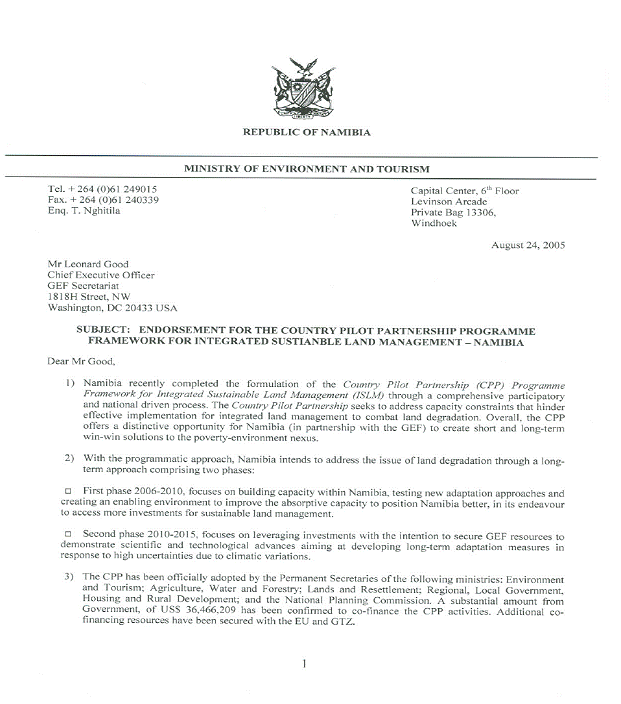
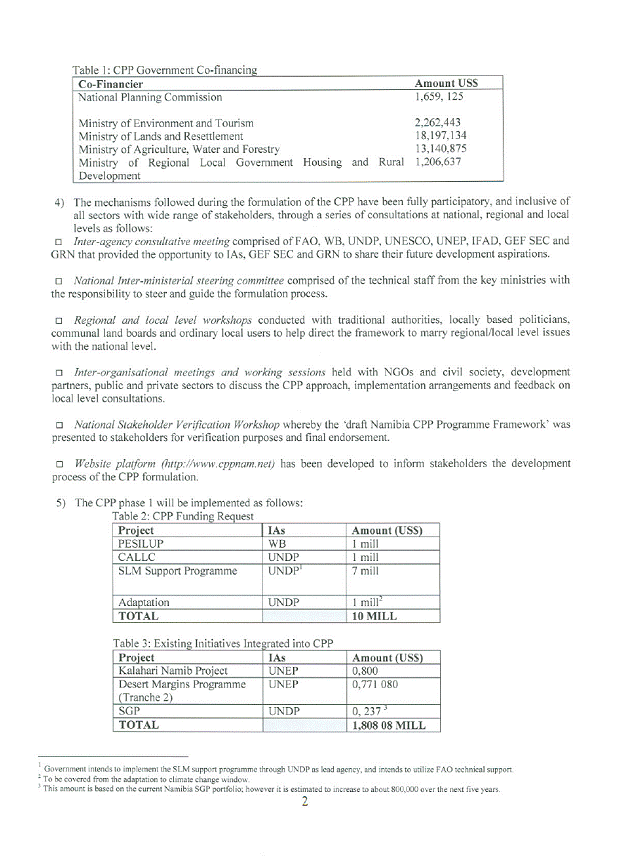

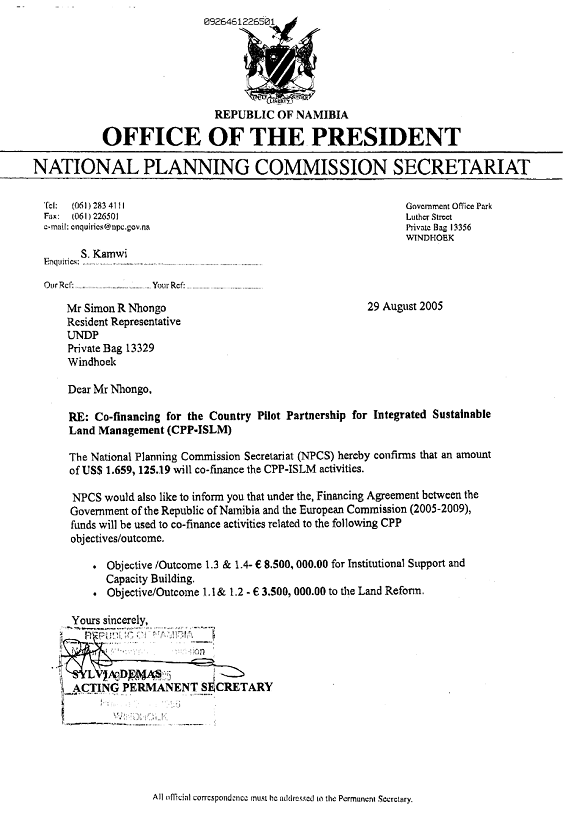

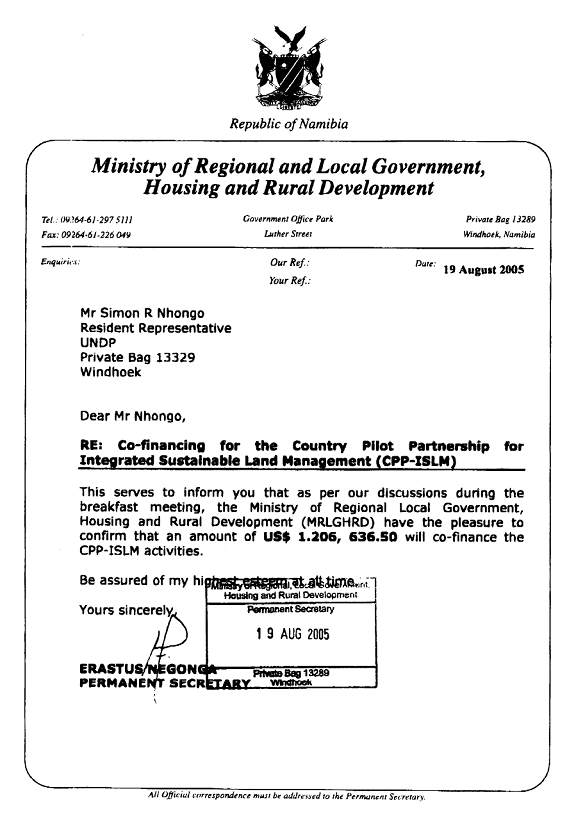

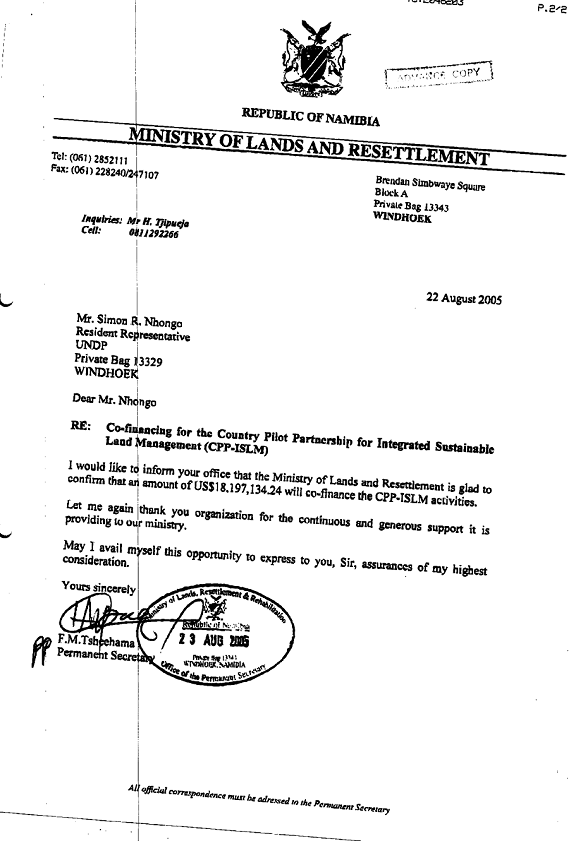
PART II: Terms of References for key project staff and main sub-contracts
TORS for CPP GOVERNING BODY
Background to CPP
151. The Government of Namibia has identified land degradation as a serious problem which demands remedial intervention, and has recognised that integrated ecosystem management strategies are needed to effectively address the underlying causes. Existing efforts on-the-ground are obstructed by a series of barriers, which undermine their efficacy. Although the government has been, and remains, fully committed to combating land degradation, insufficient capacity at systemic, institutional and individual levels, and inadequate knowledge and technology dissemination constrain the effectiveness of interventions.
152. Five Ministries, namely the Ministry of Agriculture, Water and Forestry, Ministry of Environment and Tourism, Ministry of Lands and Resettlement, Ministry of Regional and Local Government and Housing and Rural Development, and the National Planning Commission, have agreed in conjunction with the GEF and its Implementing Agencies, the European Union, GTZ and the NGO community to overcome these barriers by spearheading a Country Pilot Partnership for Integrated Sustainable Land Management (CPP). The goal of the CPP is to “Combat land degradation using integrated cross-sectoral approaches which enable Namibia to reach its MDG #7: “environmental sustainability” and assure the integrity of dryland ecosystems and ecosystem services”. The objectives are to build and sustain capacity at systemic, institutional and individual level, ensuring cross-sectoral and demand driven coordination and implementation of sustainable land management (SLM) activities and, second, to identify cost effective, innovative and appropriate SLM methods which integrate environmental and economic objectives.
1. CPP Implementation Arrangements
153. The first phase of the Sustainable Land Management Support and Adaptive Management (CPP SLM SAM) Project will be implemented over a period of five years, officially commencing September 2006-September 2011. In accordance with the new simplified and harmonised procedures, the County Programme Action Plan (CPAP) and national execution (NEX) modalities, final project delivery and accountability rests with the National Planning Commission as the Government Coordinating Authority; while the actual implementation, including financial and administrative management will be with the MET as the Government Cooperating Agency, in partnership with the Ministry of Agriculture, Water and Forestry (MAWF), Ministry of Lands and Resettlement (MLR), Ministry of Regional, Local Government Housing and Rural Development (MRLGHRD) in their capacities as implementing partners for certain components and other key implementing partners within the CPP including the civil society, in particular the Namibia Nature Foundation. This will be in accordance with the UNDP National Executing Modality and Results Management Guide (RMG) supported by yearly Annual Work Plans (AWPs) which will be signed by UNDP and the respective implementing partners.
154. The CPP Governing Body will comprise high level staff from various CPP Partner organisations including:
· The Permanent Secretaries of key partner Ministries (NPC, MET, MAWF, MLR, MRLGHRD)
· One or two senior (Director level) support staff,
· Two representative from the private sector (NCCI and SME Sector)
· Two organised agricultural representatives (NAU, NNFU)
· One representatives from the donor community (rotating chair)
· The GEF Operational Focal Point representing the various members of the GEF Family[24]
· UNDP as lead agency for the Namibia CPP
· One representative from DRFN and NNF respectively
· The Programme Coordinator as secretary
· The Senior Business and Livelihood Expert as advisor
· The M&E Specialist as rapporteur
2. Role of the CPP Governing Body
155. The main function of the CPP-GB is strategic planning with the purpose of coordinating and harmonising the planning and implementation of activities, identifying areas of cooperation and synergy through inter-agency information sharing. More specifically the responsibilities of the CPP Governing Body include but are not limited to:
Ø Review progress reports received through the CPP Management Unit and ensure that CPP Objectives are realised.
Ø Based on these reports, monitor and assess progress made in SLM as contribution to Vision 2030
Ø Review the status of cooperation, policy harmonisation, institutionalisation and mainstreaming of ISLM in modus operandi and budgetary allocations.
Ø Provide recommendations to the CPP Consortium in case of strategic changes and adjustments.
Ø Bring together different institutions to help systematically implement Chapter 5 of Vision 2030, one of the major components of which is the CPP for SLM.
Ø Ensure that environmental issues and livelihood/poverty alleviation are adequately integrated within ISLM.
3. Management Arrangements
156. The CPP Governing Body will be called and chaired by NPCS. It will meet once annually for one day with the proviso to hold emergency meetings if needs arise. The CPP Coordinating Unit on behalf of NPCS will be responsible for organising the annual meetings while the Consortium Core Group may call for extraordinary meetings. Dates for the respective next meetings will be set each year at the Governing Body meeting. In year one of the CPP, the NPCS in its capacity as chair of the Governing Body will invite organisations to the meeting.
4. Reporting
157. Minutes of the CPP Governing Body meetings will be included in the regular reports to UNDP/GEF.
C TORs of the CPP Management UNIT
1. Background to CPP
158. The Government of Namibia has identified land degradation as a serious problem which demands remedial intervention, and has recognised that integrated ecosystem management strategies are needed to effectively address the underlying causes. Existing efforts on-the-ground are obstructed by a series of barriers, which undermine their efficacy. Although the government has been, and remains, fully committed to combating land degradation, insufficient capacity at systemic, institutional and individual levels, and inadequate knowledge and technology dissemination constrain the effectiveness of interventions.
159. Five Ministries, namely the Ministry of Agriculture, Water and Forestry, Ministry of Environment and Tourism, Ministry of Lands and Resettlement, Ministry of Regional and Local Government and Housing and Rural Development, and the National Planning Commission, have agreed in conjunction with the GEF and its Implementing Agencies, the European Union, GTZ and the NGO community to overcome these barriers by spearheading a Country Pilot Partnership for Integrated Sustainable Land Management (CPP). The goal of the CPP is to “Combat land degradation using integrated cross-sectoral approaches which enable Namibia to reach its MDG #7: “environmental sustainability” and assure the integrity of dryland ecosystems and ecosystem services”. The objectives are to build and sustain capacity at systemic, institutional and individual level, ensuring cross-sectoral and demand driven coordination and implementation of sustainable land management (SLM) activities and, second, to identify cost effective, innovative and appropriate SLM methods which integrate environmental and economic objectives.
2. CPP Implementation Arrangements
160. The first phase of the Sustainable Land Management Support and Adaptive Management (CPP SLM SAM) Project will be implemented over a period of five years, officially commencing September 2006-September 2011. In accordance with the new simplified and harmonised procedures, the County Programme Action Plan (CPAP) and national execution (NEX) modalities, final project delivery and accountability rests with the National Planning Commission as the Government Coordinating Authority; while the actual implementation, including financial and administrative management will be with the MET as the Government Cooperating Agency, in partnership with the Ministry of Agriculture, Water and Forestry (MAWF), Ministry of Lands and Resettlement (MLR), Ministry of Regional, Local Government Housing and Rural Development (MRLGHRD) in their capacities as implementing partners for certain components and other key implementing partners within the CPP including the civil society, in particular the Namibia Nature Foundation. This will be in accordance with the UNDP National Executing Modality and Results Management Guide (RMG) supported by yearly Annual Work Plans (AWPs) which will be signed by UNDP and the respective implementing partners.
161. Coordination among the various organisations will be ensured through the establishment of a three-tier coordination mechanism: the CPP Governing Body (CPP-GB), the CPP Consortium (CPP-C) and the CPP Coordination Unit (CPP-CU) who relate to each other as shown in the Diagram below and elaborated in more detail in the UNDP Project Document.
3. Staffing of the CPP Coordinating Unit
162. The Coordinating Unit will house:
· The Programme Coordinator
· The Programme Assistant (UNV- UNDP/GEF specialist)
· The M&E Expert
· The Communication and Outreach Officer
· The Senior Livelihoods and Business/Enterprise Expert
· Seconded staff of the CPP Partner Ministries
· A Programme Accountant, if this responsibility is not outsourced to a sub-contractor.
· Professional Young Interns
· Messenger/Driver
4. Role of the CPP Coordinating Unit
163. The role and responsibilities of the CPP Coordinating Unit is to be the main driving force for day-to-day management and implementation of the CPP and locus for communication, monitoring and reporting. Its responsibilities include but are not limited to:
· Administration and financial management of the CPP Programme.
· Plan and organise the CPP Governing Body, CPP Consortium and other meetings and workshops as needs arise.
· Collate progress reports from the various project activities, condense them and channel them on to the CPP Consortium Core Group and Governing Body.
· Facilitate programme implementation at the various project levels, communicate with and supervise project implementers and consultants.
· Provide point of communication for inquiries in particular where non-CPP Partners would like to obtain information or coordinate activities through the framework.
· Liaise with CPP Implementing and broader ISLM partners.
· Organise recruitment processes: place advertisements, draft TORs and organise screening procedures.
5. Management Arrangements
164. The unit will be headed by the Programme Coordinator/Manager who will be responsible for the day-to-day administration and management of the programme. The unit will be housed in a location provided by GRN.
6. Reporting
165. The unit will report to the Consortium Core Group on a quarterly basis and overall progress to the Governing Body on an annual basis.
D TORs of the CPP PROGRAMME COORDINATOR
1. Background to CPP
166. The Government of Namibia has identified land degradation as a serious problem which demands remedial intervention, and has recognised that integrated ecosystem management strategies are needed to effectively address the underlying causes. Existing efforts on-the-ground are obstructed by a series of barriers, which undermine their efficacy. Although the government has been, and remains, fully committed to combating land degradation, insufficient capacity at systemic, institutional and individual levels, and inadequate knowledge and technology dissemination constrain the effectiveness of interventions.
167. Five Ministries, namely the Ministry of Agriculture, Water and Forestry, Ministry of Environment and Tourism, Ministry of Lands and Resettlement, Ministry of Regional and Local Government and Housing and Rural Development, and the National Planning Commission, have agreed in conjunction with the GEF and its Implementing Agencies, the European Union, GTZ and the NGO community to overcome these barriers by spearheading a Country Pilot Partnership for Integrated Sustainable Land Management (CPP). The goal of the CPP is to “Combat land degradation using integrated cross-sectoral approaches which enable Namibia to reach its MDG #7: “environmental sustainability” and assure the integrity of dryland ecosystems and ecosystem services”. The objectives are to build and sustain capacity at systemic, institutional and individual level, ensuring cross-sectoral and demand driven coordination and implementation of sustainable land management (SLM) activities and, second, to identify cost effective, innovative and appropriate SLM methods which integrate environmental and economic objectives.
2. CPP Implementation Arrangements
168. The first phase of the Sustainable Land Management Support and Adaptive Management (CPP SLM SAM) Project will be implemented over a period of five years, officially commencing September 2006-September 2011. In accordance with the new simplified and harmonised procedures, the County Programme Action Plan (CPAP) and national execution (NEX) modalities, final project delivery and accountability rests with the National Planning Commission as the Government Coordinating Authority; while the actual implementation, including financial and administrative management will be with the MET as the Government Cooperating Agency, in partnership with the Ministry of Agriculture, Water and Forestry (MAWF), Ministry of Lands and Resettlement (MLR), Ministry of Regional, Local Government Housing and Rural Development (MRLGHRD) in their capacities as implementing partners for certain components and other key implementing partners within the CPP including the civil society, in particular the Namibia Nature Foundation. This will be in accordance with the UNDP National Executing Modality and Results Management Guide (RMG) supported by yearly Annual Work Plans (AWPs) which will be signed by UNDP and the respective implementing partners.
169. Coordination among the various organisations will be ensured through the establishment of a three-tier coordination mechanism: the CPP Governing Body (CPP-GB), the CPP Consortium (CPP-C) and the CPP Management Unit (CPP-CU) who relate to each other as shown in figure and elaborated in more detail in the UNDP Project Document.
3. Role/responsibilities of the CPP Programme Coordinator
170. As head of the CPP Coordinating Unit, the Programme Coordinator will provide the link between all three levels of CPP implementation. In this position, his/her responsibilities will include but are not limited to:
Ø Lead, manage and coordinate the day-to-day management of the Programme Coordinating Unit including administration, accounting, technical expertise, and actual project implementation and reporting.
Ø Finalise the inception phase including inception report and drafting the second phase strategy.
Ø Lead the development of detailed project implementation inputs including preparation of subcontractors Terms of Reference, identification and selection of national, regional and international subcontractors, cost estimation, time scheduling, contracting, and reporting.
Ø Coordinate activities of consultants including contract management, direction and supervision of field operations, logistical support, review of technical outputs/reports, measurement/assessment of project achievements before submitting to stakeholders.
Ø Provide a first point of contact and backstopping where necessary to project implementers at CPP Pilot sites.
Ø Facilitate the formation of the Governing Body and once established plan and coordinate its annual meetings as stipulated in the Programme Document.
Ø Act as secretary to the Governing Body, compiling proceedings and reporting outcomes and decisions of the meeting.
Ø Plan and coordinate regular meetings of the CPP Consortium.
Ø Organise the annual donor coordination meeting.
Ø Liaise and build relations between CPP, the CPP Partner Ministries, stakeholders from non-governmental sector and the donor community.
Ø Supervise and provide substantive support to junior staff, through mentoring, coaching and capacity building.
Ø Assist in developing policy frameworks to showcase and demonstrate direct benefits from integrated sustainable land management to human-well being in Namibia.
Ø Facilitate communication, cooperation and synergies not only within but especially beyond CPP.
Ø Mobilise additional resources (financial and technical) for the project.
Ø Undertake other management duties that contribute to the effective functioning of the project.
4. Work Arrangements
171. The Programme Coordinator will be employed by MET on a full-time basis for the duration of the first phase of the CPP programme, starting in 2006 and ending in 2011. S/he will be housed in the Coordinating Unit, which will provide office space and equipment as necessary to implement his/her responsibilities. S/he will undertake Namibian students throughout programme activities for training purposes and to assist him/her with specific tasks up to an amount of N$2,000 per month (N$24,000 per year). Generic TORs for CPP Interns have been drafted and will be specified by CPP Coordinator according to the specific requirements.
5. Reporting
172. The Programme Coordinator will report on a regular basis to the CPP Consortium Core Group. S/he will further take part in the participatory M&E sessions of the CPP Consortium. S/he will report once a year to the CPP Governing Body.
E TORs CPP PROGRAMME ASSISTANT
1. Background to CPP
173. The government of Namibia has identified land degradation as a serious problem which demands remedial intervention, and has recognised that integrated ecosystem management strategies are needed to effectively address the underlying causes. Existing efforts on-the-ground are obstructed by a series of barriers, which undermine their efficacy. Although the government has been, and remains, fully committed to combating land degradation, insufficient capacity at systemic, institutional and individual levels, and inadequate knowledge and technology dissemination constrain the effectiveness of interventions.
174. Five Ministries, namely the Ministry of Agriculture, Water and Forestry, Ministry of Environment and Tourism, Ministry of Lands and Resettlement, Ministry of Regional and Local Government and Housing and Rural Development, and the National Planning Commission, have agreed in conjunction with the GEF and its Implementing Agencies, the European Union, GTZ and the NGO community to overcome these barriers by spearheading a Country Pilot Partnership for Integrated Sustainable Land Management (CPP). The goal of the CPP is to “Combat land degradation using integrated cross-sectoral approaches which enable Namibia to reach its MDG #7: “environmental sustainability” and assure the integrity of dryland ecosystems and ecosystem services”. The objectives are to build and sustain capacity at systemic, institutional and individual level, ensuring cross-sectoral and demand driven coordination and implementation of sustainable land management (SLM) activities and, second, to identify cost effective, innovative and appropriate SLM methods which integrate environmental and economic objectives.
2. CPP Implementation Arrangements
175. The first phase of the Sustainable Land Management Support and Adaptive Management (CPP SLM SAM) Project will be implemented over a period of five years, officially commencing September 2006-September 2011. In accordance with the new simplified and harmonised procedures, the County Programme Action Plan (CPAP) and national execution (NEX) modalities, final project delivery and accountability rests with the National Planning Commission as the Government Coordinating Authority; while the actual implementation, including financial and administrative management will be with the MET as the Government Cooperating Agency, in partnership with the Ministry of Agriculture, Water and Forestry (MAWF), Ministry of Lands and Resettlement (MLR), Ministry of Regional, Local Government Housing and Rural Development (MRLGHRD) in their capacities as implementing partners for certain components and other key implementing partners within the CPP including the civil society, in particular the Namibia Nature Foundation. This will be in accordance with the UNDP National Executing Modality and Results Management Guide (RMG) supported by yearly Annual Work Plans (AWPs) which will be signed by UNDP and the respective implementing partners.
176. Coordination among the various organisations will be ensured through the establishment of a three-tier coordination mechanism: the CPP Governing Body (CPP-GB), the CPP Consortium (CPP-C) and the CPP Coordination Unit (CPP-CU). This position will be sourced from the national and international UNV Roosters with strict requirements for GEF UNVs vis-à-vis general UNVs.
3. Responsibility
177. The Programme Assistant will be directly assisting the tasks of the Programme Coordinator. S/he will be responsible for day-to-day administrative tasks of the programme, including procurement, financial oversight, filing and other clerical and technical duties. The responsibilities of the Programme Assistant include but are not limited to:
Ø Ensure that all procurement is carried out in accordance with UNDP/GEF and Government of the Republic of Namibia (GRN) requirements, which includes:
Ø Becoming conversant with UNDP/GEF financial management procedures including use of UNDP ATLAS system.
Ø Working with the Programme Accountants, ensure smooth flow of funds, to enable timely execution of contracts including timely replenishment of the Programme accounts, arrange for annual audits of all accounts.
Ø Compile quarterly and annual financial reports for CPP Consortium, focusing on financial delivery and rate of implementation of the overall Programme.
Ø Act as secretary for Consortium Core Group and other meetings as arising.
Ø Assist the Programme Coordinator in overseeing consultants and financial reports.
Ø Maintain good filing system at the CPP Coordinating Unit.
Ø Manage programme resources e.g. office equipment/stationery, including management of a fleet of Programme vehicles, ensuring appropriate use and maintenance.
Ø Assist the Programme Coordinator in organising workshops and meetings as necessary.
Ø Provide training to interns and where relevant to other Programme staff.
Ø Assist the CPP Coordinating Unit in all other administrative and clerical work.
4. Work Arrangements
178. The CPP Programme Assistant will be employed by MET on a full-time basis for the duration of the first phase of the CPP programme, starting in 2006 and ending in 2011. S/he will be housed in the Coordinating Unit, which will provide office space and equipment as necessary to implement his/her responsibilities. This position will be sourced from the national and international UNV Roosters with strict requirements for GEF UNVs vis-à-vis general UNVs.
5. Reporting
179. The Administrator shall report directly to the CPP Programme Coordinator (PC).
F TORs CPP M&E SPECIALIST
1. Background to CPP
180. The Government of Namibia has identified land degradation as a serious problem which demands remedial intervention, and has recognised that integrated ecosystem management strategies are needed to effectively address the underlying causes. Existing efforts on-the-ground are obstructed by a series of barriers, which undermine their efficacy. Although the government has been, and remains, fully committed to combating land degradation, insufficient capacity at systemic, institutional and individual levels, and inadequate knowledge and technology dissemination constrain the effectiveness of interventions.
181. Five Ministries, namely the Ministry of Agriculture, Water and Forestry, Ministry of Environment and Tourism, Ministry of Lands and Resettlement, Ministry of Regional and Local Government and Housing and Rural Development, and the National Planning Commission, have agreed in conjunction with the GEF and its Implementing Agencies, the European Union, GTZ and the NGO community to overcome these barriers by spearheading a Country Pilot Partnership for Integrated Sustainable Land Management (CPP). The goal of the CPP is to “Combat land degradation using integrated cross-sectoral approaches which enable Namibia to reach its MDG #7: “environmental sustainability” and assure the integrity of dryland ecosystems and ecosystem services”. The objectives are to build and sustain capacity at systemic, institutional and individual level, ensuring cross-sectoral and demand driven coordination and implementation of sustainable land management (SLM) activities and, second, to identify cost effective, innovative and appropriate SLM methods which integrate environmental and economic objectives.
2. CPP Implementation Arrangements
182. The first phase of the Sustainable Land Management Support and Adaptive Management (CPP SLM SAM) Project will be implemented over a period of five years, officially commencing September 2006-September 2011. In accordance with the new simplified and harmonised procedures, the County Programme Action Plan (CPAP) and national execution (NEX) modalities, final project delivery and accountability rests with the National Planning Commission as the Government Coordinating Authority; while the actual implementation, including financial and administrative management will be with the MET as the Government Cooperating Agency, in partnership with the Ministry of Agriculture, Water and Forestry (MAWF), Ministry of Lands and Resettlement (MLR), Ministry of Regional, Local Government Housing and Rural Development (MRLGHRD) in their capacities as implementing partners for certain components and other key implementing partners within the CPP including the civil society, in particular the Namibia Nature Foundation. This will be in accordance with the UNDP National Executing Modality and Results Management Guide (RMG) supported by yearly Annual Work Plans (AWPs) which will be signed by UNDP and the respective implementing partners.
183. Coordination among the various organisations will be ensured through the establishment of a three-tier coordination mechanism: the CPP Governing Body (CPP-GB), the CPP Consortium (CPP-C) and the CPP Coordination Unit (CPP-CU).
3. Responsibility
184. The overall responsibility of the M&E Expert is to set up and implement the M&E Plan as stipulated in the CPP Programme Framework (Annex B) and UNDP Project Document and thus assist the Programme in reaching and monitoring its targets. His/her main responsibilities include but are not limited to:
Ø Test, refine and set up the CPP M&E Plan during the inception phase of the programme and formalise its implementation through an M&E Manual.
Ø Implement the CPP M&E Plan, assessing progress and challenges based on data collection on the ground and participatory evaluations during Consortium Meetings and report these to respective bodies.
Ø Assess the functionality of CPP’s M&E system throughout the programme to assess (i) whether the indicator system is still valid and relevant, (ii) whether data registration, data use and data analysis is feasible in the long term, and (iii) whether the data collected is useful for those involved, and helping them to measure progress and impact in achieving their targets.
Ø Finalise the M&E tools to monitor project progress and challenges and to collect the baseline; this includes:
Ø The development of Local Level Monitoring Systems in cooperation with ICEMA, WWF-Life Plus, the M&E Working Group, the PESILUP Team, the CPP Senior Business and Livelihood Expert and other partners as appropriate.
Ø The collection of the baseline based on a participatory inventory of natural resources and human capacities at each of the CPP Pilot sites at the inception of the project. This inventory will not only establish the baseline but provide necessary information for land use planning and zonation.
Ø The development of the Management Effectiveness Self Assessment Tool (MESAT), its inception and implementation.
Ø To establish data storage and reporting system which allows service providers, support organisations and the CPP Programme to establish progress and challenges without burdening resource users.
Ø To drive the application of the Sustainable Development Index in cooperation with the NNF who will be responsible for the development and testing of the latter.
Ø To promote Local Level Monitoring as basis for decision making and land use planning at regional and national level in cooperation with PESILUP and the outreach and communication officer.
Ø To collect and collate data from the field as well as through regular participatory evaluation sessions of the CPP Consortium, as stipulated in the M&E Manual developed during the inception phase.
Ø To evaluate data, highlight progress and challenges; consolidate findings into reports as required by UNDP and GEF.
Ø To report and discuss progress in person to the CPP Governing Body and the CPP Consortium and contribute to annual workplan preparation to ensure that activities correspond to targets.
Ø Cooperate and liaise with external, independent evaluators at Mid Term and End Term Evaluation as applicable.
185. The M&E Expert will also be responsible for driving the National M&E Group which was established under MET.
4. Work Arrangements
186. The M&E Expert will be employed by MET on a full-time basis for the duration of the first phase of the CPP programme, starting in 2006 and ending in 2011. S/he will be housed in the Coordinating Unit, which will provide office space and equipment as necessary to implement his/her responsibilities. S/he will undertake Namibian students throughout programme activities for training purposes and to assist him/her with specific tasks up to an amount of N$2,000 per month (N$24,000 per year). Generic TORs for CPP Interns have been drafted and will be specified by the M&E expert according to the specific requirements.
5. Reporting
187. The M&E Expert will report day-to-day activities to the Programme Coordinator within the Coordinating Unit. S/he will also report once a year to the CPP Governing Body and provide advice as stipulated in the TORs. S/he will further take part in the participatory M&E sessions of the CPP Consortium Group and project interventions.
G CPP SENIOR TECHNICAL LIVELIHOOD and BUSINESS/ENTERPRISE ADVISOR
1. Background to CPP
188. The Government of Namibia has identified land degradation as a serious problem which demands remedial intervention, and has recognised that integrated ecosystem management strategies are needed to effectively address the underlying causes. Existing efforts on-the-ground are obstructed by a series of barriers, which undermine their efficacy. Although the government has been, and remains, fully committed to combating land degradation, insufficient capacity at systemic, institutional and individual levels, and inadequate knowledge and technology dissemination constrain the effectiveness of interventions.
189. Five Ministries, namely the Ministry of Agriculture, Water and Forestry, Ministry of Environment and Tourism, Ministry of Lands and Resettlement, Ministry of Regional and Local Government and Housing and Rural Development, and the National Planning Commission, have agreed in conjunction with the GEF and its Implementing Agencies, the European Union, GTZ and the NGO community to overcome these barriers by spearheading a Country Pilot Partnership for Integrated Sustainable Land Management (CPP). The goal of the CPP is to “Combat land degradation using integrated cross-sectoral approaches which enable Namibia to reach its MDG #7: “environmental sustainability” and assure the integrity of dryland ecosystems and ecosystem services”. The objectives are to build and sustain capacity at systemic, institutional and individual level, ensuring cross-sectoral and demand driven coordination and implementation of sustainable land management (SLM) activities and, second, to identify cost effective, innovative and appropriate SLM methods which integrate environmental and economic objectives.
2. CPP Implementation Arrangements
190. The first phase of the Sustainable Land Management Support and Adaptive Management (CPP SLM SAM) Project will be implemented over a period of five years, officially commencing September 2006-September 2011. In accordance with the new simplified and harmonised procedures, the County Programme Action Plan (CPAP) and national execution (NEX) modalities, final project delivery and accountability rests with the National Planning Commission as the Government Coordinating Authority; while the actual implementation, including financial and administrative management will be with the MET as the Government Cooperating Agency, in partnership with the Ministry of Agriculture, Water and Forestry (MAWF), Ministry of Lands and Resettlement (MLR), Ministry of Regional, Local Government Housing and Rural Development (MRLGHRD) in their capacities as implementing partners for certain components and other key implementing partners within the CPP including the civil society, in particular the Namibia Nature Foundation. This will be in accordance with the UNDP National Executing Modality and Results Management Guide (RMG) supported by yearly Annual Work Plans (AWPs) which will be signed by UNDP and the respective implementing partners.
191. Coordination among the various organisations will be ensured through the establishment of a three-tier coordination mechanism: the CPP Governing Body (CPP-GB), the CPP Consortium (CPP-C) and the CPP Coordination Unit (CPP-CU).
3. Role/responsibilities of the Senior Technical Livelihood and Business/Enterprise Advisor
192. The Senior Livelihoods Expert will work across all three levels of the CPP to ensure that the nexus between environmental management and livelihoods/poverty alleviation is adequately and appropriately addressed. S/he will be directly involved in the practical implementation of ISLM livelihood development at the CPP Pilot sites and feed lessons learned into technical coordination, strategic planning, policy development and mainstreaming activities.
a) Activities at the project Implementation Level
193. Within the Pilot sites of the CPP, the responsibilities of the Livelihoods and Business Advisor will include but are not limited to the following tasks:
Ø To identify opportunities for ISLM business and enterprise development leading to diversification of livelihoods with added economic value to ISLM in the respective pilot sites.
Ø S/he will place specific focus on activities suitable for engagement and creation of incomes to marginalised and disadvantaged groups such as women, indigenous people and PLWHA affected households both directly (e.g. crafts development and marketing, small scale fruit and vegetable (“doorstep gardens”), processing and marketing of veld fruits) and indirectly through community-based income re-distribution channels.
Ø To drive market analyses to identify the economic viability of ISLM enterprises with participation of interested entrepreneurs.
Ø To facilitate the drafting and finalisation of business plans with communities and support organisations.
Ø To link resource entrepreneurs with existing funding opportunities (e.g. small grants).
Ø To facilitate the establishment of new funding opportunities (e.g. small grants, micro-finance etc) and their implementation in Phase 2.
Ø To identify training and capacity needs for business and enterprise establishment and ideal training providers.
Ø To identify opportunities to overcome market access constraints, e.g. through establishing supply chains with established market players (e.g. private sector).
Ø To establish partnerships and liaise with other relevant service providers and partners such as the private sector in the respective regions; the Ministry of Trade and Investment; the Ministry of Health; NACSO Business and Enterprise Group; CRIAA amongst others.
Ø To provide assistance to the M&E Specialist to ensure that Livelihoods and Poverty Measures are adequately monitored, evaluated and reported within the CPP M&E Plan.
Ø To provide business/entrepreneurial skills to the CPP beneficiaries at local level.
Ø To support Government efforts in mainstreaming Namibia’s natural resources management and economic development through regional and sub-regional bodies e.g. SADC, NEPAD and AU.
b) Activities at technical coordination level
194. At the level of technical coordination the responsibilities of the Business and Livelihoods Advisor will include but are not limited to the following tasks:
Ø To participate in Participatory Evaluation sessions with the Consortium Core Group.
Ø To provide advice to the Consortium Core Group on technical cooperation and coordination to overcome challenges on the ground.
Ø To assist in establishing Working Groups and setting their agendas to cover challenges and issues arising regarding livelihoods and business development.
Ø To ensure that HIV/AIDS and gender issues are adequately considered in technical planning and coordination of CPP activities.
Ø To provide support and backstopping to CPP Partners regarding the mainstreaming and institutionalisation of livelihoods and poverty issues into modus operandi, daily operations and budgetary processes.
Ø To liaise and cooperate with the CPP Consortium at large.
Ø To ensure that CPP Working Groups incorporate partners beyond the immediate CPP Implementation mechanism, relevant to ISLM business development and livelihoods issues.
c) Activities at the Level of Strategic Planning
195. At the level of Strategic Planning the responsibilities of the Business and Livelihoods Advisor will include but are not limited to the following tasks:
Ø To participate in the annual Governing Body meetings and, where required, the PS Breakfast Meetings to report issues and challenges arising regarding livelihoods.
Ø To act as advisor to the CPP Governing Body in matters concerning the linkages between ISLM and livelihoods.
Ø To provide technical advice to CPP GB on mainstreaming environmental initiatives to address the poverty-environment nexus as catalytic to mobilize/leverage resources.
Ø To support the establishment of an integrated policy framework for ISLM and sustainable livelihoods that effectively combines national and sectoral strategies within the National Development Plan (NDP) and Vision 2030.
Ø To ensure the creation of linkages between ISLM and Poverty and livelihoods issues as addressed in National Development Documents
Ø To linking CPP planning with NPRAP, MDGs and poverty issues as outlined in Vision 2030.
Ø To ensure that HIV/AIDS and gender issues are mainstreamed in programme and strategic policy interventions.
4. Work Arrangements
196. The Senior Business and Livelihoods Advisor will be employed by MET on a full-time basis for the duration of the first phase of the CPP programme, starting in 2006 and ending in 2011. The Senior Business and Livelihoods Advisor will be housed in the Coordinating Unit, which will provide office space and equipment as necessary to implement his/her responsibilities.
5. Reporting
197. The Senior Livelihoods and Business/Entrepreneur Advisor will report day-to-day activities to the Programme Coordinator within the Coordinating Unit. S/he will report once a year to the CPP Governing Body and provide advice as stipulated in the TORs. S/he will further take part in the participatory M&E sessions of the CPP Consortium Group.
H SECONDED STAFF FROM CPP PARTNER MINISTRIES and IMPLEMENTING ORGANISATIONSD
1. Background to CPP
198. The Government of Namibia has identified land degradation as a serious problem which demands remedial intervention, and has recognised that integrated ecosystem management strategies are needed to effectively address the underlying causes. Existing efforts on-the-ground are obstructed by a series of barriers, which undermine their efficacy. Although the government has been, and remains, fully committed to combating land degradation, insufficient capacity at systemic, institutional and individual levels, and inadequate knowledge and technology dissemination constrain the effectiveness of interventions.
199. Five Ministries, namely the Ministry of Agriculture, Water and Forestry, Ministry of Environment and Tourism, Ministry of Lands and Resettlement, Ministry of Regional and Local Government and Housing and Rural Development, and the National Planning Commission, have agreed in conjunction with the GEF and its Implementing Agencies, the European Union, GTZ and the NGO community to overcome these barriers by spearheading a Country Pilot Partnership for Integrated Sustainable Land Management (CPP). The goal of the CPP is to “Combat land degradation using integrated cross-sectoral approaches which enable Namibia to reach its MDG #7: “environmental sustainability” and assure the integrity of dryland ecosystems and ecosystem services”. The objectives are to build and sustain capacity at systemic, institutional and individual level, ensuring cross-sectoral and demand driven coordination and implementation of sustainable land management (SLM) activities and, second, to identify cost effective, innovative and appropriate SLM methods which integrate environmental and economic objectives.
2. CPP Implementation Arrangements
200. The first phase of the Sustainable Land Management Support and Adaptive Management (CPP SLM SAM) Project will be implemented over a period of five years, officially commencing September 2006-September 2011. In accordance with the new simplified and harmonised procedures, the County Programme Action Plan (CPAP) and national execution (NEX) modalities, final project delivery and accountability rests with the National Planning Commission as the Government Coordinating Authority; while the actual implementation, including financial and administrative management will be with the MET as the Government Cooperating Agency, in partnership with the Ministry of Agriculture, Water and Forestry (MAWF), Ministry of Lands and Resettlement (MLR), Ministry of Regional, Local Government Housing and Rural Development (MRLGHRD) in their capacities as implementing partners for certain components and other key implementing partners within the CPP including the civil society, in particular the Namibia Nature Foundation. This will be in accordance with the UNDP National Executing Modality and Results Management Guide (RMG) supported by yearly Annual Work Plans (AWPs) which will be signed by UNDP and the respective implementing partners.
201. Coordination among the various organisations will be ensured through the establishment of a three-tier coordination mechanism: the CPP Governing Body (CPP-GB), the CPP Consortium (CPP-C) and the CPP Coordination Unit (CPP-CU).
3. Responsibility
202. The role and responsibilities of the seconded staff from CPP Partner Ministries and other implementing organisations will include but is not limited to:
Ø Act as counterparts to advisors and consultants, ensuring that recommendations build on existing activities and programmes in their Ministries.
Ø Drive implementation of recommendations and Action Plans (e.g. capacity building strategy, policy harmonisation and mainstreaming Action Plans etc) in their particular Ministries, thus ensuring the alignment of their Ministries’ programmes and activities to the CPP framework.
Ø Form part of the CPP Consortium Core Group and attend its meetings on a regular basis.
Ø Chair Consortium Working Groups and drive processes and actions identified during working group discussions between Consortium Meetings.
Ø Participate in and contribute to the activities to establish the enabling environment for the CPP.
Ø Create the linkage between the CPP Implementation and their respective Ministries/organisations.
4. Work Arrangements
203. Seconded staff of CPP Partner Ministries will be housed within the CPP Coordinating Unit for their activities directly related to the CPP. They will share office space and sufficient equipment to be able to fulfil their responsibilities. When necessary, the arrangements will be based on the delivery of specified and agreed (outputs) assignments instead of full secondment options.
5. Reporting
204. Seconded staff will report day-to-day activities to the CPP Programme Coordinator. They will contribute to participatory evaluation activities through the CPP Consortium.
I CPP PROGRAMME ACCOUNTANT
1. Background to CPP
205. The Government of Namibia has identified land degradation as a serious problem which demands remedial intervention, and has recognised that integrated ecosystem management strategies are needed to effectively address the underlying causes. Existing efforts on-the-ground are obstructed by a series of barriers, which undermine their efficacy. Although the government has been, and remains, fully committed to combating land degradation, insufficient capacity at systemic, institutional and individual levels, and inadequate knowledge and technology dissemination constrain the effectiveness of interventions.
206. Five Ministries, namely the Ministry of Agriculture, Water and Forestry, Ministry of Environment and Tourism, Ministry of Lands and Resettlement, Ministry of Regional and Local Government and Housing and Rural Development, and the National Planning Commission, have agreed in conjunction with the GEF and its Implementing Agencies, the European Union, GTZ and the NGO community to overcome these barriers by spearheading a Country Pilot Partnership for Integrated Sustainable Land Management (CPP). The goal of the CPP is to “Combat land degradation using integrated cross-sectoral approaches which enable Namibia to reach its MDG #7: “environmental sustainability” and assure the integrity of dryland ecosystems and ecosystem services”. The objectives are to build and sustain capacity at systemic, institutional and individual level, ensuring cross-sectoral and demand driven coordination and implementation of sustainable land management (SLM) activities and, second, to identify cost effective, innovative and appropriate SLM methods which integrate environmental and economic objectives.
2. CPP Implementation Arrangements
207. The first phase of the Sustainable Land Management Support and Adaptive Management (CPP SLM SAM) Project will be implemented over a period of five years, officially commencing September 2006-September 2011. In accordance with the new simplified and harmonised procedures, the County Programme Action Plan (CPAP) and national execution (NEX) modalities, final project delivery and accountability rests with the National Planning Commission as the Government Coordinating Authority; while the actual implementation, including financial and administrative management will be with the MET as the Government Cooperating Agency, in partnership with the Ministry of Agriculture, Water and Forestry (MAWF), Ministry of Lands and Resettlement (MLR), Ministry of Regional, Local Government Housing and Rural Development (MRLGHRD) in their capacities as implementing partners for certain components and other key implementing partners within the CPP including the civil society, in particular the Namibia Nature Foundation. This will be in accordance with the UNDP National Executing Modality and Results Management Guide (RMG) supported by yearly Annual Work Plans (AWPs) which will be signed by UNDP and the respective implementing partners.
208. Coordination among the various organisations will be ensured through the establishment of a three-tier coordination mechanism: the CPP Governing Body (CPP-GB), the CPP Consortium (CPP-C) and the CPP Coordination Unit (CPP-CU).
3. Responsibility
209. The part-time Programme Accountant will be responsible for development of a financial management system and day-to-day management of project finances in line with ATLAS system. His/her responsibility will include but are not limited to:
Ø Become conversant with UNDP/GEF financial management procedures including use of UNDP ATLAS system.
Ø Develop and maintain appropriate financial accounting policies and procedures manuals.
Ø Develop and maintain a structure of accounts and analysis codes that address the Programme’s accounting, cost control and reporting requirements.
Ø Ensure all payments are adequately supported, computations on the supporting vouchers are correct, spending is within budget and is correctly approved by budget holder and are effected in accordance with the UNDP/GEF procedure.
Ø Ensure all advance payments are correctly and fully accounted for with appropriate expenditure documents.
Ø Ensure monthly reconciliation procedures of various accounts are carried out in a timely manner.
Ø Ensure approved budgets are input into the budget ledger in a timely manner to facilitate monitoring of actual against budget.
Ø Ensure timely production of periodical management reports showing budget versus actual and analysis by various cost centres.
Ø Provide financial accounts, audit schedules and supporting documents to auditors as required.
Ø Provide capacity building in ATLAS and project financial management for relevant project and MET staff including staff in field demonstration sites.
4. Work Arrangements
210. The CPP Programme Accountant will be employed by MET on a part-time basis for the duration of the first phase of the CPP programme, starting in 2006 and ending in 2011. Depending on arrangement s/he will be housed in the Coordinating Unit, which will provide office space and equipment as necessary to implement his/her responsibilities; or if financial services are contracted out in his/her particular office which will then provide him/her with office space and equipment as required to fulfil his/her responsibilities. This arrangement might be further sub-contracted to an organisation depending on future deliberations.
5. Reporting
211. Depending on arrangement, the accountant will report directly to the Programme Assistant and Coordinator or if services are contracted out, to his/her supervisor in the respective office with quarterly reporting to the CPP Coordination Unit.
CPP YOUNG PROFESSIONAL INTERNS
1. Background to CPP
212. The Government of Namibia has identified land degradation as a serious problem which demands remedial intervention, and has recognised that integrated ecosystem management strategies are needed to effectively address the underlying causes. Existing efforts on-the-ground are obstructed by a series of barriers, which undermine their efficacy. Although the government has been, and remains, fully committed to combating land degradation, insufficient capacity at systemic, institutional and individual levels, and inadequate knowledge and technology dissemination constrain the effectiveness of interventions.
213. Five Ministries, namely the Ministry of Agriculture, Water and Forestry, Ministry of Environment and Tourism, Ministry of Lands and Resettlement, Ministry of Regional and Local Government and Housing and Rural Development, and the National Planning Commission, have agreed in conjunction with the GEF and its Implementing Agencies, the European Union, GTZ and the NGO community to overcome these barriers by spearheading a Country Pilot Partnership for Integrated Sustainable Land Management (CPP). The goal of the CPP is to “Combat land degradation using integrated cross-sectoral approaches which enable Namibia to reach its MDG #7: “environmental sustainability” and assure the integrity of dryland ecosystems and ecosystem services”. The objectives are to build and sustain capacity at systemic, institutional and individual level, ensuring cross-sectoral and demand driven coordination and implementation of sustainable land management (SLM) activities and, second, to identify cost effective, innovative and appropriate SLM methods which integrate environmental and economic objectives.
2. CPP Implementation Arrangements
214. The first phase of the Sustainable Land Management Support and Adaptive Management (CPP SLM SAM) Project will be implemented over a period of five years, officially commencing September 2006-September 2011. In accordance with the new simplified and harmonised procedures, the County Programme Action Plan (CPAP) and national execution (NEX) modalities, final project delivery and accountability rests with the National Planning Commission as the Government Coordinating Authority; while the actual implementation, including financial and administrative management will be with the MET as the Government Cooperating Agency, in partnership with the Ministry of Agriculture, Water and Forestry (MAWF), Ministry of Lands and Resettlement (MLR), Ministry of Regional, Local Government Housing and Rural Development (MRLGHRD) in their capacities as implementing partners for certain components and other key implementing partners within the CPP including the civil society, in particular the Namibia Nature Foundation. This will be in accordance with the UNDP National Executing Modality and Results Management Guide (RMG) supported by yearly Annual Work Plans (AWPs) which will be signed by UNDP and the respective implementing partners.
215. Coordination among the various organisations will be ensured through the establishment of a three-tier coordination mechanism: the CPP Governing Body (CPP-GB), the CPP Consortium (CPP-C) and the CPP Coordination Unit (CPP-CU).
216. In order to foster the capacity building of Namibian citizens, the CPP Programme has incorporated several internship positions within its implementation arrangements both at project implementation and programme coordination level. Internship positions target students and graduates who will be offered a 6 months to one year paid position. Working as a part of the Programme Coordinating Unit or in an office within one of the pilot sites, interns will be exposed to various dimensions of the project coordination and formulation work as well as to a variety of issues regarding the protected areas management and biodiversity conservation. It is envisaged that the Intern will acquire invaluable job experience in a donor funded programme which should help his/her future career on the one hand, and Namibia’s ISLM, on the other.
3. Responsibility
217. Depending on individuals’ competency, interest and respective placement responsibilities will vary as stipulated in detailed TORs to be developed by the respective supervisor. In general, a young professional intern’s responsibilities will include but are not limited to:
Ø Assist his/her respective office of placement in management and coordinating activities of the CPP.
Ø Assist his/her respective office of placement in organising meetings and workshops as arising.
Ø Learn and participate in substantive, technical and project management.
Ø Attend capacity building and training initiatives relevant to ISLM, including the Consortium Group meetings and Working Groups.
Ø Capture minutes and proceedings of group work, meetings and workshops.
Ø Closely liaise with consultants to ensure timing and quality of their work.
Ø Assist his/her respective office of placement in managing financial transactions and records of the PMU and help to compile progress and financial reports to be submitted.
Ø Perform specific duties as stipulated in his/her detailed TORs.
4. Work Arrangements
218. The young professional intern will be employed by his/her respective office of placement, which will provide office space and equipment necessary to fulfil his/her responsibilities. He/she will be selected on the basis of academic qualifications, gender and potential for future mid-management positions.
5. Reporting
219. The intern will report directly to his/her supervisor in the respective project office as stipulated in his/her detailed TORs.
K TORs for the CPP CONSORTIUM
1. Background to CPP
220. The government of Namibia has identified land degradation as a serious problem which demands remedial intervention, and has recognised that integrated ecosystem management strategies are needed to effectively address the underlying causes. Existing efforts on-the-ground are obstructed by a series of barriers, which undermine their efficacy. Although the government has been, and remains, fully committed to combating land degradation, insufficient capacity at systemic, institutional and individual levels, and inadequate knowledge and technology dissemination constrain the effectiveness of interventions.
221. Five Ministries, namely the Ministry of Agriculture, Water and Forestry, Ministry of Environment and Tourism, Ministry of Lands and Resettlement, Ministry of Regional and Local Government and Housing and Rural Development, and the National Planning Commission, have agreed in conjunction with the GEF and its Implementing Agencies, the European Union, GTZ and the NGO community to overcome these barriers by spearheading a Country Pilot Partnership for Integrated Sustainable Land Management (CPP). The goal of the CPP is to “Combat land degradation using integrated cross-sectoral approaches which enable Namibia to reach its MDG #7: “environmental sustainability” and assure the integrity of dryland ecosystems and ecosystem services”. The objectives are to build and sustain capacity at systemic, institutional and individual level, ensuring cross-sectoral and demand driven coordination and implementation of sustainable land management (SLM) activities and, second, to identify cost effective, innovative and appropriate SLM methods which integrate environmental and economic objectives.
2. CPP Implementation Arrangements
222. The first phase of the Sustainable Land Management Support and Adaptive Management (CPP SLM SAM) Project will be implemented over a period of five years, officially commencing September 2006-September 2011. In accordance with the new simplified and harmonised procedures, the County Programme Action Plan (CPAP) and national execution (NEX) modalities, final project delivery and accountability rests with the National Planning Commission as the Government Coordinating Authority; while the actual implementation, including financial and administrative management will be with the MET as the Government Cooperating Agency, in partnership with the Ministry of Agriculture, Water and Forestry (MAWF), Ministry of Lands and Resettlement (MLR), Ministry of Regional, Local Government Housing and Rural Development (MRLGHRD) in their capacities as implementing partners for certain components and other key implementing partners within the CPP including the civil society, in particular the Namibia Nature Foundation. This will be in accordance with the UNDP National Executing Modality and Results Management Guide (RMG) supported by yearly Annual Work Plans (AWPs) which will be signed by UNDP and the respective implementing partners.
223. Coordination among the various organisations will be ensured through the establishment of a three-tier coordination mechanism: the CPP Governing Body (CPP-GB), the CPP Consortium (CPP-C) and the CPP Coordination Unit (CPP-CU).
3. Participants
224. The CPP Consortium will comprise all CPP implementing Partners in addition to partners not directly but interested in and critical for ISLM in Namibia. This includes but is not limited to:
225.Ø The CPP Governing Body.
Ø CPP Project implementers on the ground.
Ø CPP Advisors and consultants.
Ø CPP Coordinating Unit, in their functions as outlined in their TORs.
Ø Key NGOs.Ø The tertiary institutions and research centres (Polytechnic, UNAM and the Gobabeb Research Centre).
Ø Private sector representatives (NCCI, SME sector) and other private sector SLM SAM bodies.
Ø NNFU and NAU.
Ø CBOS and Conservancy Associations.
Ø Donors that wish to be involved.
Ø Others interested and involved in ISLM.
4. Responsibilities of the CPP Consortium
226. The role and responsibilities of the CPP-C will be the technical advice to the CPP management unit and activities. This body will create a platform to facilitate collaboration, resolve challenges, and review progress (participatory monitoring and evaluation) and to share best practices and information among project coordinators and implementers. More specifically the responsibilities of the Consortium include but are not limited to:
Ø Hold meetings three times a year that comprise a set of open working group sessions to discuss issues, exchange information and best practices as they arise throughout the CPP Programme.
Ø Identify barriers to the implementation of ISLM activities, and develop Action Plans to overcome these.
Ø Monitor and evaluate progress on the ground through participatory evaluation sessions and feed these into regular reports to the Governing Body and UNDP/GEF.
Ø Familiarise project implementers with existing ISLM practices and techniques, provide backstopping and advice.
Ø Discuss and identify approaches and strategies which can be employed to derive CPP outputs.
Ø Reach out to and involve partners which are not directly engaged in CPP activities, including the private sector, students/future ISLM leaders, academics and researchers etc. to learn and share experiences with them.
.5. Management Arrangements
227. The Consortium will be chaired by MET and MAWF on a rotational basis. It will meet three times per year for 1 to 2 days depending on agenda. Annual meeting dates will be agreed at the start of each year and will be organised through the CPP Coordinating Unit. MET, as first chair will invite the official nominations from the above-mentioned organisations.
6. Reporting
228. Participatory Evaluations and Proceedings from the Consortium Meetings will be included in the reports to the CPP Governing Body on progress of the CPP.
SHORT TERM CAPACITY BUILDING ADVISOR
1. Background to CPP
229. The Government of Namibia has identified land degradation as a serious problem which demands remedial intervention, and has recognised that integrated ecosystem management strategies are needed to effectively address the underlying causes. Existing efforts on-the-ground are obstructed by a series of barriers, which undermine their efficacy. Although the government has been, and remains, fully committed to combating land degradation, insufficient capacity at systemic, institutional and individual levels, and inadequate knowledge and technology dissemination constrain the effectiveness of interventions.
230. Five Ministries, namely the Ministry of Agriculture, Water and Forestry, Ministry of Environment and Tourism, Ministry of Lands and Resettlement, Ministry of Regional and Local Government and Housing and Rural Development, and the National Planning Commission, have agreed in conjunction with the GEF and its Implementing Agencies, the European Union, GTZ and the NGO community to overcome these barriers by spearheading a Country Pilot Partnership for Integrated Sustainable Land Management (CPP). The goal of the CPP is to “Combat land degradation using integrated cross-sectoral approaches which enable Namibia to reach its MDG #7: “environmental sustainability” and assure the integrity of dryland ecosystems and ecosystem services”. The objectives are to build and sustain capacity at systemic, institutional and individual level, ensuring cross-sectoral and demand driven coordination and implementation of sustainable land management (SLM) activities and, second, to identify cost effective, innovative and appropriate SLM methods which integrate environmental and economic objectives.
2. CPP Implementation Arrangements
231. The first phase of the Sustainable Land Management Support and Adaptive Management (CPP SLM SAM) Project will be implemented over a period of five years, officially commencing September 2006-September 2011. In accordance with the new simplified and harmonised procedures, the County Programme Action Plan (CPAP) and national execution (NEX) modalities, final project delivery and accountability rests with the National Planning Commission as the Government Coordinating Authority; while the actual implementation, including financial and administrative management will be with the MET as the Government Cooperating Agency, in partnership with the Ministry of Agriculture, Water and Forestry (MAWF), Ministry of Lands and Resettlement (MLR), Ministry of Regional, Local Government Housing and Rural Development (MRLGHRD) in their capacities as implementing partners for certain components and other key implementing partners within the CPP including the civil society, in particular the Namibia Nature Foundation. This will be in accordance with the UNDP National Executing Modality and Results Management Guide (RMG) supported by yearly Annual Work Plans (AWPs) which will be signed by UNDP and the respective implementing partners.
232. Coordination among the various organisations will be ensured through the establishment of a three-tier coordination mechanism: the CPP Governing Body (CPP-GB), the CPP Consortium (CPP-C) and the CPP Coordination Unit (CPP-CU).
3. Responsibility
233. The responsibility of the advisor will be to provide services pertaining to the implementation of CPP Outcome 1.3: Individual capacity to implement ISLM is strengthened at all levels. S/he will specifically be responsible to implement activities under Output 1.3.1 which builds the capacity of service providers and ministerial staff at all levels. To this end, the advisor will develop an integrated capacity building strategy and Action Plan spanning the two phases of CPP. The overall aim of this strategy is to build capacity efficiently and effectively without placing a burden on the day-to-day running of offices and building on existing mechanisms and approaches. The responsibilities of the advisor will include but are not limited to:
Ø Consolidate recommendations from existing capacity needs assessments and capacity building needs arising from CPP Project specified per target group.
Ø Identify existing and planned capacity building projects across Ministries which are relevant to ISLM and identify opportunities for synergies between these different projects and activities.
Ø Identify partners which are well placed to provide training through innovative approaches (e.g. UNAM, Polytechnic, Gobabeb etc).
Ø Develop capacity building tools and approaches in cooperation with the partners identified above and building on the identified opportunities for synergies and cooperation.
Ø Develop approaches which identify those individuals which will make most use of training.
Ø Finalise the CPP Capacity building strategy and Action Plan which allows integrating new training and capacity building needs as they arise through the implementation of the various project components of the CPP.
Ø The advisor will work closely with the Programme Coordinating Office, the CPP Implementation Partners and seconded staff from the CPP Partner Ministries to ensure that ISLM capacity building activities are streamlined and mainstreamed with existing and newly arising capacity building strategies.
234. Within his/her capacity building strategy a particular group to be targeted are future experts, i.e. current students, to train a cadre of experts and scientists (CPP Output 1.3.2). This will be achieved through exposing students to ISLM practices (throughout programme) through internships and summer courses. Under this component and as critical point of the capacity building strategy, the advisor will be responsible for developing an integrated and coordinated set of summer courses in cooperation with the Gobabeb Research and Training Centre, UNAM and Polytechnic, which exposes students to the different facets of ISLM in Phase 1 of the CPP. To this end, the advisor will:
Ø Revisit current summer courses; identify strengths and weaknesses and opportunities to strengthen these.
Ø Set out a five-year plan for improved summer course activities across the three tertiary institutions within the general capacity building strategy, specify topics which link in directly to CPP-ISLM issues and themes, suggest relevant practitioners and lecturers to participate and share experiences and suggest effective organisation and logistical matters where necessary.
4. Work Arrangements
235. The advisor will be employed for duration of 6 months by the MET. S/he will be expected to have his/her own office space and equipment available.
5. Reporting
236. The advisor will be expected to communicate regularly and work closely with the Programme Coordinating Unit. S/he will report directly to the Programme Coordinating Unit and take part in participatory evaluations with the CPP Consortium as applicable.
N SHORT TERM POLICY ADVISORY SERVICES
1. Background to CPP
237. The Government of Namibia has identified land degradation as a serious problem which demands remedial intervention, and has recognised that integrated ecosystem management strategies are needed to effectively address the underlying causes. Existing efforts on-the-ground are obstructed by a series of barriers, which undermine their efficacy. Although the government has been, and remains, fully committed to combating land degradation, insufficient capacity at systemic, institutional and individual levels, and inadequate knowledge and technology dissemination constrain the effectiveness of interventions.
238. Five Ministries, namely the Ministry of Agriculture, Water and Forestry, Ministry of Environment and Tourism, Ministry of Lands and Resettlement, Ministry of Regional and Local Government and Housing and Rural Development, and the National Planning Commission, have agreed in conjunction with the GEF and its Implementing Agencies, the European Union, GTZ and the NGO community to overcome these barriers by spearheading a Country Pilot Partnership for Integrated Sustainable Land Management (CPP). The goal of the CPP is to “Combat land degradation using integrated cross-sectoral approaches which enable Namibia to reach its MDG #7: “environmental sustainability” and assure the integrity of dryland ecosystems and ecosystem services”. The objectives are to build and sustain capacity at systemic, institutional and individual level, ensuring cross-sectoral and demand driven coordination and implementation of sustainable land management (SLM) activities and, second, to identify cost effective, innovative and appropriate SLM methods which integrate environmental and economic objectives.
2. CPP Implementation Arrangements
239. The first phase of the Sustainable Land Management Support and Adaptive Management (CPP SLM SAM) Project will be implemented over a period of five years, officially commencing September 2006-September 2011. In accordance with the new simplified and harmonised procedures, the County Programme Action Plan (CPAP) and national execution (NEX) modalities, final project delivery and accountability rests with the National Planning Commission as the Government Coordinating Authority; while the actual implementation, including financial and administrative management will be with the MET as the Government Cooperating Agency, in partnership with the Ministry of Agriculture, Water and Forestry (MAWF), Ministry of Lands and Resettlement (MLR), Ministry of Regional, Local Government Housing and Rural Development (MRLGHRD) in their capacities as implementing partners for certain components and other key implementing partners within the CPP including the civil society, in particular the Namibia Nature Foundation. This will be in accordance with the UNDP National Executing Modality and Results Management Guide (RMG) supported by yearly Annual Work Plans (AWPs) which will be signed by UNDP and the respective implementing partners.
240. Coordination among the various organisations will be ensured through the establishment of a three-tier coordination mechanism: the CPP Governing Body (CPP-GB), the CPP Consortium (CPP-C) and the CPP Coordination Unit (CPP-CU).
3. Responsibility
241. The responsibility of the advisory services will be to provide services pertaining to the implementation of CPP Outcome 1.1: Policies related to LM and production are harmonised & incentives for SLM created and/or strengthened.
242. The organisation will specifically be responsible for implementing activities under Output 1.1.1: Policies reviewed and adapted to ISLM objectives; and Output 1.1.2: ISLM mainstreamed in national development plans and provide support, and providing advice for Output 1.1.3: Policies communicated to local level. The main focus of the policy advisory services will be to provide inputs to Output 1.1.1. For this it will produce consolidated policy recommendations and an action Plan to overcome barriers to policy enactment. More specifically the responsibilities will include but are not limited to:
Ø Consolidate existing recommendations of policy reviews relevant to ISLM.
Ø Organise a CPP Consortium Working Group session to solicit policy recommendations from practitioners (both service providers of line Ministries and support non-governmental support organisations).
Ø Identify barriers to policy implementation through a CPP Consortium Working Group Session.
Ø Elaborate a strategy to overcome identified barriers and develop an Action Plan based on this strategy.
Ø Verify consolidated recommendations, barriers and Action Plan at the PS Level.
Ø Throughout this component buy-in will be solicited at the highest level through several PS Breakfast Meetings. The advisor will be expected to attend these meetings where appropriate. The advisor will further be expected to cooperate and liaise with the CPP Partner Ministries and its respective seconded staff to ensure smooth implementation of the Action Plan.
243. Besides supporting the policy harmonisation process as outlined above, the advisor will provide support to the Integrated Policy Communication strategy which will be developed by the CPP Outreach and Communication Officer in the first year of the CPP. In particular, s/he will assist the outreach and communication officer to identify priority issues to be communicated to specific target groups and provide technical advice on contents and information to be disseminated.
4. Work Arrangements
244. The advisory services will be sub-contracted for duration of 6 months by the MET. The sub-contractors will be expected to have their own office space and equipment available. The specific deliverables from this service will be finalised by the Programme Coordinator and approved by the CPP Management Unit.
5. Reporting
245. The sub-contractors will be expected to communicate regularly and work closely with the Programme Coordinating Unit. The team will report directly to the Programme Coordinating Unit and take part in participatory evaluations with the CPP Consortium as applicable.
O TORS for the Programme Implementing Partner Organisation (NNF)
1. Background to CPP
246. The Government of Namibia has identified land degradation as a serious problem which demands remedial intervention, and has recognised that integrated ecosystem management strategies are needed to effectively address the underlying causes. Existing efforts on-the-ground are obstructed by a series of barriers, which undermine their efficacy. Although the government has been, and remains, fully committed to combating land degradation, insufficient capacity at systemic, institutional and individual levels, and inadequate knowledge and technology dissemmination constrain the effectiveness of interventions.
247. Five Ministries, namely the Ministry of Agriculture, Water and Forestry, Ministry of Environment and Tourism, Ministry of Lands and Resettlement, Ministry of Regional and Local Government and Housing and Rural Development, and the National Planning Commission, have agreed in conjunction with the GEF and its Implementing Agencies, the European Union, GTZ and the NGO community to overcome these barriers by spearheading a Country Pilot Partnership for Integrated Sustainable Land Management (CPP). The goal of the CPP is to “Combat land degradation using integrated cross-sectoral approaches which enable Namibia to reach its MDG #7: “environmental sustainability” and assure the integrity of dryland ecosystems and ecosystem services”. The objectives are to build and sustain capacity at systemic, institutional and individual level, ensuring cross-sectoral and demand driven coordination and implementation of sustainable land management (SLM) activities and, second, to identify cost effective, innovative and appropriate SLM methods which integrate environmental and economic objectives.
2. CPP Implementation Arrangements
248. The first phase of the Sustainable Land Management Support and Adaptive Management (CPP SLM SAM) Project will be implemented over a period of five years, officially commencing September 2006-September 2011. In accordance with the new simplified and harmonised procedures, the County Programme Action Plan (CPAP) and national execution (NEX) modalities, final project delivery and accountability rests with the National Planning Commission as the Government Coordinating Authority; while the actual implementation, including financial and administrative management will be with the MET as the Government Cooperating Agency, in partnership with the Ministry of Agriculture, Water and Forestry (MAWF), Ministry of Lands and Resettlement (MLR), Ministry of Regional, Local Government Housing and Rural Development (MRLGHRD) in their capacities as implementing partners for certain components and other key implementing partners within the CPP including the civil society, in particular the Namibia Nature Foundation. This will be in accordance with the UNDP National Executing Modality and Results Management Guide (RMG) supported by yearly Annual Work Plans (AWPs) which will be signed by UNDP and the respective implementing partners.
249. Coordination among the various organisations will be ensured through the establishment of a three-tier coordination mechanism: the CPP Governing Body (CPP-GB), the CPP Consortium (CPP-C) and the CPP Coordination Unit (CPP-CU).
3. Responsibility
250. The responsibility of the programme implementing partner organisation will be to provide services pertaining to the implementation of CPP Objective 2:
4. Management arrangements
251. MET, as Government Cooperating Agency, will subcontract Namibia Nature Foundation (NNF) anon-profit organization, registered as a Section 21 company in Namibia, as an implementing partner for the CPP SLM SAM. This choice is based on the fact that NNF has been heavily involved in the development and implementation of the CPP during the preparatory phase recruited through a competitive, transparent process to act in the PIO capacity. With its proven technical competency and acquired in-depth knowledge to develop and implement ISLM, NNF is the sole organization appropriately positioned to ensure effective and timely contributions and delivery of the proposed outputs.
252. NNF will be responsible for the management and day-to-day tasks associated with implementation of the project outputs (and further specified below).
5. General duties and responsibilities of NNF
253. In this role, NNF will have direct responsibility for:
Ø Overall technical support to the implementation of the project and demonstration projects (demo1-7);
Ø Act as an advisory organization for the enabling activities (objective 1):
Ø As an integral part of this subcontract, NNF provides the implementation services to the demonstration sites through local offices and hence is directly responsible for all latter’s deliveries. All other services required to support the demonstration activities will be competitively sourced by NNF, through use of its standard recruitment and procurement policy. NNF will make sure that the CPP Consortium discusses and decides on the exact location of the duty station of the Field Coordinators, during its 1st meeting.
Ø Timely quality delivery of all project outputs specified in the project document as indicated in the logframe depicting the different outcomes of CPP-ISLM as well as demonstration activities and their timeline.
Ø Financial management, including ensuring cost-effectiveness of project activities, as per standard UNDP NEX procedures.
Ø Keeping MET, UNDP and other partner Ministries fully informed on all progress, challenges and achievements throughout implementation.
Ø Timely delivery of all compulsory reporting (quarterly progress reports, APR/PIR, regular financial reporting).
Ø Secretarial functions for the Demonstration activities.
Ø Regular organization and reporting to key stakeholders during the CPP Management meetings and participation at CPP Management and Consortium.
Ø Assuring that the implementation of the Demonstration site-specific activities will be done in close cooperation with the other demonstrations, i.e. CALLC, CCA and IWRM, and other local ISLM initiatives.
Ø Assuring full participation of all stakeholders, with special attention to local/community level actors and CBOs as identified during the stakeholder participation plan;
254. Although engaging experts for different activities and outputs, the final responsibility lies with NNF to ensure the timely and quality delivery of all outputs. NNF will therefore:
Ø Coordinate the work of the consultants and all other key role players, ensuring timely recruitment and delivery of specific outputs;
Ø Consolidate the work of the consultants;
Ø Assist and support the consultants as required.
255. As a lead IAs for CPP-ISLM, UNDP Namibia and MET has overall responsibility for monitoring and evaluation and quality control of the NNF work, including review and acceptance of all deliverables before the associated payment will be made.
P Principles and general guidelines for partner implementing organisations at national and local level
256. In line with the CPP Programme Framework, all implementing partners to the CPP will prescribe to the followings principles and guidelines. This is also to cover certain principles and support mechanisms provided by the national machineries on gender, human rights and HIV/AIDS. These are:
Ø Principles of gender equality and women participation at all levels;
Ø Involvement of women and people living with HIV/AIDS in all activities;
Ø The actual recruitment and selection processes including the selection of pilot sites shall include gender criteria, PLWHA and women concerns;
Ø Stakeholder Participation Arrangements;
Ø Same M&E system ;
Ø Logical framework;
Ø Impacts oriented results;
Ø Replication Strategy through knowledge management, generation and sharing of lessons learned
Q Roles and responsibilities for each of the partner ministry within the CPP -SAM
Project: Sustainable Land Management Support and Adaptive Management (CPP SLM SAM)
The National Planning Commission Secretariat:
257. The National Planning Commission Secretariat will have the following roles and responsibilities:
Ø PS to call and chair the CPP Governing Body and its associated meetings including PSs breakfast updates;
Ø PS to officially write to all members of the Governing Body and invite them to the first meeting during the first three months of the CPP inception phase;
Ø PS to participate and officiate at the CPP inception meeting/workshop;
Ø NPCS to ensure that the CPP Programme Framework is popularised and shared with donors and development partners so as to mobilize additional resources to support the implementation and secure co-financing for the second phase;
Ø Development Cooperation and Development Planning to participate in the CPP Consortium and Core Group meetings
Ø Development Planning or Development Cooperation to participate in the selection and recruitment panel for key personnel and major consultancies within the CPP
Ø Development Planning and/or Development cooperation to second staff (or assignment periods)to serve as technical members in the CPP Coordination Unit if and when need arises, as well as within the availability of human resources
Ø NPCS to participate in the CPP symposium or science fair activities;
Ø Development Planning to include and promote the CPP regional and community based activities to ensure that they are included in the national development plans and associated documents;
Ø Development Planning to identify appropriate activities in line with objective 1 that contribute to the attainment of the CPP outcomes and key results so as to ensure that NPCS benefit maximally from the CPP and vice versa;
Ø NPCS to participate in both the Mid-Term and Final Evaluation of the CPP-ISLM as a key partner ministry to it as well as members of the Governing Body and Consortium Core group;
Ø NPCS to open and officiate at major events of the CPP, nationally , regionally and internationally as agreed upon with other partner Ministries and Responsible Ministry (MET) as and when appropriate;
Ø NPCS to ensure that CPP is evaluated on an annual basis in line with other programmes supported by the United Nations;
Ministry of Environment and Tourism - MET
258. MET will serve as the Responsible Ministry for the CPP as selected by other partner ministries. In this role MET will be responsible for overall management, coordination and financial responsibility for the CPP SLM SAM including authorization of the use and commitment of funds as well as issuance of staff recruitment contracts. It will nominate an official at the level of Director or higher to act in the capacity of the National Programme Director (NPD), who shall at least dedicate ample time to CPP activities. Pursuant to point (1), the MET PS sign all the CPP contracts (consultancies and staff) excluding those which are implemented by other partners. The PS will sign the Annual Work Plans (AWPs) with the UNDP RR.
259. During the first month of the CPP Inception Phase, MET will secure and make appropriate office space available as agreed and discussed with other PSs. This will be a government house/ building for the day-to-day management of the CPP Coordination Unit. The PS will officially invite members of the CPP Governing Body and Management Committee within the first two months of the CPP Inception Phase. MET will ensure that the CPP NAM SLM SAM Inception Workshop is conducted at the end of the third month of the inception phase and ensure that all stakeholders that were represented at the first CPP consultative Workshop in Ondangwa are invited.
260. MET PS will officially invite MME to be a partner Ministry as per the agreement reached during the appraisal meeting. The PS will attend the CPP Governing Body and its associated meetings especially the PSs breakfast updates. The PS will chair the PSs breakfast updates and/or meetings in case of NPCS unavailability. S/he will co-officiate at the CPP inception meeting/workshop with other PSs. MET will also ensure that the CPP Programme Framework is popularised and shared with donors and development partners so as to mobilise additional resources to support the implementation and secure co-financing for the second phase.
261. Directorate of Environmental Affairs will participate in the CPP Consortium and Core Group meetings. The Director of Environmental Affairs or a higher MET official will serve as the National Programme Director (NPD) of the CPP SAM. The Director of Environmental Affairs (in its capacity of NPD) will therefore chair the CPP Management and Consortium meetings and secure high MET officials if and when consortium meetings require high level officials. The Directorate of Environmental Affairs will participate in the selection and recruitment panel for key personnel and major consultancies within the CPP.
262. MET will second staff (or assignment periods) to serve as technical members in the CPP Management Unit if and when need arises, as well as within the availability of human resources. MET will participate in the CPP symposium or science fair activities. In addition, the Directorate of Environmental Affairs will identify appropriate activities in line with objective 1 that contribute to the attainment of the CPP outcomes and key results so as to ensure that MET benefit maximally from the CPP and vice versa.
263. MET will participate in both the Mid-Term and Final Evaluation of the CPP-ISLM as a Responsible Ministry as well as members of the Governing Body and Consortium Core Group. MET to open and officiate at major events of the CPP, nationally, regionally and internationally as agreed upon with other partner Ministries and as and when appropriate. MET will review and complete the Programme Implementation Report. It will also participate and support regional activities as part of the CPP objective 2; in particular where on the ground activities work with conservancies, but also in general to promote integrated approaches.
The Ministry of Agriculture, Water and Forestry (MAWF):
264. MAWF will serve as the lead Ministry for the projects under the CPP. These are CCA and CALLC. Both projects have separate project documents which will guide the specific implementation and can be referred to for more details. In the first role (CCA), MAWF will designate the appropriate personnel in Omusati region to serve as National Project Director as well as to facilitate all the necessary set up of the regional PMU. In the second role, MAWF will designate an implementing organization for the CALLC project in accordance with consultations and agreement reached during the formulation and preparation of the CALLC project.
265. Following point 1, the PS will sign the Annual Work Plans (AWPs) with the UNDP RR for CCA. During the first month of the CPP Inception Phase, MAWF will secure and make office space available for the day-to-day management of the CCA regional project management unit (PMU) in Omusati or another appropriate area to ensure smooth coordination and complementarity with agricultural extension services. Other duties for the MAWF include:
¨ DEES to ensure that the CCA and CALLC Inception Workshop is conducted at the end of the third month of the inception phase;
¨ PS to attend the CPP Governing Body and its associated meetings especially the PSs breakfast updates;
¨ PS to attend and officiate at the CPP SLM SAM inception meeting/workshop;
¨ MAWF to ensure that the CPP Programme Framework is popularised and shared with donors and development partners so as to mobilise additional resources to support the implementation and secure co-financing for the second phase;
¨ DEES and Research Extension and Directorate of Forestry to participate in the CPP Consortium and Core Group meetings;
¨ MAWF will co-chair the CPP Consortium meetings and secure high MAWF officials if and when consortium meetings require high level officials;
¨ MAWF to participate in the selection and recruitment panel of key personnel and major consultancies within the CPP;
¨ DEES, Directorate of Forestry and any other suitable directorate to second staff (or assignment periods) to serve as technical members in the CPP Coordination Unit if and when need arises, as well as within the availability of human resources;
¨ MAWF to participate in the CPP symposium or science fair activities;
¨ MAWF to participate and support regional activities as part of the CPP objective 2;
¨ DEES, Directorate of Forestry and Development Planning to include and promote the CPP regional and community based activities to ensure that they are included in the national development plans and associated documents;
¨ DEES and Directorate of Forestry to identify appropriate activities in line with objective 1 that contribute to the attainment of the CPP outcomes and key results so as to ensure that MAWF benefit maximally from the CPP and vice versa;
¨ MAWF to participate in both the Mid-Term and Final Evaluation of the CPP-ISLM as a partner ministry as well as members of the Governing Body and Consortium Core Group;
¨ MAWF to open and officiate at major events of the CPP, nationally , regionally and internationally as agreed upon with other partner Ministries and the Responsible Ministry (MET) as and when appropriate;
¨ MAWF to review and make inputs to the Programme Implementation Report;
The Ministry of Lands and Resettlement (MLR):
266. MLR will serve as the lead Ministry for one project under the CPP, PESILUP supported through the WB. The PESILUP project has separate project document which will guide the specific implementation and can be referred to for more details. MLR and/or MET will designate the appropriate institution to serve as executing agency for this project as discussed and agreed by MLR, MET and the WB. The Ministry will ensure that the PESILUP Inception Workshop is conducted at the end of the third month of the inception phase. Other roles and responsibilities for the MLR include;
Ø PS to attend the CPP Governing Body and its associated meetings especially the PSs breakfast updates;
Ø PS to attend and officiate at the CPP SLM SAM inception meeting/workshop;
Ø MLR to ensure that the CPP Programme Framework is popularised and shared with donors and development partners so as to mobilise additional resources to support the implementation and secure co-financing for the second phase;
Ø MLR through an appropriate directorate to participate in the CPP Consortium and Core Group meetings;
Ø MLR will secure high officials if and when consortium meetings require high level officials;
Ø MLR to participate in the selection and recruitment panel of key personnel and major consultancies within the CPP;
Ø MLR though an appropriate directorate to second staff (or assignment periods) to serve as technical members in the CPP Coordination Unit if and when need arises, as well as within the availability of human resources;
Ø MLR to participate in the CPP symposium or science fair activities;
Ø MLR through a suitable directorate to include and promote the CPP regional and community based activities to ensure that they are included in the national development plans and associated documents;
Ø MLR to identify appropriate activities in line with objective 1 that contribute to the attainment of the CPP outcomes and key results so as to ensure that MAWF benefit maximally from the CPP and vice versa;
Ø MLR to participate and support regional activities as part of the CPP objective 2;
Ø MLR to participate in both the Mid-Term and Final Evaluation of the CPP-ISLM as a partner ministry as well as members of the Governing Body and Consortium Core Group;
Ø MLR to open and officiate at major events of the CPP, nationally , regionally and internationally as agreed upon with other partner Ministries and the Responsible Ministry (MET) as and when appropriate;
Ø MLR to review and make inputs to the Programme Implementation Report;
The Ministry of Regional, Local Government, Housing and Rural Development (MRLGHRD):
267. MRLGHRD will serve as the lead Ministry for regional and rural development focused interventions within the CPP. In this role, MRLGHRD though the regional offices (decentralised government) will provide overall support and coordination in each of the demonstration sites. At levels, it will designate the appropriate staff to serve as contacts for site and demonstration activities as discussed at regional, community, local levels (CPP SLM SAM project has more details for these). It will also ensure that the implementation of activities at local level is included in regional plans and promoted within the regions. Other roles and responsibilities include:
¨ PS to attend the CPP Governing Body and its associated meetings especially the PSs breakfast updates;
¨ PS to attend and officiate at the CPP SLM SAM inception meeting/workshop;
¨ MRLGHRD to ensure that the CPP Programme Framework is popularised and shared with donors and development partners so as to mobilise additional resources to support the implementation and secure co-financing for the second phase;
¨ MRLGHRD through an appropriate directorate to participate in the CPP Consortium and Core Group meetings;
¨ MRLGHRD will secure high officials if and when consortium meetings require high level officials;
¨ MRLGHRD to participate in the selection and recruitment panel of key personnel and major consultancies within the CPP;
¨ MRLGHRD though an appropriate directorate to second staff (or assignment periods) to serve as technical members in the CPP Coordination Unit if and when need arises, as well as within the availability of human resources;
¨ MRLGHRD to participate in the CPP symposium or science fair activities;
¨ MRLGHRD through a suitable directorate to include and promote the CPP regional and community based activities to ensure that they are included in the national development plans and associated documents;
¨ MRLGHRD to identify appropriate activities in line with objective 1 that contribute to the attainment of the CPP outcomes and key results so as to ensure that MAWF benefit maximally from the CPP and vice versa;
¨ MRLGHRD to participate and support regional activities as part of the CPP objective 2;
¨ MRLGHRD to participate in both the Mid-Term and Final Evaluation of the CPP-ISLM as a partner ministry as well as members of the Governing Body and Consortium Core Group;
¨ MRLGHRD to open and officiate at major events of the CPP, nationally , regionally and internationally as agreed upon with other partner Ministries and the Responsible Ministry (MET) as and when appropriate;
¨ MRLGHRD to review and make inputs to the Programme Implementation Report;
PART III: Stakeholder Involvement Plan: Public Participation Plan
268. Stakeholder participation plan is presented in two tables below: One outlining primary and secondary beneficiaries, their interests in the CPP and their capacities; and the second outlining participation arrangement.
Table 14: Table of Primary and Secondary Beneficiaries
|
STAKEHOLDER |
CAPABILITIES/CURRENT ROLE |
INTERESTS IN CPP |
POSSIBLE CONFLICTS |
MITIGATION STRATEGY |
|
Primary Stakeholders | ||||
|
Farmers – communal and freehold |
Agricultural and diversified land used to market produce, to support families, to manage the land in sustainable fashion and contribute to national economic growth. |
Acquiring increased capacity for sustainable land management and improving livelihoods. |
Unequal power relations between wealthier farmers (those with large herds or fenced off communal land) and poorer farmers (with few herds); Weak capacity of communities to draw down services and support from services organisations in integrated and harmonised ways. Poor and marginalised groups are excluded by more powerful groups. |
Identify all stakeholders groups in local communities and determine their power status and interests; involve all groups in planning and decision-making; build capacity of poor and marginalised to participate; provide conflict resolution facilitation if necessary. Strengthen institutional and knowledge capacity of communities through SLM training programmes and multi-agency stakeholder forums. |
|
Conservancies (freehold and communal) |
Institution for group management of what was previously open access, common property resources – e.g. wildlife, but also applies to forests, water and wetlands, aquatic resources (e.g. fish, reeds) and rangelands. |
Acquiring increased capacity for sustainable land management and improving livelihoods. Assistance in developing common property management regimes for natural resources. |
Sectoral approaches of support to conservancies continue to dominate, giving undue prominence to a particular resource or land use option. Competition between conservancies for funding opportunities/market share for products (e.g. tourism) arises which may marginalise less established conservancies. |
Implement FIRM approach to ensure coordinated support and a holistic approach to management; government extension staff trained in SLM approaches create partnerships between conservancies to exchange skills and enhance cooperation. Link conservancy investment to potential, subject to factors such as business plan and ecological significance (biodiversity). |
|
Water Point Committees |
Institution for managing water points on behalf of local residents. Can determine who has access to water points. |
Acquiring increased capacity for managing local water resources sustainably, through improved supply and demand management. Reducing the problem of illegal fencing of boreholes |
Water point committees are dominated by wealthy farmers, and the poor and marginalised are excluded, implying that institutional arrangements are not yet streamlined and effective. This is reflected in resistance against payment for water due to inability (lack of funds) and/or unwillingness (perception of water as a free resource). |
Identify all stakeholders groups in local communities and determine their power status and interests; involve all groups in planning and decision-making; build capacity of poor and marginalised to participate; provide conflict resolution facilitation if necessary. Introduce pro-poor pricing mechanisms. Raise awareness of the benefits of appropriate water pricing structures for service delivery. |
|
Government – National Level | ||||
|
Ministry of Environment and Tourism | ||||
|
Overall mission is to ensure the maintenance and rehabilitation of natural ecosystems and ecological processes, conservation of biological diversity, and ensure that renewable natural resources are used in a sustainable way for the benefit of all Namibians, both present and future, and for the global community. |
Promotion of sustainable land practices at local-level, leading to increased environmental protection. Cooperation with other Ministries. New partnerships to assist in implementing its mission. |
Inadequate implementation capacity. |
Capacity building, training and strengthening of project management capability. | |
|
Directorate of Environmental Affairs |
Overall mission is to plan, coordinate and protect Namibia’s environment and its natural resources, at local to national levels. Has broad cross-cutting obligations to the environment in its broadest context |
Promotion of sustainable land practices at local-level, leading to increased environmental protection. Cooperation with other Ministries. New partnerships to assist in implementing its mission. |
Coordinates a number of cross-cutting projects with potential overlap. |
Strong involvement in project planning and implementation including monitoring and evaluation of developmental impacts. |
|
Directorate of Parks and Wildlife |
Responsible for managing protected areas. Promotes and ensures the conservation and sustainability of natural resources and wildlife habitat in Namibia and the sustainable use of wildlife resources. |
Improved land management adjacent to and near protected areas including the promotion of compatible land uses on adjoining land. Integration of wildlife management with management of other resources. |
Slow in developing partnerships and has shown reluctance to let go of authority to conservancies. |
Involvement in project planning and implementation, particularly in FIRMs. Capacity building and training. |
|
Division of Scientific Services |
Provides essential specialist support for the implementation of Article 95 of the constitution of the Republic of Namibia, and thus enables the MET to implement resource management and conservation policies aimed at improving the quality of life for Namibians through the sustainable use of renewable resources and the maintenance of biodiversity. |
Improved data gathering and monitoring of land degradation trends, increased capacity and increased cooperation with other Ministries. |
Roles not clear regarding monitoring and research responsibilities for SLM and in support of community based NRM. |
Clarify roles. Involve in project planning and implementation. Capacity building and training. |
|
Ministry of Agriculture, Water and Forestry (mawf) | ||||
|
Department of Agriculture and Rural Development |
Overall mission is to promote integrated rural development and agricultural growth, improve food security at household and national levels, create jobs, combat land degradation and enhance productivity, promote complementary on- and off-farm livelihood opportunities and maximise the potential value added within the country to national agricultural output. |
Diversified land uses and improved land and resource management leading to increased agricultural production and improved livelihoods. |
Policies identify “off-farm” diversification as important, but central implementation focus remains crops, livestock, irrigation schemes and high value crops. Extension staff does not take holistic approach. |
Strong involvement in project planning and implementation. Capacity building and training especially of extension staff. Focus staff on integrated management and identifying best land uses for prevailing ecological and social conditions. |
|
Directorate of Forestry |
Overall mission is to practice and promote the sustainable and participatory management of forest resources and other woody vegetation, to enhance socio-economic and environmental stability. |
Promotion of best practices for forestry management, reduction of forest clearance for shifting agriculture, reduced number of fires, integration of forest management with management of other resources. |
In the past, directorate has developed community forestry in isolation from other CBNRM activities. |
Full integration of forestry personnel in project activities, particularly FIRM development. |
|
Department of Water Affairs |
To achieve the efficient supply and allocation of water, ensuring equitable access to water resources and sanitation, and to ensure the sustainable use of water and its associated resources. In sum, the challenge is to ensure that water resource management contributes to and is compatible with sustainable and equitable economic development. |
Improved management of local water resources, improved management of catchments and increased equity in access to water. |
Although water is clearly critical to the management of land and other renewable natural resources, there have been limited attempts in the past to link community based water management with other CBNRM approaches. Officials follow a sectoral approach. |
Ensure involvement of the ministry in planning and implementation from the start. Training and capacity building for extension staff. |
|
Ministry of Lands and Resettlement (MLR) |
To promote the equitable distribution and wise management of land, through planning, administration and the implementation of sustainable management practices, to enhance livelihoods and economic empowerment. |
Improved land use practices and land use planning leading to improved livelihoods. |
The ministry is developing participatory land use plans for the regions, but its overall strategic planning takes place in isolation, particularly with the identification of land (freehold and communal) for resettlement. |
Ensure involvement of the ministry in planning and implementation from the start Exposure and awareness on SLM for key headquarter staff. Involvement in FIRMs for regional staff. |
|
Ministry of Local, Regional Government and Housing and Rural Development (MRLGHRD) |
To facilitate the establishment of an effective Regional and Local Government system, this brings government closer to the people, and is capable of delivering services to the satisfaction of all communities. Decentralisation seeks to devolve, in a phased manner, agreed responsibilities, functions and resource capacities to the regional and local-levels, within the framework of a unitary state. |
Devolution of rights and responsibilities to appropriate lowest levels in order to support effective local governance. Involvement in regional planning and development to ensure benefits for people. |
There is potential for the ministry to plan and implement its activities in isolation from the project, undermining project impact. |
Ensure involvement in project planning and implementation from the start. Exposure and awareness on SLM for key headquarter staff. |
|
National Planning Commission (NPC) |
To coordinate activities undertaken by line Ministries, with particular respect to coordination of the capital development budget and development assistance from donor nations. |
Improved coordination for development activities at national, regional and local-levels. |
There is potential for the NPC to approve development projects that could undermine the activities of the CPP by not taking into account environmental considerations. |
Ensure involvement in project planning and implementation from the start. Exposure and awareness on SLM for key headquarter staff. |
|
Regional level | ||||
|
Regional Authorities (Councils) |
Authority over certain decentralised issues, and coordination role. Regional development plans and their implementation. |
Support to the development coordination functions and capacity of Regional Governments, particularly the Regional Development Coordinating Committees. Capacity of local communities built to engage in development planning, particularly for sustainable land management. |
There is potential for regional developments to be supported without proper environmental considerations/ assessments. The various development committees at regional, constituency and village level could take decisions that undermine project objectives. Potential reluctance to devolve decision making power to actual resource users. |
Involve regional governors and councillors as partners in planning and implementing the CPP. Exposure and awareness on SLM for governors, councillors and regional planners. Keep governors and councillors informed of progress and project activities through regular report backs. Incorporate SLM into Regional Development Coordination Committee activities. |
| Land Boards |
Allocating and administering land in communal areas. |
Improve capacity to settle disputes between local authorities regarding land allocation. Reduce problem of illegal fencing through land tenure rights. |
Land boards could allocate land for unsustainable and inappropriate land uses. |
Exposure, information and awareness on SLM for land board members. Regular report backs to land boards on activities and progress. Submission to land boards of all conservancy/CBO natural resource use and zoning plans for use when allocating land. |
|
Local level | ||||
|
Local Authorities |
Broad role in town planning and land administration; basic service provision (water, sanitation, electricity, waste collection etc) and, through that, general environmental protection within municipal areas and implementation of Agenda 21 activities. |
Strengthen institutional capacity to fulfill obligations through devolution of responsibilities. Sustainable development promoted in areas surrounding their jurisdiction, thus reducing pressure on environment. |
Potentially new challenges arise from emergence of new activities, in particular tourism and consequential needs of services provision. Inadequate waste disposal could pollute aquifers and rivers and the soil in farming areas close to towns and villages. |
Strengthen capacity of local authorities to foresee and prepare for new challenges. Local authorities encouraged where appropriate to deal adequately with waste disposal. |
|
Traditional Authorities (TA) |
Currently still play an important role in land and natural resource allocation. Overview, representation and control of many community activities. |
Sustainable land and resource management leading to improved livelihoods for local people. |
Allocation of land for inappropriate and unsustainable land uses that conflict with project objectives. |
Should be involved in the project planning and implementation as key partners. Exposure and awareness on SLM for TA members. Regular report backs to TAs on activities and progress. |
|
Secondary Stakeholders | ||||
|
Government | ||||
|
Ministry of mines and energy |
To facilitate and regulate the responsible development and sustainable utilization of minerals and energy resources for the benefit of all Namibians |
Sustainable contribution of resources in the socio-economic development of the country, regulating and monitoring the exploration and exploitation of mineral and energy resources and minimize impact to the environment Research on alternative energy leading to reduction on dependence on fuel wood |
Allocation of prospecting and mining licence in sensitive areas and therefore undermine the ecosystem standards and enforcement of prospecting and mining |
Sharing of information especially on licensing of prospecting. EIA prerequisite. |
|
Ministry of Health |
To promote the health of all Namibians |
Establish mechanisms that will be able to continuously identify information needs for prevention of diseases including HIV/AIDS and for other services to ensure health leading to improved livelihood for local people |
Capacity to cope with the HIV/AIDS pandemic |
Should coordinate with institutions and agencies outside the ministry for joint support |
|
Ministry of trade and industry |
To spearhead trade and industrial development in the country by establishing appropriate instruments and mechanisms that enable investment, trade and industrial activities to flourish |
Cooperate with CPP programme in providing assistance to private enterprises and promote their products in external markets |
Monopoly of natural resource products markets by powerful private business people at the cost of poor/local community-based enterprises |
Information sharing and support to local communities in promoting their products Promotion of community-based partnerships and joint ventures with established businesses |
|
Support organisations | ||||
|
Namibia Nature Foundation |
To promote sustainable development, the conservation of biological diversity and natural ecosystems, and the wise and ethical use of natural resources for the benefits of all Namibians, both present and future. |
Implementing organisation of PDF-B phase. Sustainable land management project successfully implemented. Coordination with existing NNF supported projects. Support and implementation of sustainable rural development and river basin initiatives. Grant-making to support Sustainable Development, biodiversity conservation and livelihoods. |
Conflicts unlikely, but in the case of continuing role as implementing organisation must ensure it doesn’t antagonize partners by seemingly using CPP to drive own agenda. |
Continue transparent and fully participatory approach. Maintain communication with all partners. |
|
Namibia Association of CBNRM Support Organisations (NACSO) |
To promote the national Community-based Natural Resource Management (CBNRM) programme, to facilitate collaboration and synergy between the work of the partners, and to liaise closely with MET and community based organisations to ensure that the CBNRM/Conservancy programme is meeting its objectives. |
The implementation of the SLM approach in conservancies including diversified land and natural resource use activities that lead to improved conservation and improved livelihoods. Coordination and cooperation with project implementers. |
Conflicts unlikely, but some member organisations might implement own activities in isolation. |
Full involvement in planning and implementation of project. Regular feedback to NACSO members on activities and progress. |
|
Desert Research Foundation of Namibia (DRFN) |
To create, and further, awareness and understanding of arid environments and develop the capacity, skills and knowledge to manage arid environments appropriately. |
Implementing CALLC project - a project falling under CPP. |
Conflicts unlikely, but need to ensure that CALLC project is integrated into the CPP. |
Full involvement in project from the start, especially joint planning. Regular exchange of information between DRFN and other CPP implementers on activities and progress. |
|
Integrated Rural Development and Nature Conservation (IRDNC) |
To improve the lives of rural people by diversifying the socio-economy in Namibia’s communal areas through wildlife and other natural resources to secure a long-term place for wildlife outside national parks. |
Supports conservancies in Kunene and Caprivi regions, including holistic resource management in some Kunene conservancies. Coordination and cooperation with project implementers. SLM incorporated in conservancy management activities. |
Conflicts unlikely but need to ensure there is good cooperation between CPP and IRDNC. |
Full involvement in project from the start, especially joint planning. Regular exchange of information between IRDNC and other CPP implementers on activities and progress. |
|
Namibia Development Trust (NDT) |
To support sustainable development and develop institutional capacity through the environmentally sound management of local natural resources and raise awareness on effective natural resource management through community organisations and community groups. |
Supports conservancies in the south and in Otjozondjupa Region, where sustainable range management is a priority. Coordination and cooperation with project implementers. SLM incorporated in conservancy management activities. |
Conflicts unlikely but need to ensure there is good cooperation between CPP and NDT. |
Full involvement in project from the start, especially joint planning. Regular exchange of information between NDT and other CPP implementers on activities and progress. |
|
Conservancy Association of Namibia (CANAM) |
To promote conservation though the development of policy on conservancies on freehold farms in collaboration with the MET. |
Interest/lobby group for freehold conservancies. SLM promoted in freehold conservancies. |
Potential competition between freehold and communal conservancies for CPP benefits. |
Create partnerships between conservancies by looking for areas of potential collaboration and mutual support. |
|
Unions |
||||
|
Namibia Agricultural Union (NAU) |
To interpret the wishes of the Namibian farming community and promote their interests, and to work toward the systematic development of the agricultural industry, with the objective of solving the existing problems and drafting the necessary legislation. |
Interest/lobby group for freehold farmers. Improved farming and livelihood conditions for members. Improved soil and rangeland conservation. |
Involvement of members crucial on freehold land. Could influence members against project. Members tend to work in isolation and are difficult to mobilise for collective action. |
Involve NAU in project planning and implementation. Work closely with NAU in order to ensure involvement of members when appropriate. Keep informed of project progress and activities. |
|
Namibia National Farmers Union (NNFU) |
To serve as a mouthpiece for Communal Land farmers, run an advocacy and lobby programme that aims to influence national policy on land reform, marketing, credit, GRN extension services and regional trade. |
Interest/lobby group for communal area farmers. Improved farming and livelihood conditions for members. Improved soil and rangeland conservation. |
Involvement of members crucial on communal land. Could influence members against project. |
Involve in project planning and implementation. Keep informed of project progress and activities. |
|
Others | ||||
|
Political Parties |
Gain sufficient support to become the governing party. |
Sustainable land management implemented in their constituencies. |
Could influence constituents against the project. Could support activities/land uses that undermine project objectives. |
Keep local and national politicians informed of project activities and progress through regional council forums, the parliamentary committee on natural resources, newsletters etc. |
| Church Leaders |
Spiritual welfare of the nation and poverty reduction. |
Sustainable land management contributes to reduced poverty and improved material and spiritual welfare. |
Conflicts unlikely, but can wield considerable local influence. |
Keep involved and informed as becomes necessary. |
| Donors |
Assist Namibians to reduce poverty and promote sustainable development. |
Enhance effectiveness of funding through improved capacity and coordination of Ministries/NPC; enhance efficiency of funding through reduction of double spending or supporting contradictory projects. Support implementation of Vision 2030 and NPD2 goals and obligations. |
Other donor projects could undermine, overlap with or duplicate CPP activities. Donors undermine cooperation and coordination fearing loss of influence. |
Ensure other donors are involved in project planning. Ensure there is a regular exchange of information about progress and activities of CPP and other donor projects. Solicit co-funding from other donors as this creates coordinating and joint planning. |
|
Private sector, corporate sponsors, investors, particularly in tourism |
Support sustainable land management through financial support for conservation and (rural) development; enhance business infrastructure, growing role in creating partnerships to enhance skills. |
Opportunity for business ventures, particularly in tourism. Maintaining/restoring the integrity of Namibia’s main tourist attractions (land resources). |
Business favours short-term profits over long-term sustainable profits. Competition between conservancies and businesses. |
Clear guidelines, “good practices” and legal agreements. Create (market) incentives for good practices. Create private and communal partnerships. |
|
Training institutions(UNAM, Polytech, National Botanical Institute) and researchers |
Research and information gathering, analysis, interpretation and communication of data. Training and capacity building. |
Increase available information on land resource use and resource degradation in Namibia; enhance knowledge on best SLM practices based on new as well as traditional methods. Widen training and capacity building outreach. |
Scientific interests versus direct relevance of research for CPP in general and local stakeholders in particular. Bridging the divide between modern and traditional science |
Identify research priorities for CPP funding. Allocate funding towards recording traditional SLM practices. Create partnerships between research institutes and land managers holding traditional knowledge. |
Table 15: Stakeholder Participation Arrangements
|
CPP COMPONENT |
1.5.1.1 MECHANISMS/APPROACHES FOR STAKEHOLDER PARTICIPATION |
1.5.1.2 ACTIVITIES |
|
Adopting a nationally integrated SLM approach | ||
|
Systemic capacity |
· The outcome itself is geared towards securing management rights to local resource users thus ensuring not just their involvement but their leadership in subsequent project activities · The need for policy harmonisation was raised by national level stakeholders themselves at workshops during project preparation phase |
· Consultative workshops during PDF-B Phase |
|
· Participatory approaches for policy review | ||
|
· Communication strategy to communicate policies to local-level | ||
|
Institutional capacity |
· Strengthening local decision makers and creating a community-led approach through devolution of planning/decision making to lowest possible level · Formation of national level multi-agency structure including state as well as non-state actors (NGOs) to ensure inclusion of all stakeholders at national level implementation of CPP |
· Participatory processes in establishing FIRMs/conservancies |
|
· Meetings of national level multi-agency structures/CPP implementation arrangements | ||
|
· Participatory processes to draft guidelines for extension services | ||
|
Capacity strengthening |
· Emphasis will be placed on creating partnerships between all stakeholders to share skills and thus empower potentially disadvantaged stakeholders · Local level support is based on participatory methods such as FIRM · Enhancing capacity/empowering local-level institutions for more effective resource management · Extension services will be geared to serve local-level needs · Emphasis on building on existing models, while introducing new schemes only where gaps are apparent |
· Media/communication strategy |
|
· Targeted training and capacity building at all levels | ||
|
Knowledge and Technology Management |
· Creation of a monitoring tool geared towards information needs of local decision makers · Development of monitoring tool based on participatory methods |
· Participatory approaches of SDI |
|
· Participatory approaches of LLM | ||
|
Pilot and adapt models for SLM | ||
|
Testing methods and models for SLM |
· Piloting and adapting of SLM conducive activities through participatory methods · Strong emphasis on identifying best practices based on existing/traditional local knowledge |
· Stakeholder workshops to develop regional strategies |
|
· Direct targeting of women through involvement in gender specific activities (e.g. crafts) | ||
|
· Activities as pertaining to projects | ||
|
Rolling out of best practices |
· Community to community exchanges of best practices · Information dissemination through media strategy which is geared towards local-level media consumption. · Emphasis on building on and enhancing existing channels of information. |
· Media and communication strategy |
|
· Rolling out of small grants programmes | ||
SIGNATURE PAGE
Country: NAMIBIA
UNDAF Outcome:
By 2010, livelihoods and food security among most vulnerable groups are improved
CPAP outcome 4.9: Strengthened sustainable land and water management
MYFF Service line 3.4: Sustainable land management
Expected Outcome(s):
1. Policies related to land management and production are harmonised and incentives for SLM created and/or strengthened
2. Enabling institutional mechanisms and linkages that support coordinated community-led SLM endeavours are promoted.
3. Individual capacity to implement SLM is strengthened at all levels
4. Effective Monitoring and Evaluation systems in place for adaptive management at local and national levels
5. Management methods, models and best practices for SLM identified and tested
6. Best practices are shared and replicability tested
9. Expected Output(s):
1. Policies reviewed, adapted to SLM objectives and enacted.
2. SLM mainstreamed in national development plans (NDPs, NPRAP etc)
3. Policies communicated to local level
4. Institutions at national level strengthened to achieve cross-sectoral planning and implementation of SLM
5. Mechanisms that enable partnerships for demand-led service provisions through vertical and horizontal integration institutionalised
6. Capacity of service providers/ministerial staff at all levels built through communication and information dissemination
7. A cadre of experts and scientists is trained
8. Land Use Planning Tools developed and applied
9. Information systems specific to land degradation, water resources, land use planning and sustainable development developed and applied
10. Institutional mechanisms that enable communities to coordinate their activities and manage resources in integrated ways tested
11. Tools for local-level land use planning, problem identification and solution created
12. Approaches to create local capabilities for SLM identified.
13. Information on best SLM practices and models is disseminated within and outside Namibia
14. Financing mechanisms for replication and scaling up of best practices are created
Implementing partner (designated institution/Executing agency)
Ministry of Environment and Tourism
Other Partners (formerly implementing agencies):
Ministries of: Agriculture, Water and Forestry; Lands and Resettlement; and Regional, Local Government, Housing and Rural Development and United Nations Development Programme
Partner Implementing Organisation: Namibia Nature Foundation
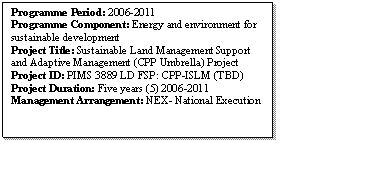 | |||
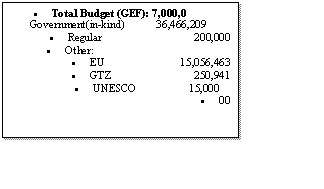 | |||
|
On Behalf of |
Signature |
Date |
Name/Title |
|
Government of Namibia National Planning Commission Secretariat (NPCS) (Government Coordinating Agency) : |
Mocks Shivute, Permanent Secretary | ||
|
Overall Implementing Partner (Government Cooperating Agency) Ministry of Environment and Tourism (MET): |
Malan Lindeque, Permanent Secretary | ||
|
Implementing partner Ministry of Agriculture, Water and Forestry (MAWF): |
Kahijoro Kahuure, Permanent Secretary | ||
|
Implementing partner Ministry of Lands and Resettlement (MLR): |
Frans Tsheehama, Permanent Secretary | ||
|
Implementing partner Ministry of Regional, Local Government, Housing and Rural Development (MRLGHRD): |
Erastus Negonga, Permanent Secretary | ||
|
Implementing partner Ministry of Mines and Energy (MME): |
Joseph Iita Permanent Secretary | ||
|
Implementing partner organisation Namibia Nature Foundation (NNF): |
Chris Brown, Executive Director | ||
|
Agreed by United Nations Development Programme (UNDP): |
Simon R Nhongo, Resident Representative |
[1] Examples of essential ecosystem water use are the Kuiseb River and the Cuvelai Wetland system; the latter requires water to sustain fish, for recharge, to feed Etosha Pan and to provide soil moisture and humidity for crop production. Water flow and recharge in the Kuiseb catchment are threatened by a myriad of small upstream farm dams. A combination of water abstraction and upstream dam construction caused the water table at the mouth of the Kuiseb River to drop from one to eight metres below the surface between 1974 and 1988, a process which threatened biota and people relying on the ephemeral river aquifer.
[2] GEF funding for phase 2 would be dependent upon the successful attainment of agreed outcomes in phase 1, which will be subject to independent validation, as well as the commitment of significant co-financing (the ratio of GEF investment to total financing is expected to decrease). Phase 1 interventions are designed to ensure that accruing global environmental benefits will be sustained irrespective of the availability of further GEF investment.
[3] BIOTA Southern Africa is a biodiversity research project aimed at understanding the bio-physical and socio-economic drivers affecting biodiversity. The initiative is currently focused on a 2000 km transect from the Cape in South Africa to the tropical semi arid savanna biome in Namibia.
[4] Environmental Long-Term Observatories Network of Southern Africa ) is a regional LTER network of country Environmental Observatories Networks (EON) encompassing the natural environments and their socioeconomic context. EON involves the documentation, analysis and dissemination of environmental information.
[5] Different methodologies to track trends will be employed, which will be based on experiences drawn from the Event Book System, which is currently used to monitor wildlife in the conservancies, and LLM applied through FIRMs, which uses photo images to rank the condition of rangeland, vegetation and livestock.
[6] NAPCOD is the officially recognized National Action Programme (NAP) for Namibia.
[7] Information on the conformity of the CPP to national priorities is given in Paras 142-147 and 153-157 of the CPP Framework.
[8] The total annual expenditure of the participating Government Ministries is US$ 300 million per annum.
[9] The expected benefits of the CPP will accrue not just to Namibia but also beyond its borders. Many countries in the Southern Africa sub continent and elsewhere in Africa face similar land degradation constraints and root causes to those evident in Namibia, particularly in the poorer communal areas. Lessons may also be mined for the development of other CPPs.
[10] The Government Cooperating Agency (MET) will play the similar role to the Responsible Ministry as defined in Vision 2030 implementation framework.
[11] This will be subject to the Harmonized Approach Cash Transfer to be adopted by the UN in Namibia.
[12] Representatives of other GEF Implementing Agencies (WB, UNEP) may participate in meetings from time-to time, as and when the need arises.
[13] These neutral premises will be provided by Government as part of its co-financing contributions MET will drive the process to secure the premises on behalf of the other line ministries.
[14] This suggestion was brought forward by the PSs of the CPP Partner Ministries themselves during the PS Breakfast Meeting on June 7th, 2006
[15] In addition to the national development plans, the UN in Namibia have reconfirmed their commitment to assist the Government of Namibia to address gender concerns and HIV/AIDS pandemic.
[16] USD 500,000 from CPP SLM SAM budget will be provided to the IWRM sub-component to implement activities identified in the proposal.
[17] Every River has Its People Project
[18] The TPR will be conducted as part of the joint UN annual review process in line with common and harmonized approaches for UNDAF Countries.
[20] These include but are not limited to Dewdney/NAPCOD, Jones, GTZ-EU evaluation of economic and financial impacts of Land Uses, WB report for PESILUP, PTT, Biodiversity Report (Jacquie Tarr), NCSA, Amendment of New Water Management Act
[21] Based on recommendations, one of these priority issues will be womens' land rights
[22] These will include strengthening existing, and creating new, opportunities for continuous learning (e.g. long distance learning), especially in the regions
[23] The following table of activities applies to each of the pilot sites in the various Intervention Areas
[24] Representatives of other GEF Implementing Agencies may participate in meetings from time-to time